

Sericulture's Ancient Beginnings
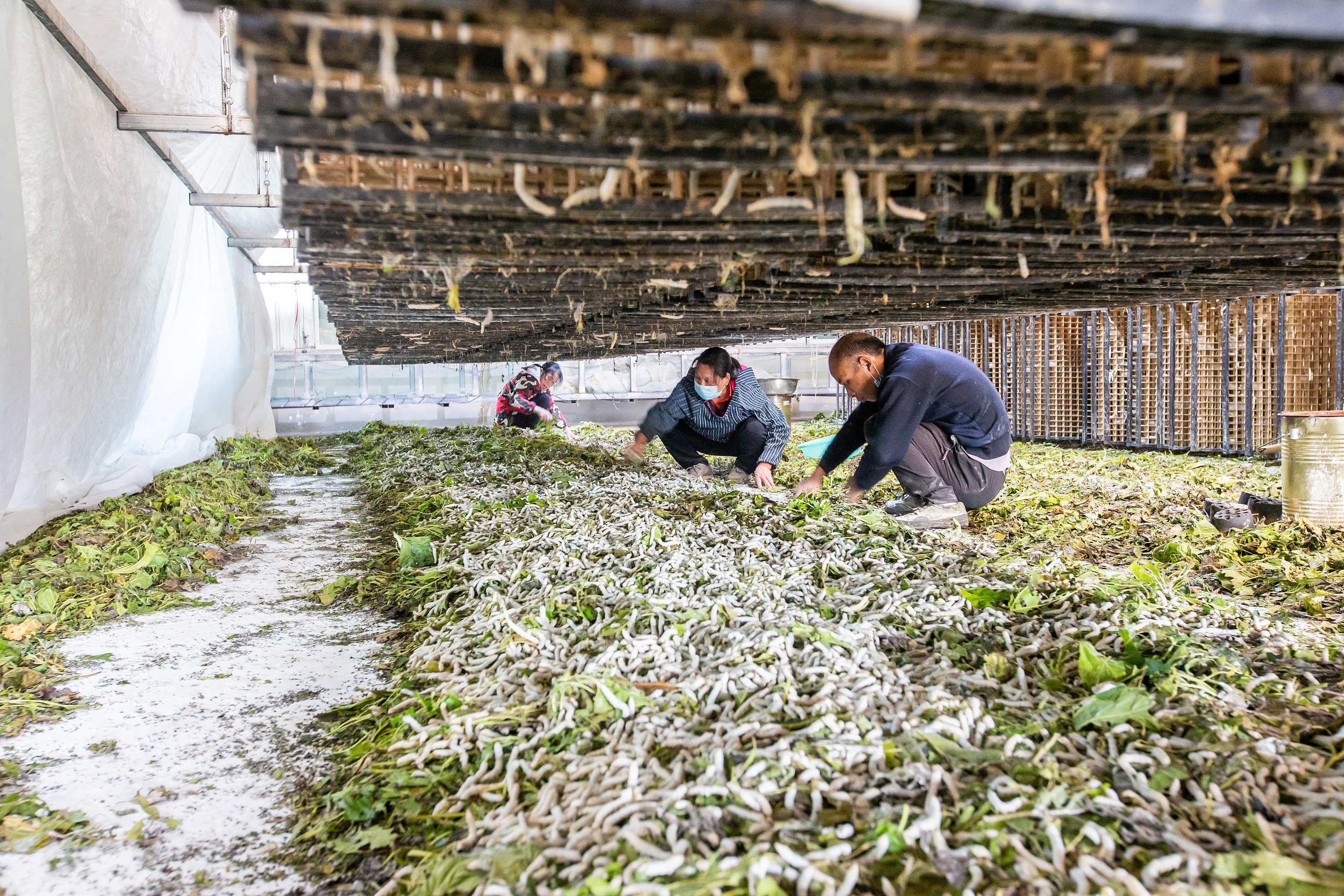
A feeder camps cocoons with square clusters in a large silkworm farming base in Xinwei Town, Meng Shan County, Guangxi Province, Dec. 24, 2022. (PHOTO:VCG)
By BI Weizi
China is the first country in the world to raise silkworms and make silks. Before cotton was introduced to the Yangtze and Yellow River basins, silk was one of the main raw materials for clothing and quilts in ancient China, and silk weaving was an important material for economic exchanges in agricultural and pastoral areas.
The Chinese legend says that the technology of raising silkworms was invented and introduced by Leizu, the wife of Yellow Emperor, in the 27th century BC, which indicates the long history of Chinese sericulture. In recent years, archaeologists have discovered uncarbonized, yellowish-brown silk pieces and carbonized silk ribbons and threads that date back to about 4700 years ago, at the Qianshanyang site in Wuxing, Zhejiang province, along with silk fragments adhering to the bronze ware at the Yin tomb in Anyang, Henan province.
In addition, there are pictographs of mulberry, silkworm, and silk in the Yin dynasty, which demonstrates that China is the birthplace of the silk industry. The original silkworms and sericulture techniques then spread to many countries throughout the world from China.
Sericulture is one of the great inventions of the ancient Chinese. For the past thousands of years, Chinese sericulturists have selected and bred many excellent farming varieties of worms, worked out a set of feeding methods, and created a variety of sericulture tools, which have all had a positive influence on the world of sericulture and silk industry.