

U.S. Shipbuilding Decline its Own Undoing
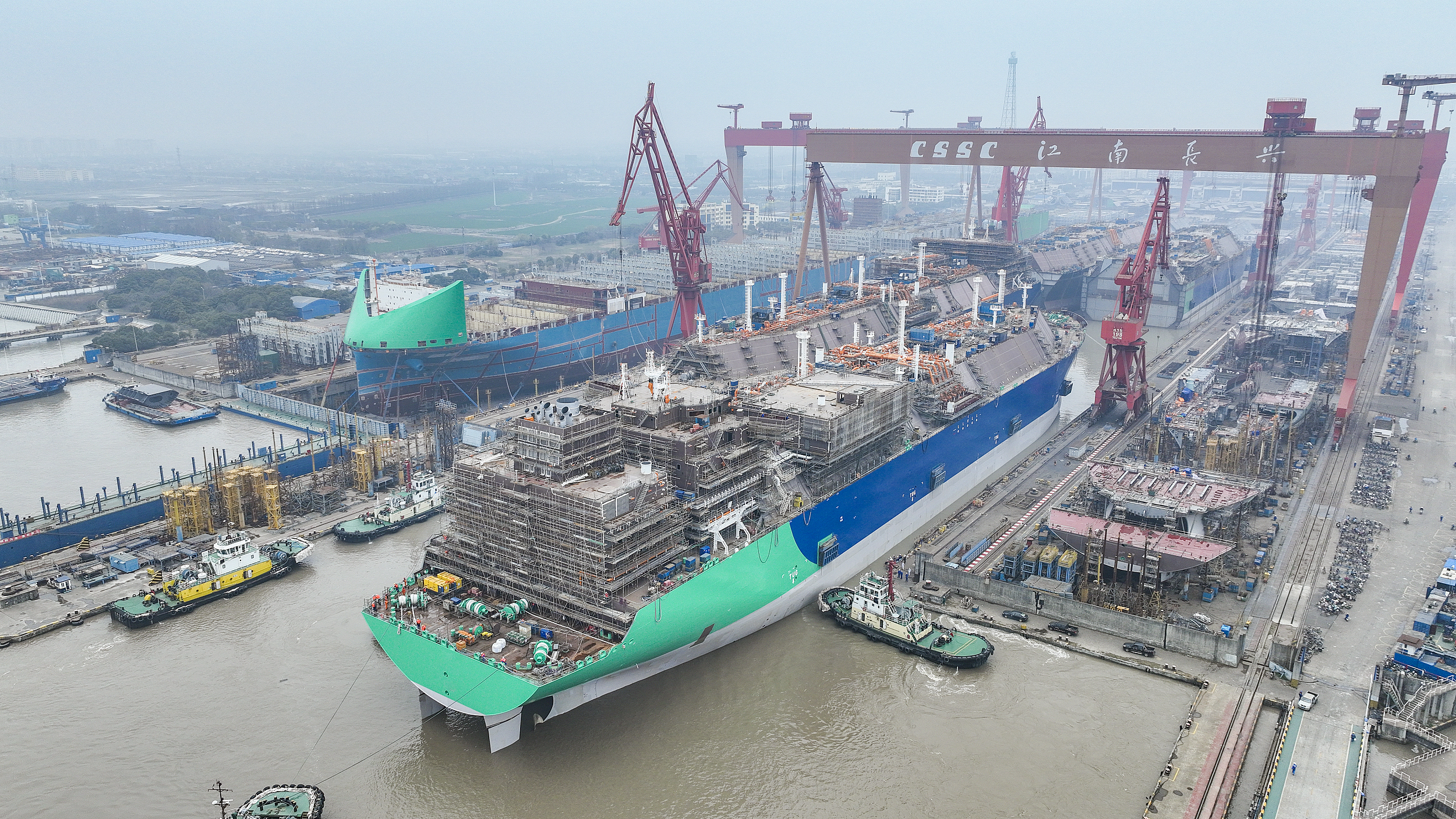
A shipbuilding base in Shanghai. (PHOTO: VCG)
By GONG Qian
A group of U.S. unions, led by the United Steelworkers Union (USW), filed a Section 301 petition in March, alleging acts of unfair trade practices by China’s shipbuilding industry, and requesting they be probed by the Biden administration.
USW International President David McCall said in the past decades the number of U.S. major shipyards has remarkably been reduced, from nearly 30 to a handful, which led to more than 70,000 job losses. Meanwhile, China has become a dominant player in the global shipping market. The USW also stressed potential national security implications of becoming too reliant on China for shipping.
Such a groundless allegation is not only strange but ridiculous. Multiple reports have pointed out that the decline of the U.S. shipbuilding industry is due mainly to overprotection while the development of the Chinese shipbuilding industry has benefited from increasing technological innovation and high-end, intelligent and green development, said He Yadong, spokesperson of the Chinese commerce ministry.
If USW cannot discover the root cause of its problem by introspection, reviewing some reports may be of help.
According to the Financial Times (FT), U.S. shipbuilding experts said the shrinkage in its shipbuilding industry is a result of several factors.
One is that starting in the 1980s, most government subsidies for shipbuilding were pulled. Second, much of the raw materials and components needed to produce new ships are no longer available in the U.S., thanks to the shrinking and outsourcing of the American manufacturing base. “That’s a problem common in many industries, not just shipbuilding,” said the FT.
Moreover, there was a disincentive for U.S. contractors to have excess capacity that could be used if the supply chain were interrupted, natural disasters or security crises occurred.
This has led to lowered investment in things like technology, factory equipment and training for U.S. workers.
Meanwhile, Bloomberg said without the infrastructure and enough workers, the U.S. is unlikely to expand its shipping industry and is not going to catch up with China in the next few decades.
Bloomberg also cited data to explain why China has an edge over its competitors. Since 2015, the world’s maritime production has decreased by 18 percent. China’s output increased by just two percent during that period, while that of its competitors, South Korea and Japan, fell by 32 percent and 26 percent, respectively. China maintained some of its shipyards thriving, while others went out of business.
For the U.S., it’s been out of the game for decades. According to data from the American Department of Transport, Bloomberg reported the U.S. commercial shipbuilding industry peaked in the 1970s and fell to eighth place by 2001.
In other words, China’s rise in shipbuilding has nothing to do with the U.S. Colin Grabow, a research fellow from U.S. think tank CATO Institute, further confirmed this. In his analysis articles, Grabow said the USW’s complaint of China is “hypocritical, ahistorical, and—most of all—misplaced.”
The industry’s inability to compete internationally is long-standing. For example, back in 1867, Canada-built ships were estimated to be less than half the price of those constructed in the U.S., said Grabow. Even before the subsidies were removed in the 1980s, the U.S. shipbuilding record was thoroughly mediocre, Grabow added. From 1951 to 1981, U.S. shipyards’ share of global ship deliveries only exceeded five percent twice (1953, 1954) and most years did not exceed three percent.
Obviously, China is not the scapegoat for this U.S. failure. It is its extreme levels of protectionism that have smothered US shipbuilders’ competitiveness. Like Grabow concluded, “Instead of casting subsidy stones, U.S. policymakers should first inspect their own glass house.”