

Tech Innovation Ensures China's Edge in Global EV Market
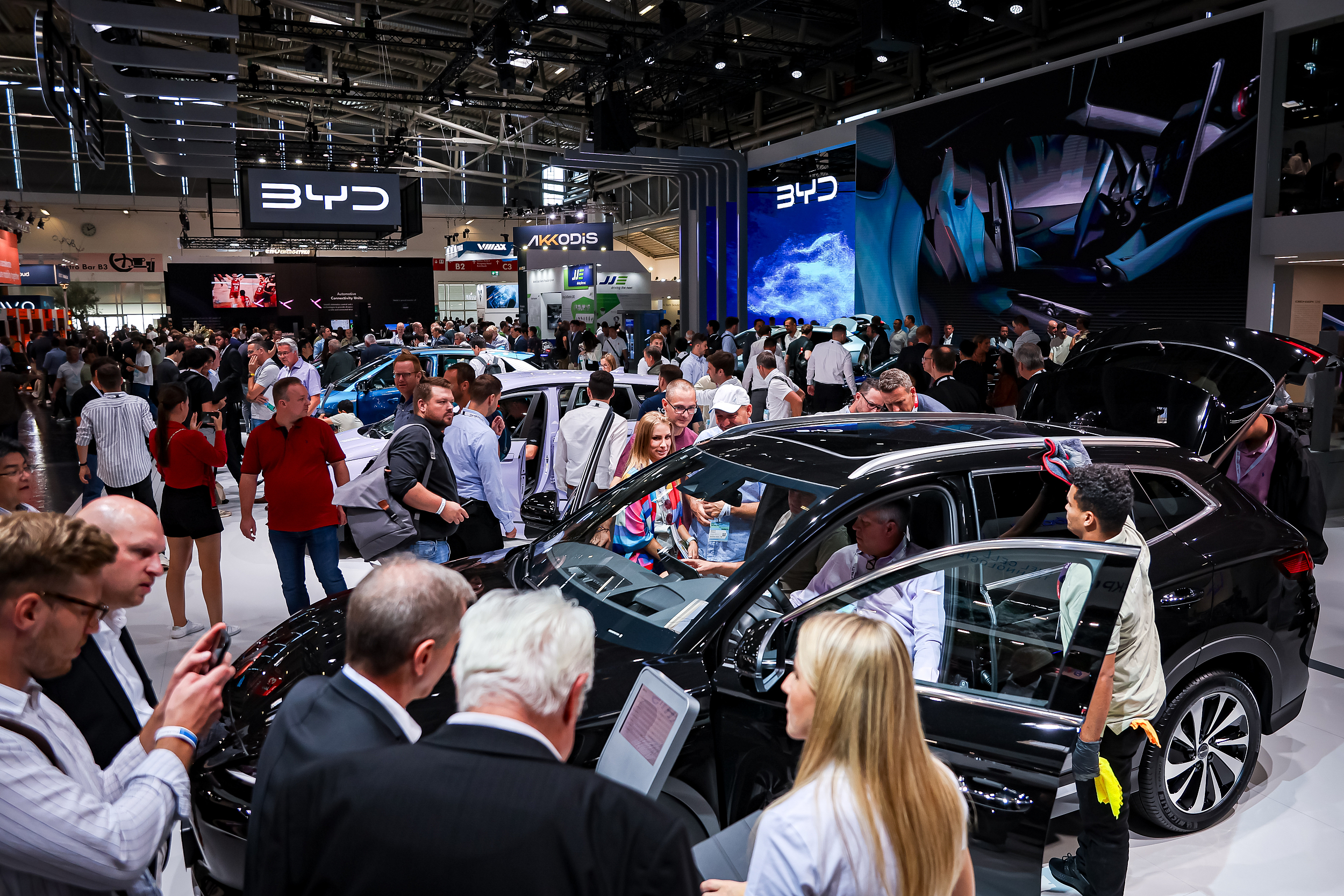
Visitors look at electric cars of Chinese car brand BYD at the IAA Mobility 2023 international motor show in Munich, Germany. (PHOTO: VCG)
By GONG Qian
Chinese electric vehicle (EV) automakers have recently faced mounting pressure when expanding their overseas markets. Currently, the UK and the U.S. are poised to launch an anti-subsidy probe into Chinese EVs, along with an investigation into the national security risks they pose. The coalition alleges that China has gained a competitive edge from so-called unfair subsidies, making the introduction of tariffs a distinct possibility.
However, the global popularity and competitive edge of Chinese EVs is based on technological innovation and superb quality, rather than government subsidies.
According to Mokter Hossain, an assistant professor at the College of Business and Economics, Qatar University, the competitive edge of Chinese EV companies is the result of a multifaceted strategy that combines governmental support, market scale, rapid innovation, and strategic global positioning.
In Hossain's article published in California Management Review, he summarizes several technological factors that explain why China holds an advantage. One is rapid innovation and product development. They've been quick to adopt new technologies, such as advanced battery technologies, autonomous driving features, and connected car services, which often bring new models and features to market faster than their international competitors.
Among those, advanced battery technology, regarded as the "heart" of EVs, cements China as the auto industry leader. China is dominant in the production of budget-friendly cobalt-free battery solutions. Lithium iron phosphate (LFP), for example, is currently a proven low-cost chemistry that adheres to many automotive like-to-haves such as low cost, high life cycle capability and good safety, and is primarily produced in China, Oliver Petschenyk, a powertrain expert analyst at GlobalData, told Just Auto, an automotive industry news site and part of leading information service company GlobalData.
The focus on advancing battery technology has led to improvements in energy density, charging speed, and battery life, enhancing the performance and appeal of Chinese-made EVs, said Hossain.
More importantly, many Chinese companies have been focused from the beginning on EVs, unlike traditional automakers who are switching from internal combustion engines. This allows them to design and optimize their vehicles specifically for electric propulsion without being constrained by legacy systems.
On this point, Western car manufacturers are suffering from self-inflicted pain as they delayed the all-but-inevitable switch to EVs, having betted on massive gas-guzzlers for too long, according to an opinion article in Project Syndicate coauthored by Gernot Wagner, a climate economist, and Shang-Jin Wei, a professor at Columbia Business School.
What the Western countries should worry about is not China's threat to their domestic market but how to solve their internal problems. Take the EU as an example. It has been trapped by the "shackles" of higher buying prices due to the higher cost of battery manufacturing, rising cost of energy, unimproved charging infrastructure and insufficient expertise.
The fundamental solution to jump out of the trap and improve its global competitiveness is to enhance technology innovation rather than imposing tariffs. Tariffs, aimed at Chinese EVs or other products such as solar panels, which are crucial for the global green transition, are not justifiable, said Wagner and Wei.
The electric vehicle is a globalized industry. Only division of labor and cooperation can bring mutual benefits, and only fair competition can bring technological progress, said Lin Jian, spokesperson of the Foreign Ministry.