

BRI Powers Connectivity Between China, Central Asia
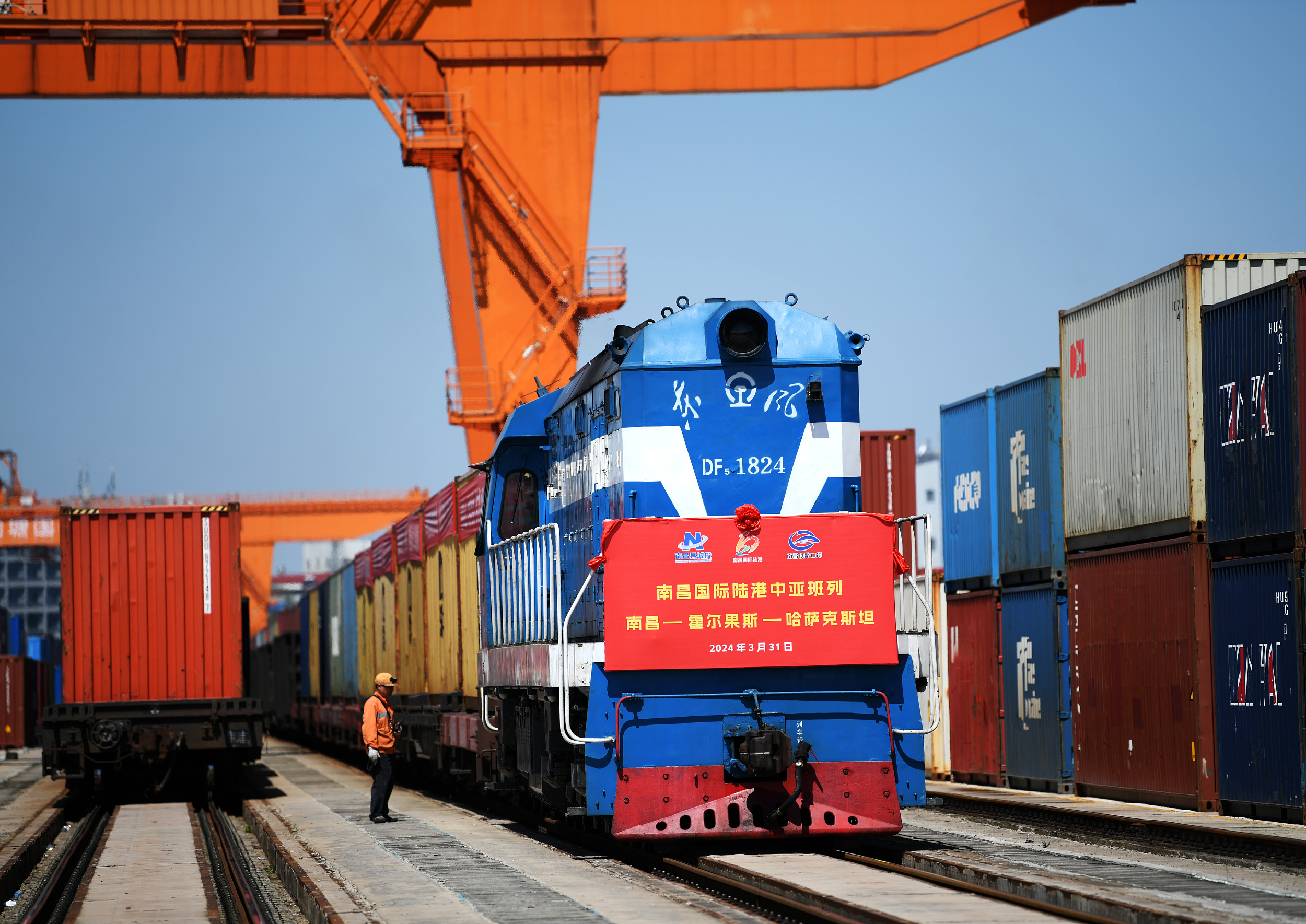
A freight train loaded with goods departs from east China's Nanchang and heads for Kazakhstan and other Central Asian countries. (PHOTO: VCG)
By TANG Zhexiao
China, Kyrgyzstan and Uzbekistan have signed an intergovernmental agreement recently on building a new 523km railway connecting the three countries, as part of the Belt and Road Initiative (BRI).
The railway begins in Kashgar, northwest China's Xinjiang Uygur autonomous region, and enters the territory of Uzbekistan through Kyrgyzstan. The line could eventually extend to West Asia and South Asia.
Kyrgyz President Sadyr Japarov said in May that Kyrgyzstan is a dead-end state in terms of logistics, according to the magazine The Diplomat, "When the [China-Kyrgyzstan-Uzbekistan] railway is built, we will be able to go out into the world," he said.
From interconnection to capacity cooperation, and clean energy to infrastructure construction, China and Central Asian countries are promoting high-quality joint construction of the BRI.
A decade on, China and Kazakhstan have been engaged in production capacity and investment cooperation, forming 52 projects with a total value of more than 21.2 billion USD. This cooperative spirit continues expanding to green, digital, scientific and technological fields.
In Kyrgyzstan, the third phase of a new Chinese-built highway is under construction. After the completion, the highway will become the main transport artery connecting the north and the south of Kyrgyzstan.
Meanwhile, the first phase of a 400MV Chinese-financed solar power plant in the country's northern Issyk-Kul region has been completed with full operation expected by the end of 2025.
In addition, the Syr Darya 1500MW gas turbine plant in Uzbekistan is an example of China's green infrastructure experience "going global." Using a gas turbine with the highest combustion temperature, the largest single source of power and the highest efficiency in the world, together with a zero wastewater discharge design scheme, the plant promotes Uzbekistan's green development.
Sheradil Baktygulov, director of the Institute for World Politics Study, noted that Central Asian countries and China are carrying out diverse beneficial cooperation under the framework of the BRI. It has further improved the sustainable development of Central Asian countries and effectively uplifted the well-being of local people's livelihoods, he added.
Relying on China-Europe freight trains, whose total trips has surpassed 90,000 on May 25, China and Central Asian countries have boosted closer cooperation.
Earlier this year, the joint-constructed freight terminal China-Kazakhstan (Xi'an) Trade Logistics was launched to further facilitate goods transportation between China and Kazakhstan, Central Asia and Europe. According to the railway company Kazakhstan Temir Zholy, the clearance process can be reduced to less than 15 minutes.
Running on the Eurasian continent, the China-Europe freight trains are improving the trade and transportation network between Central Asia and China, creating more favorable conditions to jointly build the BRI, according to Dildora Karimova, director at the Institute for Macroeconomic and Regional Studies.