

2025: A Bumper Year for Sci-tech Innovation
In 2025, China once again enjoyed a bumper year of scientific and technological innovation, with major sci-tech achievements emerging one after another. China has become one of the economies with the fastest-growing innovation capacity in the world.
Collaborative breakthroughs
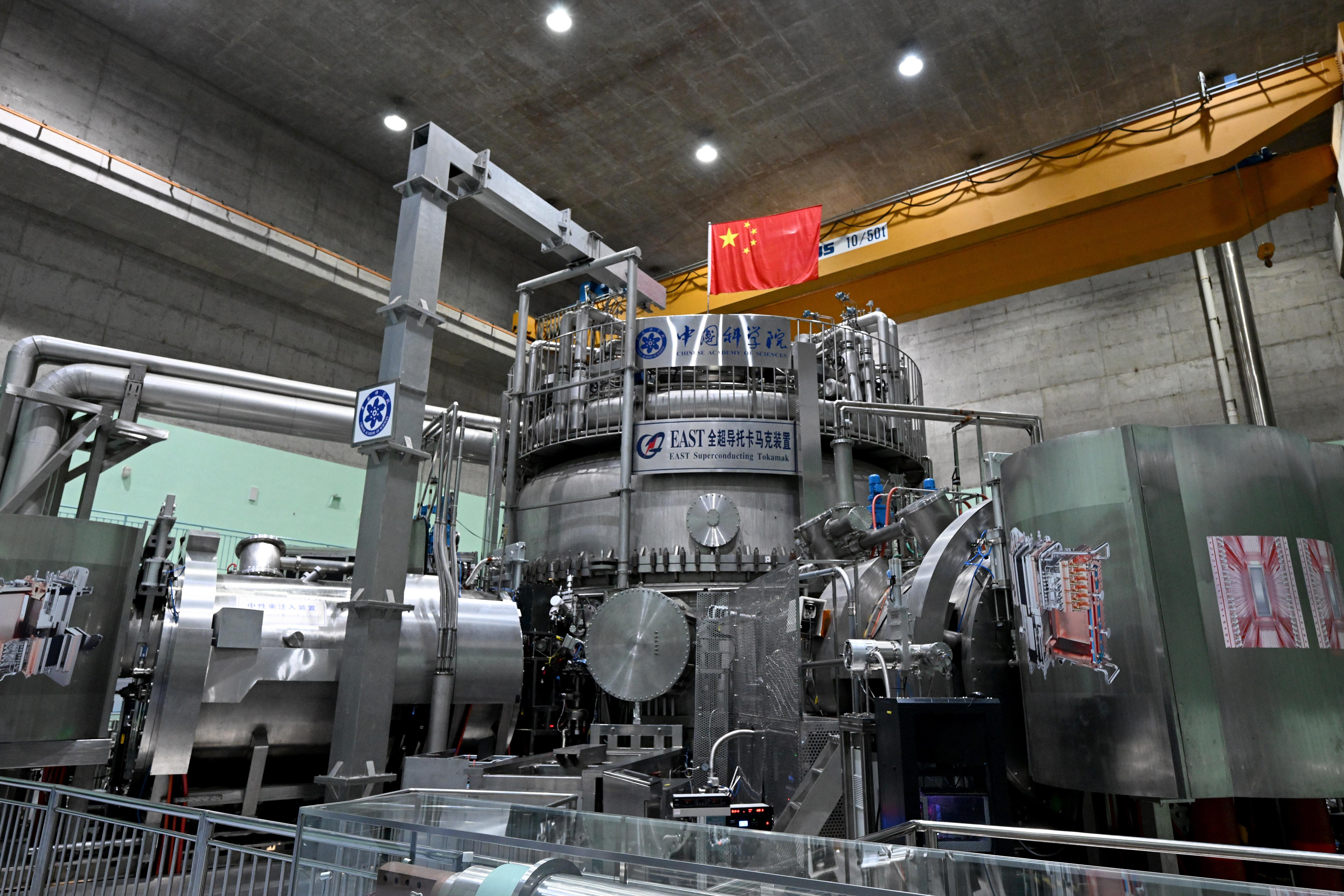
On January 20, 2025, the Experimental Advanced Superconducting Tokamak, known as China's "artificial sun," maintained a steady-state high-confinement plasma operation for a remarkable 1,066 seconds, setting a new world record.
This marks a major leap forward in China's fusion power research from basic science to engineering practice, Wang Teng, an associate researcher at the Institute of Plasma Physics, Chinese Academy of Sciences, told Science and Technology Daily.
On October 15, 2025, the Chuanke 1 well of China National Petroleum Corporation was drilled to a depth of over 10,000 meters. This breakthrough was due to the joint effort of enterprises, universities and research institutions.
Collaborative R&D has improved the innovation mechanisms nationwide. Major national sci-tech programs, including the BeiDou Navigation Satellite System, China's lunar exploration program and the CR450 EMU, next-generation, world-record-setting high-speed train, have all benefited from collaborative innovation.
The Recommendations of the Central Committee of the Communist Party of China for Formulating the 15th Five-Year Plan for National Economic and Social Development also stress improving the new system for mobilizing resources nationwide and adopting unconventional measures to drive decisive breakthroughs in core technologies across entire chains in key fields such as integrated circuits, industrial machine tools, high-end equipment, basic software, advanced materials and biomanufacturing.
Innovation-driven economy
In terms of emerging and future industries such as AI, industrial robots, quantum computing, clean energy and low-altitude economy, China has maintained a rapid and stable development momentum in recent years.
In 2025, the 5G-A network, faster than 5G, was rapidly expanded to over 300 cities across the country, and applied in multiple scenarios such as intelligent manufacturing and major events.
The innovation drivers have not only improved industrial competitiveness, but also accelerated economic transformation and upgrade.
In 2025, China's production and sales of new energy vehicles exceeded 16 million units, topping in the world for 11 consecutive years. China also built the world's largest clean power generation system and the largest power infrastructure system, facilitating its energy transformation.
Its low-altitude economy is expected to exceed 1.5 trillion RMB, and a strategic emerging industry cluster is rising.
Benefiting the people
In 2025, an increasing number of sci-tech achievements moved from laboratories to production lines, integrating into people's daily lives and bringing about tangible changes.
A Chinese-led team reported a breakthrough in brain-computer interface technology after completing the first-ever clinical trial to precisely locate deep-seated brain tumors using implanted microelectrode arrays. The technology could advance treatment of gliomas and brain metastases, which are difficult to remove because of their sensitivity locations.
Domestic high-end medical devices and innovative drugs are constantly being updated. Zhou Le, deputy director of the department of drug regulation of the National Medical Products Administration, said 76 innovative drugs were approved in 2025, ranking first in the world in terms of quantity.
Technologies such as intelligent driving are facilitating people's lives, while smart agriculture is harnessing meteorological big data to predict pests and crop diseases so that early warnings can be issued.
In museums such as the Palace Museum in Beijing and the Dunhuang Museum in Gansu province in northwest China, visitors can enjoy cultural relics in detail thanks to digital panoramic platforms and 3D modeling technology.
At the beginning of the 15th Five-Year Plan period (2026-2030), in the face of the complex global technological competition, China is steadily advancing high-quality development with independent innovation, so that innovation achievements reach every corner of life.