

AI Facilitates Industrial Transformation
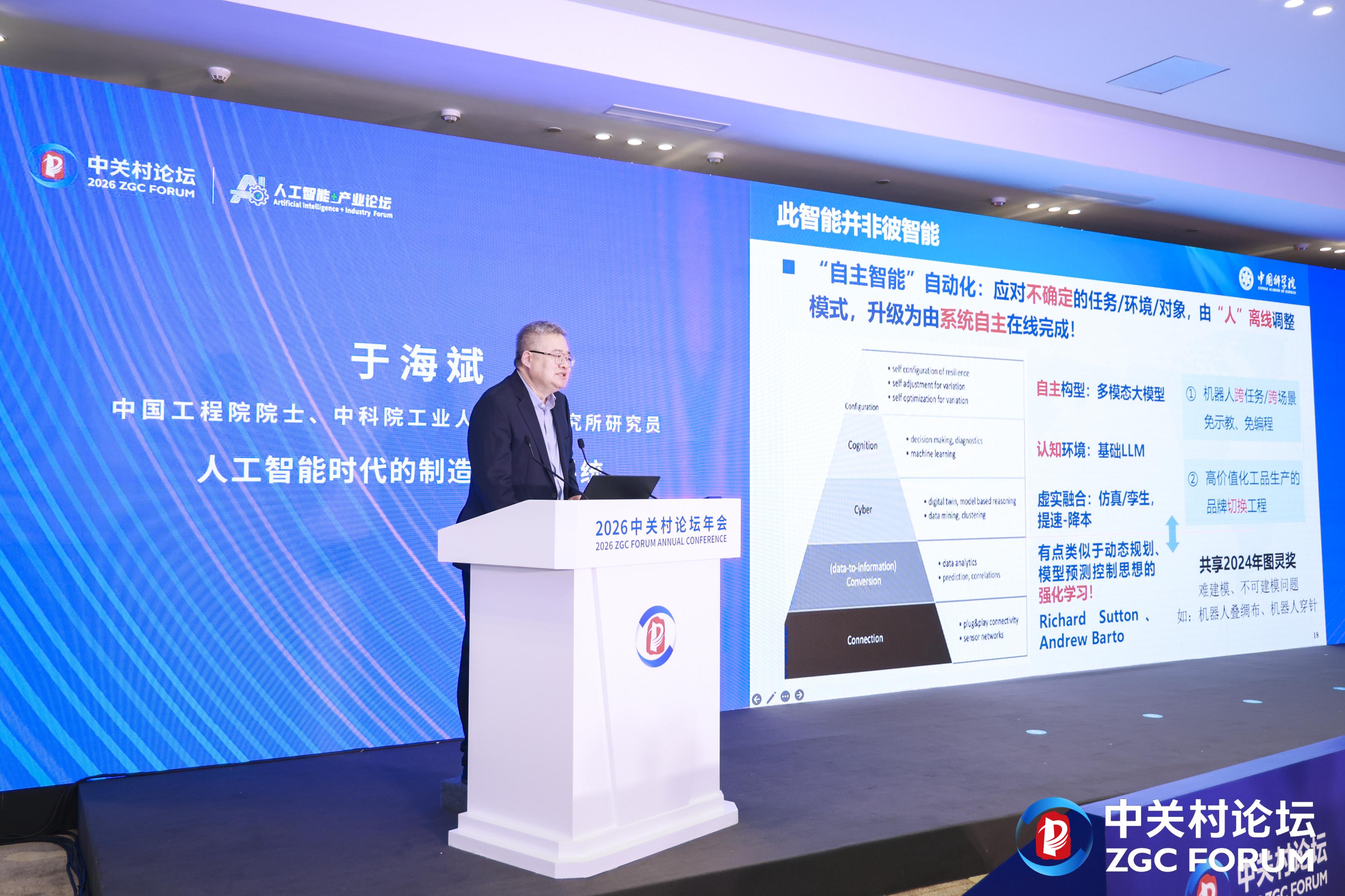
The "Artificial Intelligence + Industry" Forum, a parallel session of the 2026 Zhongguancun Forum Annual Conference, was held in Beijing on March 27, focusing on large-scale commercial application of AI, fostering new business models and formats native to AI, deepening the development and utilization of data resources, and improving AI governance.
The forum was hosted by the Ministry of Science and Technology, and organized by Science and Technology Daily (S&T Daily) and the Institute of Scientific and Technical Information of China.
Wu Jing, president of S&T Daily, said the forum was a concrete measure to carry out the national strategic deployment to accelerate the development of next-generation AI.
Experts and entrepreneurs shared their thoughts on how AI is shaping the industrial development.
It is widely acknowledged in the sector that AI will empower the automated system of manufacturing in an all-round way, said Yu Haibin, an academician of the Chinese Academy of Engineering and a researcher at the Institute of AI for Industries, Chinese Academy of Sciences, in his keynote speech.
Yu said in complex, uncertain and dynamically changing environments, the new generation systems can autonomously perceive, make decisions and execute without human intervention. With the integration of large models and embodied AI, cyber-physical systems will possess an exceptional ability to adapt to specific objectives, heralding the advent of "super-automated factories."
Such reshaping of productive forces is not only demonstrated in the underlying logic of technologies, but also in the upgrade of industrial application paradigms.
Yin Dawei, vice president of Baidu AI Cloud, said, China's AI industry is entering a new stage of large-scale development, with the shift from large models to intelligent agents emerging as the most prominent technological trend.
Baidu AI Cloud leverages its full-stack capabilities—spanning chips, cloud, models and agents—to support the evolution of intelligent agents from conversational bots to professional assistants with complex reasoning capabilities.
Yin said the maturation of this "intelligent agent infrastructure" will enable developers to rapidly build multimodal applications in scenarios such as transportation and industry, closing the loop from model services to enterprise-level services.
Liu Xin, director of Transport Planning and Research Institute, Ministry of Transport, said embodied AI is driving the evolution of transportation vehicles into autonomous agents. In the construction of smart roads and waterways, it is transforming systems from passive response into active prevention.
A platform for matching application scenarios and technology supply nationwide developed by S&T Daily was launched at the forum. It will serve as a bridge connecting scenario providers—such as governments, enterprises and industrial parks—with technology suppliers, including tech companies and research institutions.
It will reduce the costs associated with matching scenario demand and supply, enhance the efficiency of scenario development, and accelerate the practical application of technological achievements.
The platform will also provide specialized services for matching application scenarios in the "AI+Industry" sector.