

Collagen and Leather: Bridging Traditional Industries, Emerging Sectors
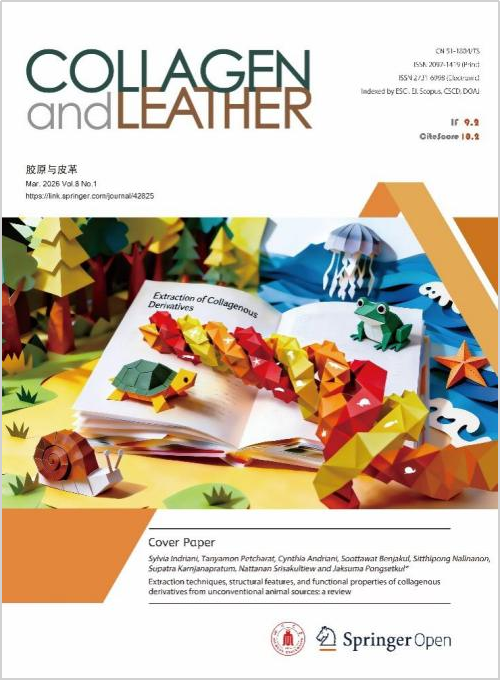
Collagen and Leather (CL), sponsored by Sichuan University in southeast China, centers its academic scope on collagen science. It is committed to advancing the green, high-end and intelligent transformation of the conventional leather industry, while exploring cutting-edge applications of collagen across various emerging sectors, including biomedicine, functional health food, daily fine chemicals and high-performance composite materials. CL has evolved into an academic hub bridging traditional industries and frontier technologies.

From a Chinese to a global journal
CL traces its origin back to 1988, a period marked by booming growth across China's leather sector. To foster indigenous innovation in leather manufacture technologies and build a dedicated platform for exchanging advanced theories and industrial practices, Professor He Xianqi of Sichuan University, founded the Chinese-language journal Leather Science and Engineering. For decades, the journal steered academic progress in China's leather research and supported the sector's sustained development.
By 2019, China had a leading global position in leather production, international trade, scientific research and higher education. However, the global leather research landscape was long dominated by two century-old overseas journals: the Journal of the American Leather Chemists Association (est.1906) and the British Journal of the Society of Leather Technologists and Chemists (est.1916).
Chinese academics lacked a prestigious in-house English journal to amplify their research on the global stage. To fill this critical gap, Journal of Leather Science and Engineering was launched.
Collagen is the fundamental raw material for leather fabrication. Driven by rapid technological advances, it has gained widespread adoption in biomedicine, daily chemicals, functional food and advanced composites, giving rise to fast-growing emerging industries.
Aligning with such disciplinary advances and industrial evolution, the journal rebranded to its current title Collagen and Leather in 2023, completing a strategic upgrade from leather-only coverage to full-spectrum research spanning the entire collagen industrial chain.
The rebranding kicked off a phase of accelerated growth and surging global visibility. In 2024, CL was indexed by the EI and ESCI databases and earned its inaugural impact factor of 9.2. Submissions arrive from more than 30 nations, including the U.S., Canada, Russia, Germany and India.
Catering to practical industrial needs
CL adheres to an editorial philosophy of "pursuing top-tier frontier research while committing to grounded industrial demands." The "top-tier pursuit" refers to spearheading pioneering theoretical exploration and core technological innovation across collagen and leather disciplines; the "grounded commitment" targets industrial bottlenecks, translating lab discoveries into deployable solutions to facilitate smart upgrading of conventional leather production.
For instance, CL published groundbreaking research on a tanning agent-free leather-making approach using self-driven oriented composite dehydration media, upending the century-old industry consensus mandating tanning agents in leather production. This drastically cut emissions of metallic and organic pollutants and pioneered an eco-friendly development pathway for low-carbon leather manufacturing, sparking follow-up investigations by research teams globally.
An open platform for cross-disciplinary integration
The editorial team views the journal as more than a publication platform — it serves as a bridge connecting scholars and industry leaders to identify emerging research directions and market demands, thereby linking academic innovation with industrial transformation.
Centered on in-depth industry-university-research collaboration, CL regularly hosts high-profile academic conferences to forge seamless links between lab innovations and commercial demands. It also delivers end-to-end support for enterprises, ranging from research results systematization to academic promotion, helping China's indigenous industrial innovations gain global traction.
As an international, application-focused journal, CL showcases China's innovative prowess in collagen and leather research in the global arena, composing a new success story of the traditional leather industry's transformative shift toward diversified collagen-based emerging businesses.
The author is Shi Bi. He is the editor-in-chief of Collagen and Leather, and a member of the Chinese Academy of Engineering.
●Journal Review
CL makes a valuable contribution to the advancement of tanning science and the valorization of collagen-based resources. Its growing international recognition reflects a strong commitment to scientific excellence, academic rigor and practical relevance.
A distinctive strength of the CL is its broad interdisciplinary scope, which encompasses fundamental and applied research across the leather, biomaterials, biotechnology and sustainability sectors. This comprehensive approach highlights the increasing importance of collagen as a versatile biological resource with applications spanning multiple scientific disciplines and industrial domains.
Looking ahead, CL is well positioned to play an increasingly influential role in advancing both the leather industry and emerging collagen-based technologies. By promoting innovative, high-value applications of collagen, supporting industrial diversification, and fostering interdisciplinary collaboration, it is expected to remain an essential platform for scientific exchange and technological progress.
—— Joan Carles Castell, former president of the International Union of Leather Technologists and Chemists Societies