

China Shock 2.0? Real Challenge Lies Elsewhere
Recently, some Western media outlets and commentators have once again revived the so-called "China Shock 2.0" narrative.
This is not the first time such an argument has surfaced. Following China's accession to the World Trade Organization in the early 2000s, critics popularized the original "China Shock" thesis, claiming that Chinese imports had devastated traditional manufacturing industries in advanced economies.
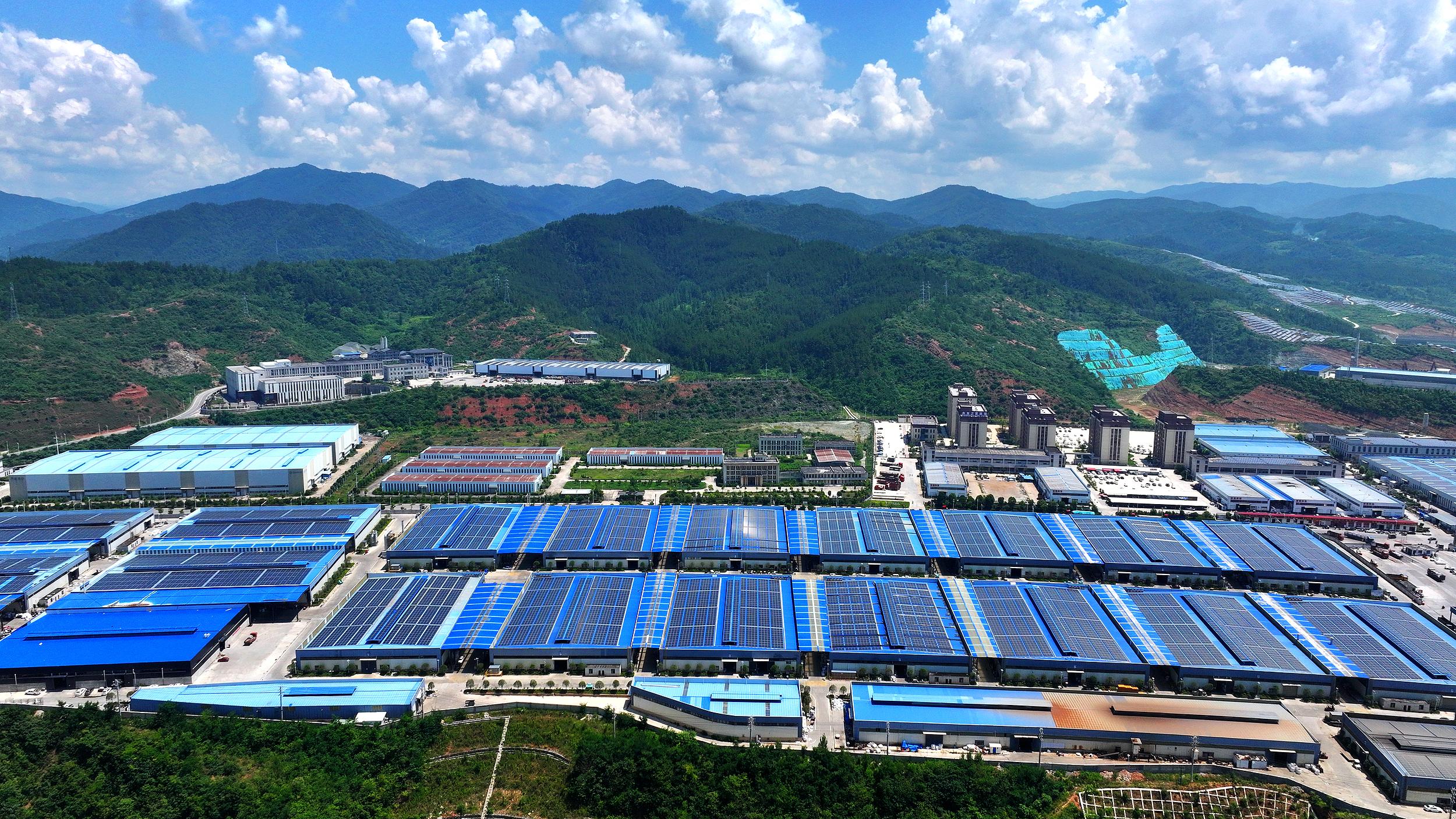
Today, the narrative has been repackaged as "China Shock 2.0," with the focus shifting to China's "new trio" industries — electric vehicles (EVs), lithium-ion batteries, and solar photovoltaics. Rather than acknowledging China's growing technological capabilities and manufacturing competitiveness, some critics portray these sectors as a new threat to global markets.
Britain's The Telegraph warned that "China Shock 2.0" could "destroy Europe as we know it," while French President Emmanuel Macron argued that Chinese exports are "literally killing a large part of the European industry."
Although framed as concerns over trade and industrial competition, such claims often expose domestic structural challenges — including sluggish industrial adjustment and weakening innovation capacity. More fundamentally, they reflect growing anxiety in parts of the West over China's rapid technological progress and industrial upgrading, while seeking to provide fresh justification for their protectionist policies.
According to The New York Times, David Autor, the MIT economist whose research gave rise to the term "China Shock," has pointed out that "China Shock" research really shows that it is not trade that is to blame, but that the U.S. failed to help workers and local economies adjust to industrial change. Autor has also acknowledged that China imports accounted for only part of U.S. manufacturing job losses; automation and technological change also played a major role.
Kristalina Georgieva, IMF managing director, recently said Europe's innovation ecosystem faces serious internal challenges. Innovative companies often relocate abroad; the region lacks enough globally competitive technology giants to achieve scale in frontier sectors such as AI; and fragmented, increasingly complex regulations have narrowed businesses' room to innovate. Against this backdrop, blaming China's manufacturing success is far easier than confronting these structural weaknesses.
Some observers attribute China's industrial rise primarily to government subsidies. Yet the competitiveness of Chinese manufacturing cannot be explained by subsidies alone. The Cambridge Industrial Innovation Policy argues that beyond subsidies, a large engineering workforce and a comprehensive industrial system played an important role in China's ability to move up the ladder.
Official statistics show that between 2020 and 2022, China produced more than 5.2 million undergraduate graduates in science, technology, engineering, and mathematics. However, scale is not the only edge. China's edge also lies in the industrial system it has built over decades, from reliable shipping and cost controls to its tightly integrated supplier network.
From an objective perspective, the improvement in China's manufacturing capabilities has not caused any shock to the world economy; on the contrary, it has been a massive dividend for global technological progress and the green transition.
The American Enterprise Institute, citing recent research from the U.S. National Bureau of Economic Research, noted that although China's rapid growth has reduced the U.S. share of global GDP, it has simultaneously increased overall U.S. welfare by allowing consumers to purchase goods at lower prices and enabling companies to benefit from cheaper and more efficient production inputs. As a result, "America looked relatively smaller, economywise — but became absolutely richer."
A report by the UK-based energy think tank Ember found that China's investment in clean energy has been instrumental in driving down the global costs of wind power, solar energy, battery storage, and EVs. At the Hamburg Sustainability Conference, which concluded on June 30, Achim Steiner, chair of the conference and former administrator of the United Nations Development Programme, said China's expansion of clean energy and green industries has helped lower global renewable energy costs and accelerate energy transition. He added that China has "begun to develop the kinds of answers that much of the rest of the world today has also become a beneficiary to."
China's position in global value chains is evolving rapidly. It is no longer confined to the lower end of manufacturing but is increasingly moving toward the technological and industrial frontier across a wide range of sectors. This transformation is a natural consequence of the evolving international division of labor and is reshaping the nature of global competition.
Casting China as the culprit may be the most convenient way for some countries to deflect responsibility, but it does little to address the underlying causes of their own industrial challenges. Rather than amplifying the rhetoric of "China Shock 2.0," governments would be better served by embracing competition, investing in innovation, and strengthening their own economic fundamentals.
In the long run, the shared gains created by open competition are far more conducive to global prosperity than narratives that seek to manufacture confrontation.