

Data-driven Report on Global Polymer Innovation Trends
The Asia-Pacific region has taken the lead in polymer innovation, with China heading fundamental research output and patent development across strategic domains such as flexible electronics, energy storage and membrane technologies.
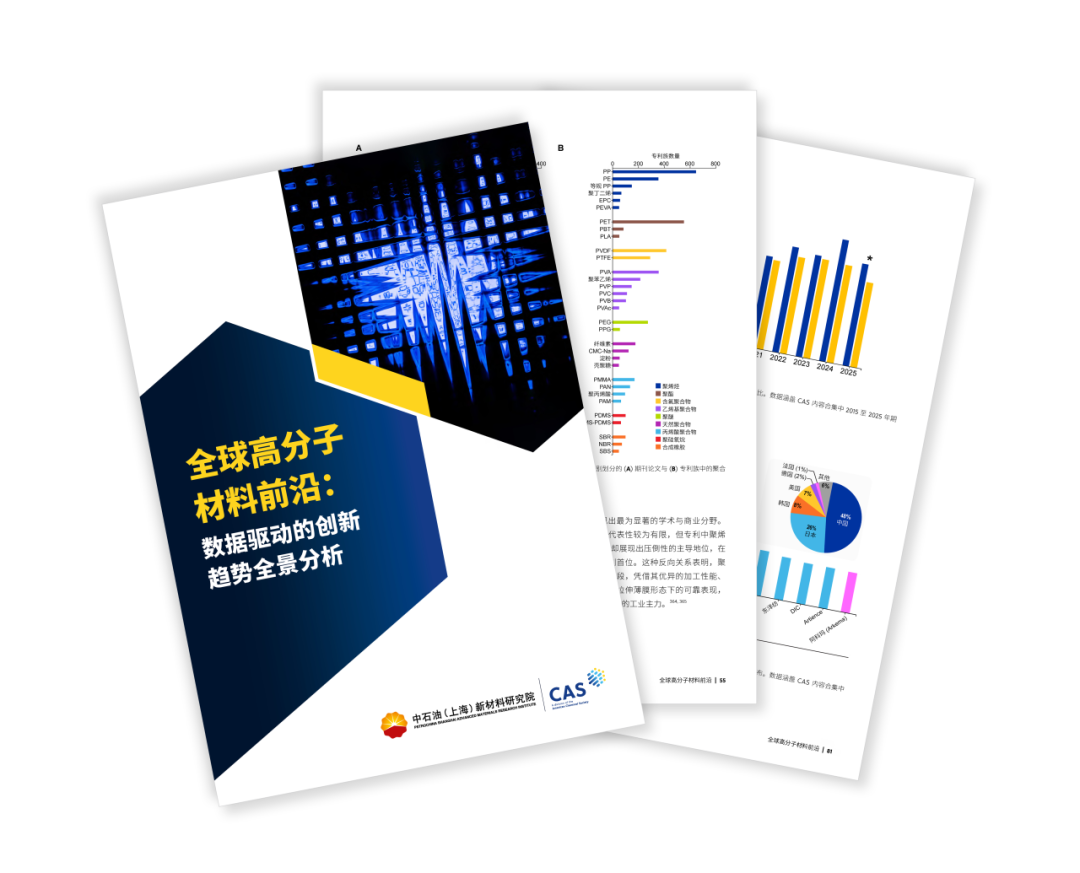
These findings are detailed in Polymer Frontiers: A Comprehensive Data-Driven Analysis of Emerging Trends, a report jointly released by PetroChina (Shanghai) Advanced Materials Research Institute Co., Ltd. (SAMRI) and Chemical Abstracts Service (CAS), a division of the American Chemical Society, that maps where global polymer innovation is headed.
The report draws on nearly one million polymer-related journal and patent records from 2015 to 2025 in the CAS Content Collection™, the world's largest curated scientific database. Using advanced bibliometric analysis and natural language processing, it identifies research hotspots, maps competitive positioning across geographies and institutions, and tracks emerging application domains.
"Polymer science is advancing on multiple fronts simultaneously. Stakeholders require data-backed insights rather than conventional experience to spot innovation hotspots. Our partnership combines CAS intelligence and SAMRI's industrial expertise to meet such demand," said Tim Wahlberg, interim president of CAS.
The report identifies four priority application areas: polymers in energy storage, sustainable polymers, flexible electronics and membrane technologies. It also examines eight emerging frontiers, ranging from next-generation polyesters and dynamic polymer networks to framework-polymer hybrids and conductive polymer systems.
In addition, the report documents substantial growth in sustainable polymer research, with bio-based materials now competing on performance metrics alongside, or even ahead of, environmental benefits.
According to the report, innovation in energy storage applications is heavily concentrated around battery technologies, which account for an overwhelming 75 percent of all polymer-related energy storage patents. Meanwhile, clean energy demands are driving rapid expansion in advanced membrane systems, particularly anion exchange membranes for fuel cells and electrolyzers.
"We are committed to bridging fundamental polymer science with large-scale industrial applications that will define the next generation of materials," said Huang Xudong, vice president of SAMRI. "The report systematically reviews global innovation trends in both the academic and industrial sectors of polymers, providing us with a clearer understanding of the global innovation competitive landscape, and offering key guidance for the strategic research direction in advanced material."
Polymer Frontiers: A Comprehensive Data-Driven Analysis of Emerging Trends is available at https://www.cas.org/resources/cas-insights/polymer-frontiers.