

Chinese AI Wows the World with Continuous Innovation
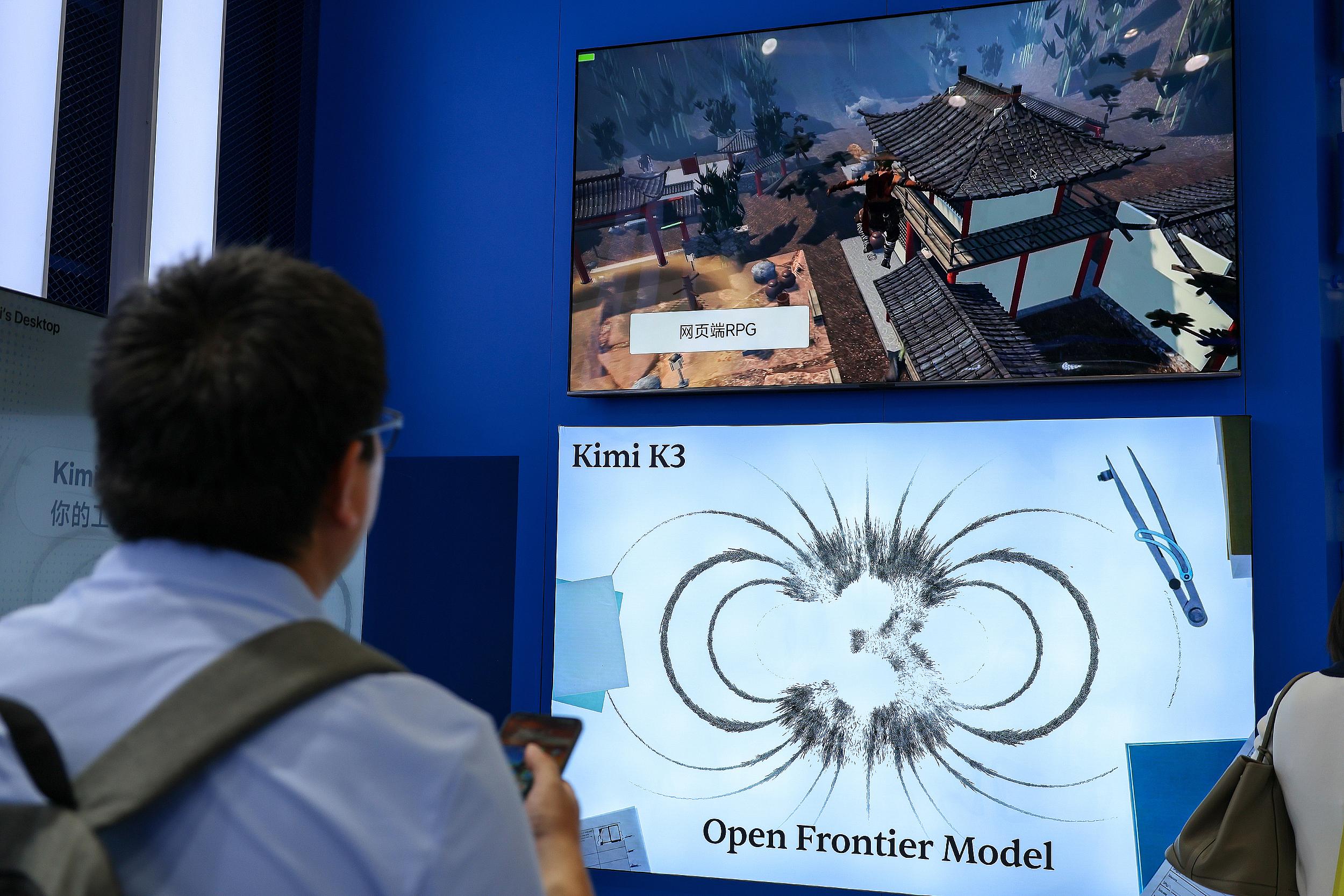
Kimi K3, developed by Chinese AI startup Moonshot, has sent shockwaves through the global tech community. The model, containing 2.8 trillion parameters, is the world's first open 3T-class model, designed for frontier intelligence across long-horizon coding, knowledge work, and reasoning, according to Moonshot.
Western media outlets said the unveiling of K3 last month demonstrated a rapidly narrowing gap between China and the U.S. in frontier AI models.
U.S. digital news platform Axios bluntly noted that "America's commanding lead in advanced AI is gone." Axios said Kimi K3's release dazzled developers, "jolted Silicon Valley." BBC said this suggests that China's tech prowess is rapidly narrowing the capabilities gap, "upending long-held assumptions in the West that Chinese developers trail their American peers."
Some experts regarded K3 as a "DeepSeek 2.0 moment." "DeepSeek increasingly looks like the beginning of a pattern," Poe Zhao, analyst and founder of the newsletter Hello China Tech, told CNN. The broader significance is that K3 proved "China's progress is becoming more repeatable."
On July 27, Moonshot released its record-setting open-weight model, making it freely available for users to download, adapt and self-host it. The Telegraph reported Ciaran Martin, former head of the UK's National Cyber Security Centre, as saying: "An open-weight model — that means it'll soon be available to anyone to use and adapt it, which, combined with its lower cost, will make it very attractive worldwide outside the U.S.'s direct sphere of influence."
China's tech industry has embraced open source, which has helped Chinese firms improve their models quickly, and the entire industry gains when every company shares its work in public, The New York Times said.
The Financial Times said Chinese AI players like Moonshot and DeepSeek have rolled out open-weight models that are less expensive to operate and can be freely downloaded and modified by users. "Moonshot's K2.6 model, for instance, costs about a third of Anthropic's Opus 4.8."
By contrast, American AI labs generally keep the weights of their most capable models on private servers. Users can chat with GPT or Claude through applications, but they never actually own the model, according to Scientific American.
Companies from Silicon Valley to Europe are turning to more affordable Chinese models with their excellent capabilities and lower cost to rein in their mounting technology costs.
Curt Meinhold, a North Carolina-based technology executive, told The Wall Street Journal that he increasingly prefers to use DeepSeek for tasks such as finding business leads or ways to generate sales. "At the end of the day, most of us, the vast majority of us, 90 plus percent, don't need [Anthropic's] Mythos or Fable," Meinhold said. "Like, we just don't need it, we need something good enough."
The BBC said the rapid arrival of Kimi K3 suggests Chinese firms are advancing independently despite U.S. restrictions on hardware sales. "Even if U.S. labs pull ahead again, China has shown it can close the gap quickly." Axios said.
While Anthropic and OpenAI have accused Chinese firms of distilling their models to develop AI systems, experts say the recent breakthroughs by Moonshot and Z.ai cannot be explained by distillation alone. Years of operating under U.S. export controls have forced Chinese companies to innovate within tight computing constraints.
"The Chinese models are not excellent only because of distillation," Graham Webster, a Stanford University professor who studies China's open-source AI ecosystem, told The New York Times. "There is real innovation going on."