

The Yau Laboratory Alliance for Mathematics and AI Launched at Tsinghua University
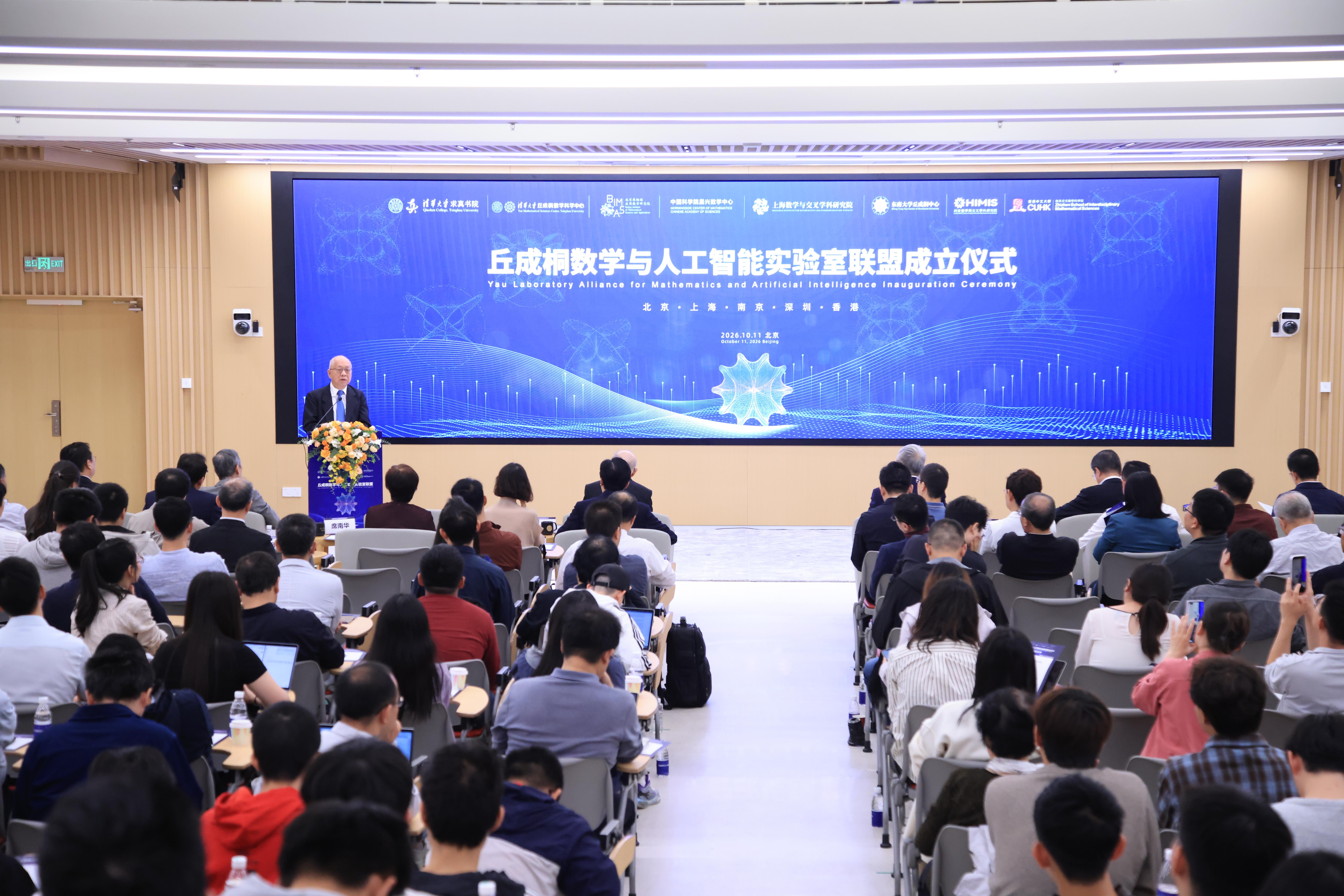
The Yau Laboratory Alliance for Mathematics and Artificial Intelligence, founded by eight leading mathematics research institutions, was inaugurated at Tsinghua University in Beijing on October 11.
Led by Shing-Tung Yau, Fields medalist and chair professor at Tsinghua, the alliance comprises Qiuzhen College of Tsinghua University, the Yau Mathematical Sciences Center at the university, the Beijing Institute of Mathematical Sciences and Applications, the Morningside Center of Mathematics of the Chinese Academy of Sciences, the Shanghai Institute for Mathematics and Interdisciplinary Sciences, the Shing-Tung Yau Center of Southeast University, the Hetao Institute of Mathematics and Interdisciplinary Sciences (Shenzhen), and the Zhizhen School of Interdisciplinary Mathematical Sciences at The Chinese University of Hong Kong.
It seeks to accelerate mathematics and interdisciplinary research through AI, and to underpin AI development with theoretical innovation in mathematics.
AI has made a series of breakthroughs in mathematical research this year, drawing widespread attention and intense discussion across the international mathematics community. The alliance is expected to bring together nearly 1,000 leading mathematical talents and research teams, creating a pronounced clustering advantage in fundamental mathematics, applied mathematics and interdisciplinary fields, and giving it a strong foundation for supporting AI development through advances in fundamental mathematics.
With Yau as director of the alliance, academic leaders designated by each participating institution sit as committee members in charge of major directional decisions and academic evaluation. The alliance will operate on an open and shared mechanism, extending large-scale model training resources, formalized mathematics libraries and computing platforms to participating institutions, safeguarding the academic environment for mathematical science in the AI era.
Going forward, it will focus on six areas, including developing specialized models for mathematical science, building infrastructure for AI-assisted mathematical research, driving mathematics-led breakthroughs in interdisciplinary science and technology, and deepening international cooperation and talent cultivation.
It will also set up mathematics and AI laboratories in five locations, namely Beijing, Shanghai, Nanjing, Shenzhen and Hong Kong, to accelerate multifaceted integration of AI with mathematics and related interdisciplinary fields on the strength of existing research capacity.
Speaking at the ceremony, Yau offered his perspective on AI and mathematics, calling the present moment both the most exciting and the most dangerous era for scholars. If AI is used properly, he said, the scholarship, results and impact it produces will be epoch-making. If handled poorly, it could bring disastrous consequences.
He added that throughout history, fundamental science has often been advanced by a small number of people, while AI is an integrative tool that brings together human thought from the past to the present through powerful computing. Truth is infinite but AI is constantly improving the ability to understand it.
Having spent 50 years in research and having witnessed many great mathematical advances, he said the transformative power of AI today is more striking than those earlier breakthroughs.