

2026 Nobel Prizes Honor Pioneering Scientific Achievements
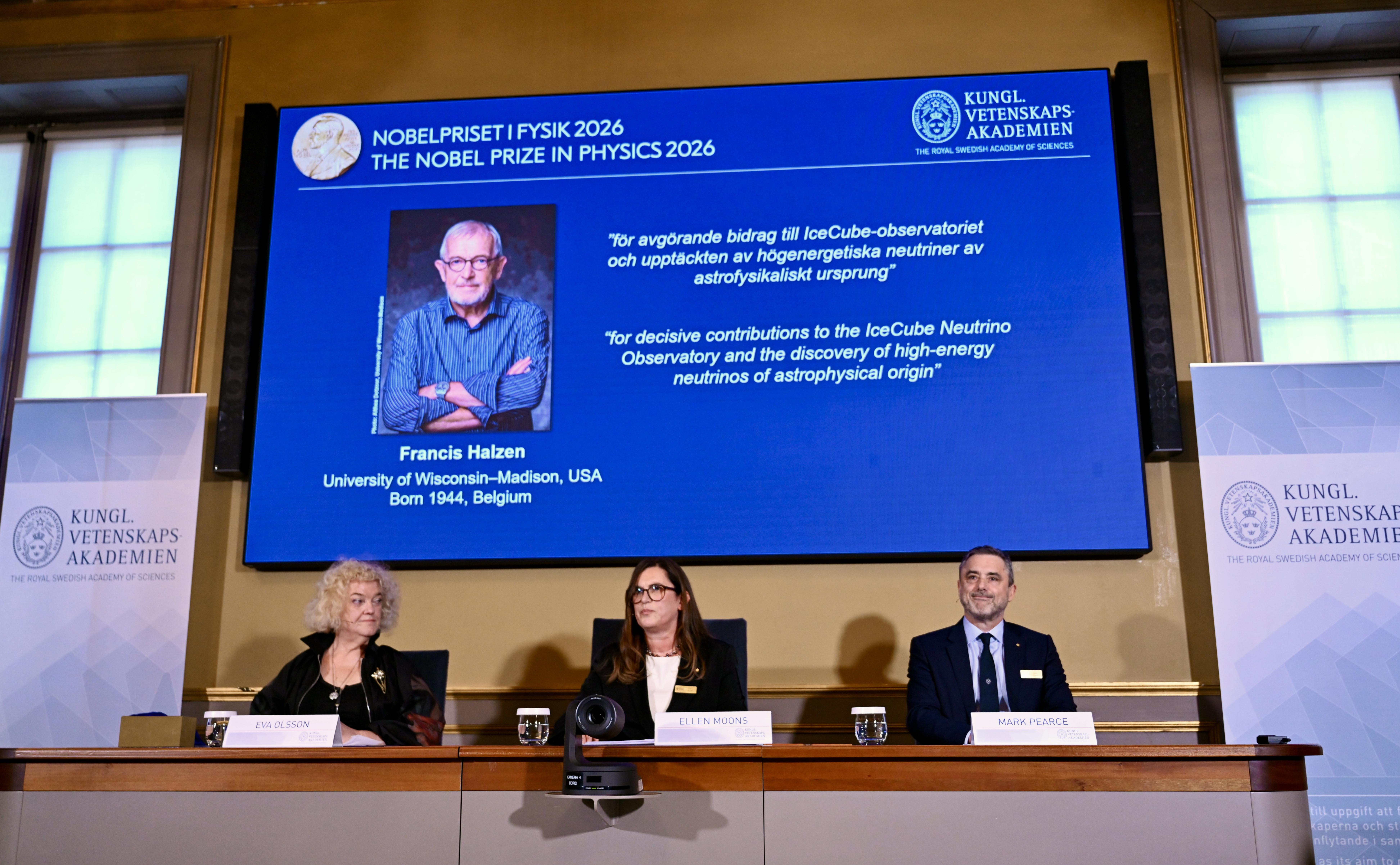
Every year, the Nobel Prizes in Physiology or Medicine, Physics, and Chemistry recognize scientists for their outstanding contributions to their respective fields. This October, the laureates for 2026 were announced.
Physiology or Medicine: Karl Deisseroth, Peter Hegemann, Georg Nagel
The Nobel Assembly at Karolinska Institutet awarded the 2026 Nobel Prize in Physiology or Medicine jointly to Karl Deisseroth, Peter Hegemann and Georg Nagel "for their discoveries concerning light-gated ion channels and optogenetics."
Optogenetics is a method that makes it possible to show how nerve cells shape memories, feelings and behaviors in the living brain. "Optogenetics provides opportunities for mapping the brain in a way that we could once only dream of," Per Svenningsson, chair of the Nobel Committee for Physiology or Medicine, said.
Hegemann and Nagel discovered a remarkable protein, channelrhodopsin, in a single-celled alga. Deisseroth transformed the protein into a light-controlled switch for nerve cells. "The laureates have laid the foundation of a new era in neuroscience," the press release said.
Physics: Francis Halzen
The Nobel Prize in Physics 2026 was awarded to Francis Halzen by the Royal Swedish Academy of Sciences "for decisive contributions to the IceCube Neutrino Observatory and the discovery of high-energy neutrinos of astrophysical origin."
The IceCube Neutrino Observatory is a cubic kilometer of ice equipped with light sensors at the South Pole. Using IceCube, researchers can capture neutrinos from extremely energy-rich processes in the distant universe.
The neutrino interactions that are continuously collected by IceCube will provide researchers with novel knowledge about the violent settings in which high-energy neutrinos can be created and could even reveal previously unknown cosmic phenomena.
"Francis Halzen has led an international team of researchers and engineers who have provided us with a fantastic instrument. His tenacity and scientific vision have paved the way for a new kind of astronomy," Mark Pearce, chair of the Nobel Committee for Physics, said.
Chemistry: Henri B. Kagan, Kenso Soai
The Royal Swedish Academy of Sciences awarded the Nobel Prize in Chemistry 2026 to Henri B. Kagan and Kenso Soai "for the discovery of non-linear effects and autocatalysis in asymmetric organic synthesis."
"Henri Kagan and Kenso Soai have provided a solution to a chemical mystery that is over a century old: how homochirality can emerge spontaneously. The chemical reactions they have developed are spectacular," Heiner Linke, chair of the Nobel Committee for Chemistry, said.
Homo and chiral come from Greek words meaning "same" and "hand," respectively. Like hands, all amino acids exist as two mirrored variants, but living organisms contain only one of these mirror images.
The two laureates provided a solution to the puzzle of how such homochirality emerges.