

3D Printing Turns Solid Waste into Highway Infrastructure in Ningxia
A 50-meter-long, three-meter-high noise barrier along the Yinchuan South Logistics Expressway in Ningxia Hui autonomous region, northwest China, is in the limelight, not only for its embossed murals depicting the Yellow River and the Helan Mountains, but for how it was built.
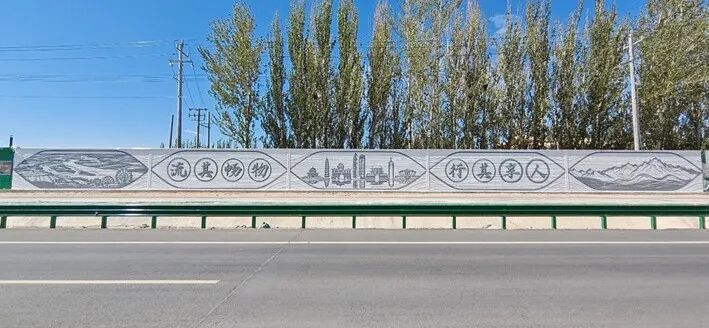
It is Ningxia's first concrete noise barrier fabricated using in-situ 3D printing technology that incorporates construction and industrial solid waste as raw materials.
Ningxia faces significant challenges in solid waste treatment. The region generates over 80 million tonnes of industrial solid waste annually, with a utilization rate of just 45 percent. Construction waste output reaches 12 million tonnes per year, of which less than 30 percent is recycled. The recycling industry for retired equipment from photovoltaic and wind power generation is still in its infancy.
The 15th Five-Year Plan (2026-2030) calls for advancing the circular economy and improving the waste-recycling system. The project marks a breakthrough in intelligent and green transport infrastructure, offering a practical example for low-carbon transition in northwest China during the plan period.
At the construction site, a large 3D printing system was used to deposit layers of concrete slurry made from solid waste, gradually forming the wall with embossed patterns.
"The cantilever-type 3D printer mixes cement, steel fibers, sand and other materials, pumps the mixture through a delivery pipe, and prints layer by layer through programmed slicing control," said Xu Xiaoguang, a researcher at Ningxia Communications Construction Co., Ltd. (NXCC). "We printed five panels highlighting Ningxia's local landscape and cultural features."
The project is part of a key provincial-level R&D initiative jointly carried out by NXCC, Southeast University and CCCC First Highway Consultants Co., Ltd. The team overcame key technical challenges, including material formulation for solid-waste-based concrete, operational stability of in-situ printing equipment, and precision control for complex geometries — all adapted to the arid and semi-arid climate of the region.
Compared with traditional concrete construction, the in-situ 3D printing technology eliminates formwork design, fabrication, installation and removal, reducing on-site procedures and labor, while achieving integrated structural formation with improved compactness and durability. It can also produce complex shapes and customized designs.
"This is the first large-scale application of 3D printing in highway auxiliary facilities in Ningxia, and an important step forward in intelligent and green transformation of transport infrastructure," said Zhang Lei, director of the division of science and technology for social development at the Science and Technology Department of Ningxia.
"This is also the first provincial-level key R&D project undertaken by the transport sector in Ningxia," said Hui Yingxin, deputy general manager of NXCC. He said the research team will continue to promote large-scale application of solid-waste-based 3D printing in road, construction and landscape projects.
"In the future, we will achieve more custom-shaped structures such as landscape bridges and hollow walls, providing technical support for the digital upgrading of transport infrastructure and high-value utilization of solid waste in Ningxia," Hui said.