

National Park Contributes Chinese Wisdom to Wildlife Conservation
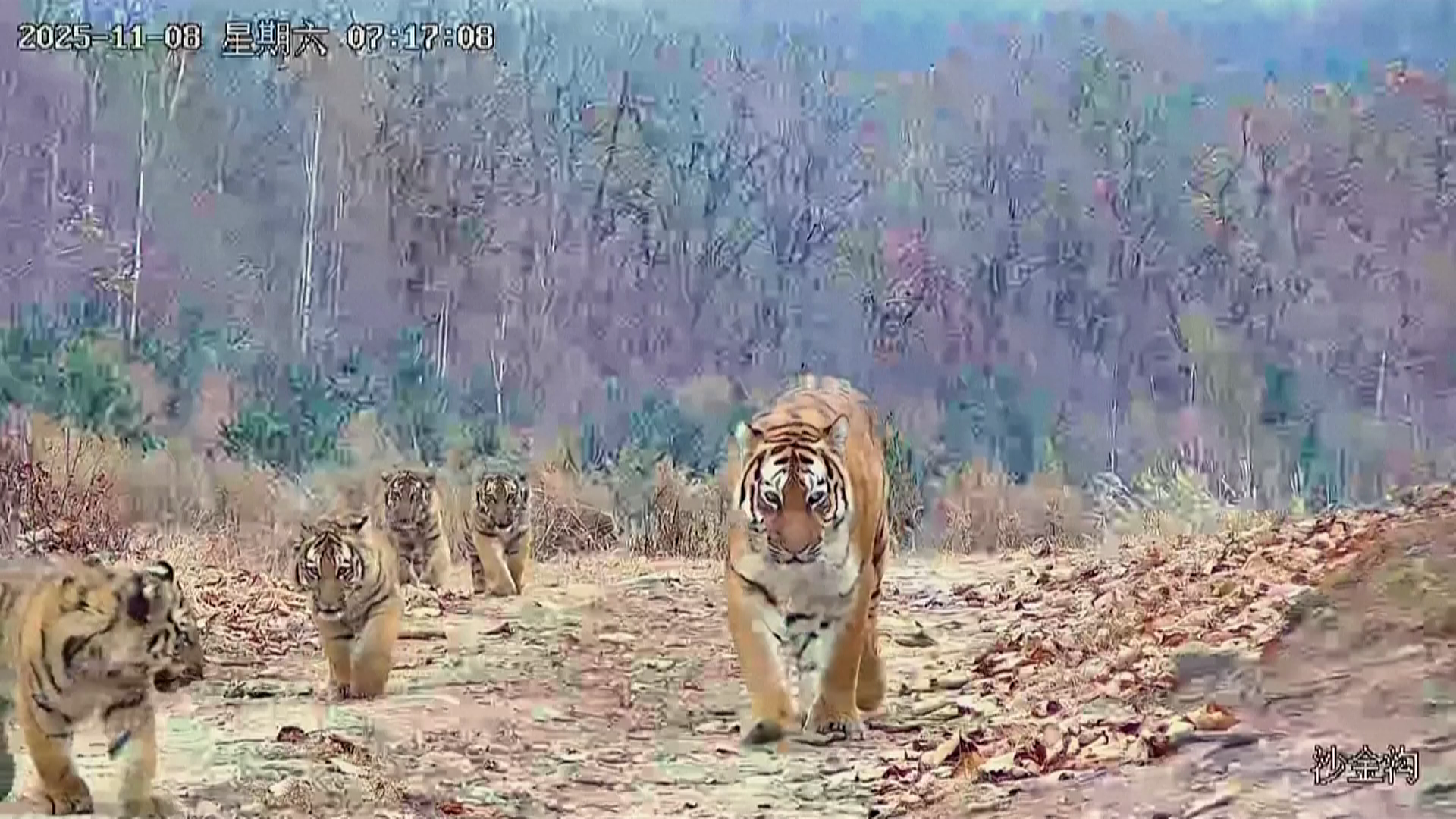
On the screen of the"space-air-ground"integrated monitoring platform in the Northeast China Tiger and Leopard National Park,a wild Amur tiger paces through its vast forest.
According to the latest monitoring data released by the National Forestry and Grassland Administration, the number of wild Amur tigers in the park has more than doubled from 27 in 2017 to 72 in 2026, while that of wild Amur leopards has climbed from 42 to 115.
Spanning Jilin and Heilongjiang provinces in northeast China, the park is 14,100 square kilometers of mountain woodland with 97.74 percent forest cover. It is the core distribution area of wild Amur tigers and leopards in China, and the country's only habitat supporting breeding family groups of these big cats.
Last winter, the monitoring system captured rare footage of a female tiger accompanied by five cubs. "After consultation and verification by numerous domestic and international experts, this marked the first time in China that wild Amur tigers appeared 'six in one frame,' which is also highly rare in global wild tiger conservation," said Duan Zhaogang, head of the park administration.
Jiang Guangshun, a professor at the College of Wildlife Resources, Northeast Forestry University, offered an in-depth interpretation: "For wild animals, especially large carnivores, obtaining enough food to raise cubs is no easy feat. Generally, when a litter is large, as many as half or a third of the cubs may not survive." The park's conservation and management in recent years has effectively recovered the tigers' prey populations, he said.
Over the five years since the park was established, about 40,000 hectares of undergrowth has been replanted, and pilot projects for artificial forest transformation and forestry pest control have been conducted in about 12,600 hectares. Five wildlife migration corridors have been opened, repairing fragmented habitats and significantly enhancing regional ecological connectivity.
Restored habitats have opened up space for tigers and leopards, while an intelligent monitoring system has fitted these forests with "eyes."
According to officials, when the monitoring system was being built, 95 percent of the park had no network coverage. Researchers had to venture into the mountains once every month or two to replace the batteries of the devices and copy data.
Today,the park has built a real-time"space-air-ground"integrated intelligent monitoring system.It uses satellite remote sensing,high-altitude lookout ball stations in the air,and infrared camera traps on the ground.
Combining the Internet, big data, the Internet of Things, AI and remote sensing, the system deploys nearly 30,000 real-time wireless infrared cameras and 95 700-mHz communication base stations. It can precisely identify more than 30 wildlife species, with the identification accuracy exceeding 90 percent for Amur tigers and Amur leopards. It also plays a major role in species-distribution monitoring, field patrols, wildlife early warning and forest fire prevention.
In addition,policy support has laid a solid foundation for the park's long-term development.
On January 1, the national park law took effect. During the 15th Five-Year Plan period (2026-2030), China will systematically restore ecological corridors and overall habitats for wild Amur tigers and leopards, and launch rescue-based conservation for 165 extremely endangered nationally protected wild animal and plant species.
With technology and researchers standing guard, the Northeast China Tiger and Leopard National Park has forged a path of harmonious coexistence between humans and nature, contributing Chinese wisdom to the global conservation of large felines.