

Drones Carry Low-Altitude Economy Success
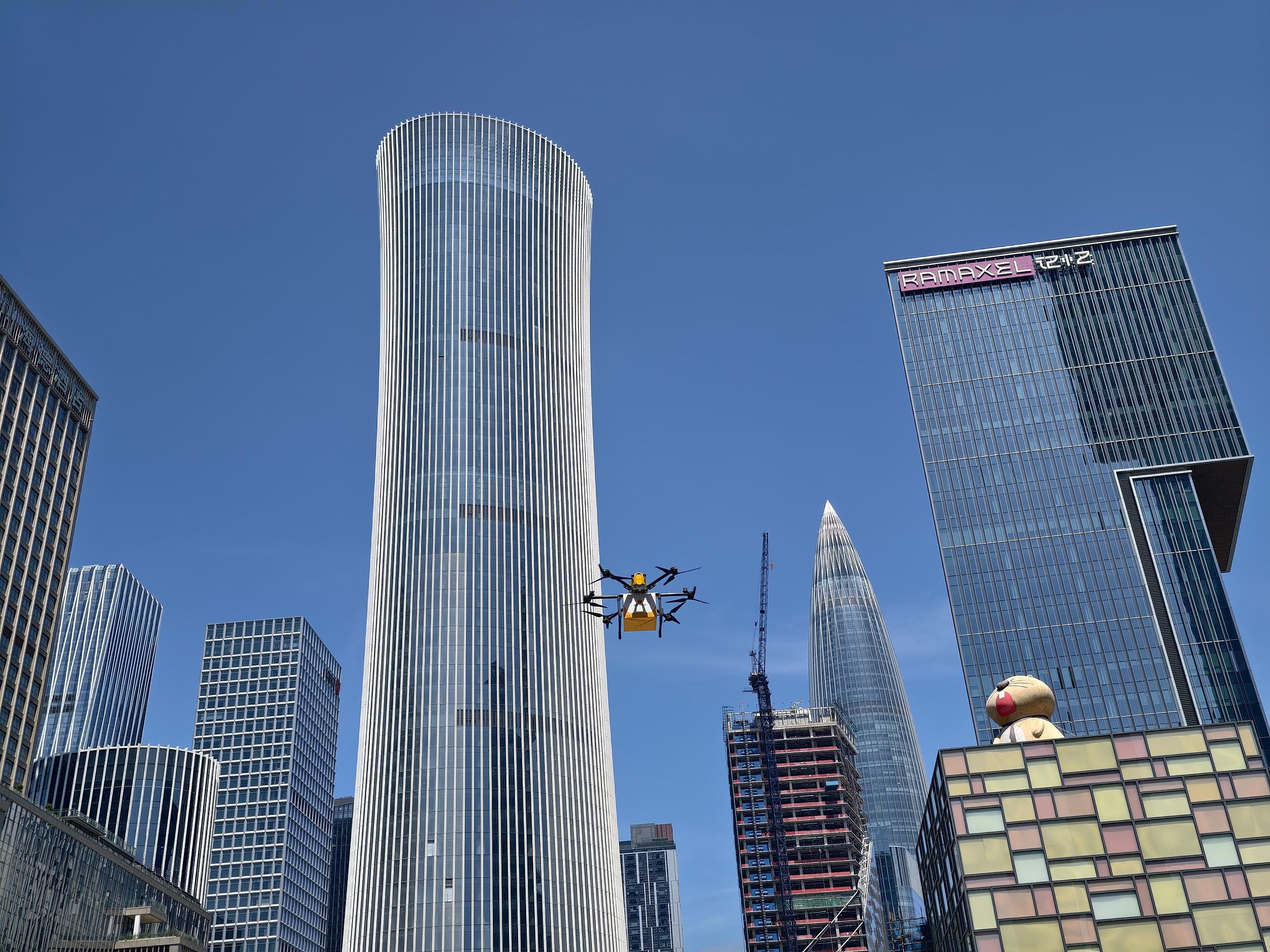
Imagine you're a thirsty tourist trekking up the steep stone steps of the remote Badaling section of the Great Wall, and you desperately need a cold drink to cool down. Now, it is as easy as placing an order on your phone and waiting for a drone to bring it to you.
Examples of such services also extend to drones carrying emergency plasma weaving across the Wuhan city skyline.
These operations all form part of low-altitude logistics — or drone-based transport operating below traditional aviation heights — which has transformed the idea of "being out of reach" into something reliably available at the touch of a phone screen.
When "low-altitude economy" appeared in China's 2024 Government Work Report for the first time, it signaled the rise of a new strategic industry. Yet among the many scenarios where low-altitude applications could develop, logistics has emerged as the first to go commercial. This is no coincidence, as it actually reflects the readiness of Chinese technology, and the strength of an institutional framework that encourages rapid change and deployment.
China's logistics system has long been both a marvel and a stress test. Daily parcel volumes soared from 100 million in 2019 to peaks of 729 million in 2023 and now push toward an almost unimaginable one billion parcels a day, according to Jin Bing, former official of the State Post Bureau of China. What once was able to expand by hiring more couriers or buying more trucks has reached its limits. Put simply, human-based logistics cannot scale up at the speed the market demands.
This shift is already visible in Chinese cities, where drones are "halving delivery times," as The Irish Times recently observed, by flying packages to neighborhood drop-off stations for couriers to finish the final stretch. What began as experimentation has quickly accelerated into mass deployment. According to Jin, one major logistics company opened more than 500 drone routes in 2024 alone — more than twice its total from the previous decade. In Shenzhen, some sorting hubs see over a thousand drone takeoffs and landings each day, supporting a drone-express network that reliably fulfills 20,000 to 30,000 orders daily. China's B2C online retailer JD.com's drones, operating routinely in seven provinces, have cut delivery times in remote mountain regions from 72 hours to just three.
Beyond scale, integrated systems are redefining efficiency. SF Express, China's largest courier, and Shenzhen Metro have launched the country's first "rail-based logistics station," knitting together aerial drones, ground depots, underground unmanned vehicles, subway corridors, airport hubs, and large cargo aircraft. This model, already spreading across Zhejiang province and the Greater Bay Area, cuts delivery time by up to 80 percent and logistics costs by up to 50 percent, proving that low-altitude logistics is not an experiment — it is a viable business model.
Policy has been the quiet but decisive enabler of this momentum. Since early 2024, Chinese regulators have introduced a series of coordinated measures: support for unmanned delivery and low-altitude logistics, the promotion of integrated air-ground transport systems, and guidance for developing drone-based feeder routes and last-mile services. This consistency has created something rare in the global landscape: a regulatory ecosystem designed to build rules in parallel with rapid deployment. It is an advantage far more powerful than any single technical breakthrough.
China has approached the low-altitude economy as both a frontier for innovation and a form of public infrastructure. The result is an ecosystem in which manufacturers, operators, city planners, and regulators evolve together.
As The Economist noted in a recent analysis of the sector, Chinese companies can "develop products faster than their counterparts elsewhere." The deeper truth is that China's advantage is not only speed, but coherence. China is building a complete model — technological, operational, and regulatory — that other countries may eventually look to as a template rather than a curiosity.