

Success Stems from Chance, Patience and Collaboration
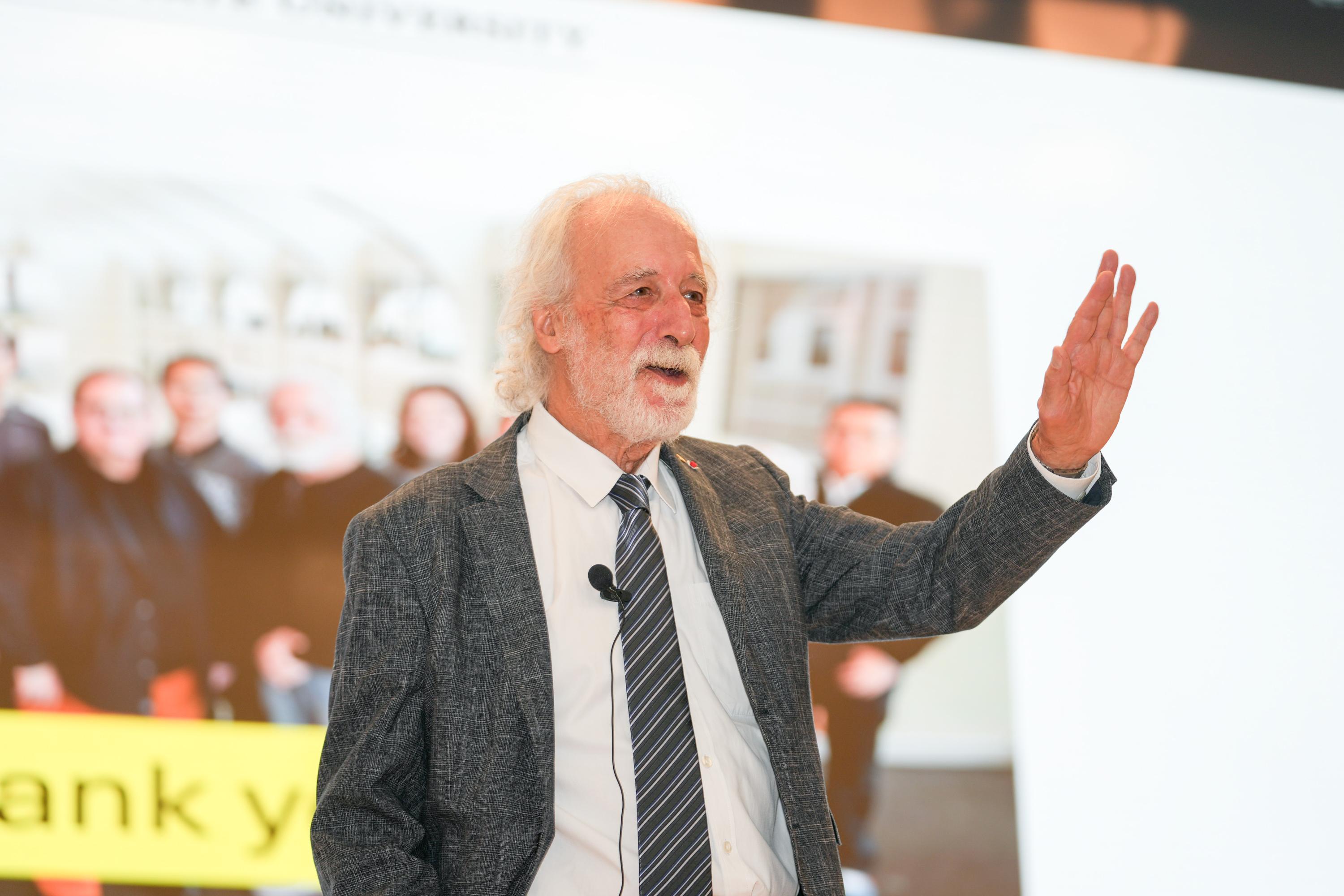
For Professor Pierre Agostini, science first appeared as a man running back and forth across a classroom. It was during high school when his chemistry teacher, demonstrating how atoms bond, dashed from the blackboard to the wall and back again, shouting out element symbols and mimicking reaction pathways.
The other person responsible for his taste for science was his professor of electronics at the university, who showed him his first laser, a modest He-Ne.
"I'm very grateful to both of them," he said.
Agostini received the 2023 Nobel Prize in physics for "experimental methods that generate attosecond pulses of light for the study of electron dynamics in matter." In 2025, he was elected a foreign member of the Chinese Academy of Sciences (CAS).
In a recent interview with Science and Technology Daily, Agostini spoke about his scientific journey with humility, acknowledging the roles of chance, patience and collaboration.
A 'little peak' appears!
In 1979, working under Gérard Mainfray at CEA Paris-Saclay, a national research center of the French Alternative Energies and Atomic Energy Commission, Agostini and his colleague Guillaume Petite built a basic retarding voltage electron spectrometer and did their first experiment with their "one-shot-per-minute" laser.
Their laser fired only once per minute, making the experiment painstakingly slow. But one day, "a small, unexpected peak" appeared on screen.
"We thought it was interesting, so we quickly wrote a paper," Agostini recalled. "But honestly, none of us realized this would become the starting point of Above-Threshold Ionization, or ATI. At the time, we still interpreted it as a higher-order perturbative effect. And we didn't yet grasp that electrons were absorbing many more photons than needed for ionization."
Ironically, after upgrading their equipment, they spent months failing to reproduce their own result. "I couldn't sleep well for weeks," he said.
In 2001, Agostini succeeded in producing and investigating a series of consecutive light pulses, in which each pulse lasted just 250 attoseconds. Potential applications of attosecond pulses include ultrafast electronics and medical diagnostics.
Discussing his Nobel Prize, he remained humble. "It did not change the trajectory of my research. With my colleague Louis DiMauro at the Ohio State University, we had been working on attosecond physics since 2005. The prize in 2023 was surely an encouragement to continue."
Science across borders
Over decades, he has collaborated across Italy, Canada, the Netherlands, Germany, the United States, and now China. What makes international collaboration work? "I believe the human factor is key, nationally or internationally. Science is by nature international, but a successful collaboration begins with a good personal connection. That's my experience."
He first visited China around 40 years ago at the invitation of CAS. Today, touring advanced labs at Nankai University, Peking University and ShanghaiTech, he sees dramatic progress.
"My recent visits have shown me the incredible advancement of Chinese research compared to my first visit to the Institutes of Optics in Xi'an and Shanghai as a guest of CAS decades ago. It makes me regret not having been more involved with the Chinese scientific community over those years."
In 2024, he was appointed honorary professor at Nankai University, where he established the International Joint Research Center for Ultrafast Optics and Applications to foster global cooperation in attosecond science.
'Don't fear the unexpected'
Young researchers often ask him for career advice. His response reflects his own winding path. "It is hard to guess where science will go, and there is certainly a part of chance in making a good career choice. Astronomy is a good candidate with the huge amount of new data now available. Applications of atomic physics, from atomic clocks and frequency combs to attophysics, are attracting many groups around the world. X-ray Free-Electron Lasers (XFELs) are also on the rise."
Looking ahead, attosecond science is pushing toward shorter wavelengths and higher intensities.
"One of the remaining challenges is to increase the intensity of attosecond pulses and push them deeper into the X-ray regime. The Linac Coherent Light Source, or LCLS, has already shown several orders of magnitude higher photon flux compared to high-harmonic generation, and more progress is likely at the growing number of XFEL facilities in Europe, China, Japan and (South) Korea."
And further into the future? "The light pulses on the zeptosecond timescale have yet to be demonstrated," he said. Generating a true one-attosecond pulse would require a bandwidth of hundreds of electronvolts and a carrier wavelength shorter than two nanometers, deep in the X-ray range, a regime already beyond the reach of current high-harmonic generation techniques.
Nankai University also contributed to this article.