

'Deep Sea Warrior' Rescues Shipwrecked History
Against the backdrop of blue lighting and the sounds of ocean waves and distant whale calls, 377 pieces of Ming Dynasty treasure are telling the story of the Maritime Silk Road as it was 500 years ago, at the Grand Canal Museum of Beijing.
These artifacts come from the No. 1 and No. 2 shipwrecks on the northwest slope of the South China Sea. The two Ming Dynasty shipwrecks were discovered on the seabed of the South China Sea in October 2022, at a depth of approximately 1,500 meters. Shipwreck No. 1 was laden with export ceramics from Jingdezhen, while Shipwreck No. 2 was carrying ebony that had been brought back from overseas. This discovery filled a gap in China's historical record of import trade return voyages along the Maritime Silk Road and bears witness to the prosperity of two-way trade along this ancient route.
So how did archaeologists manage to find these exquisite artifacts? At this depth, the seabed is perpetually dark, with water temperatures ranging from 3°C to 4°C. Without technological support, the deep seabed is an archaeological blind spot, necessitating the use of a variety of deep-sea technologies and equipment during this discovery.
For example, archaeologists used 3D laser scanners and high-definition cameras to create panoramic photographs and scan the shipwreck site in 3D, gaining an initial understanding of where the artifacts were located.
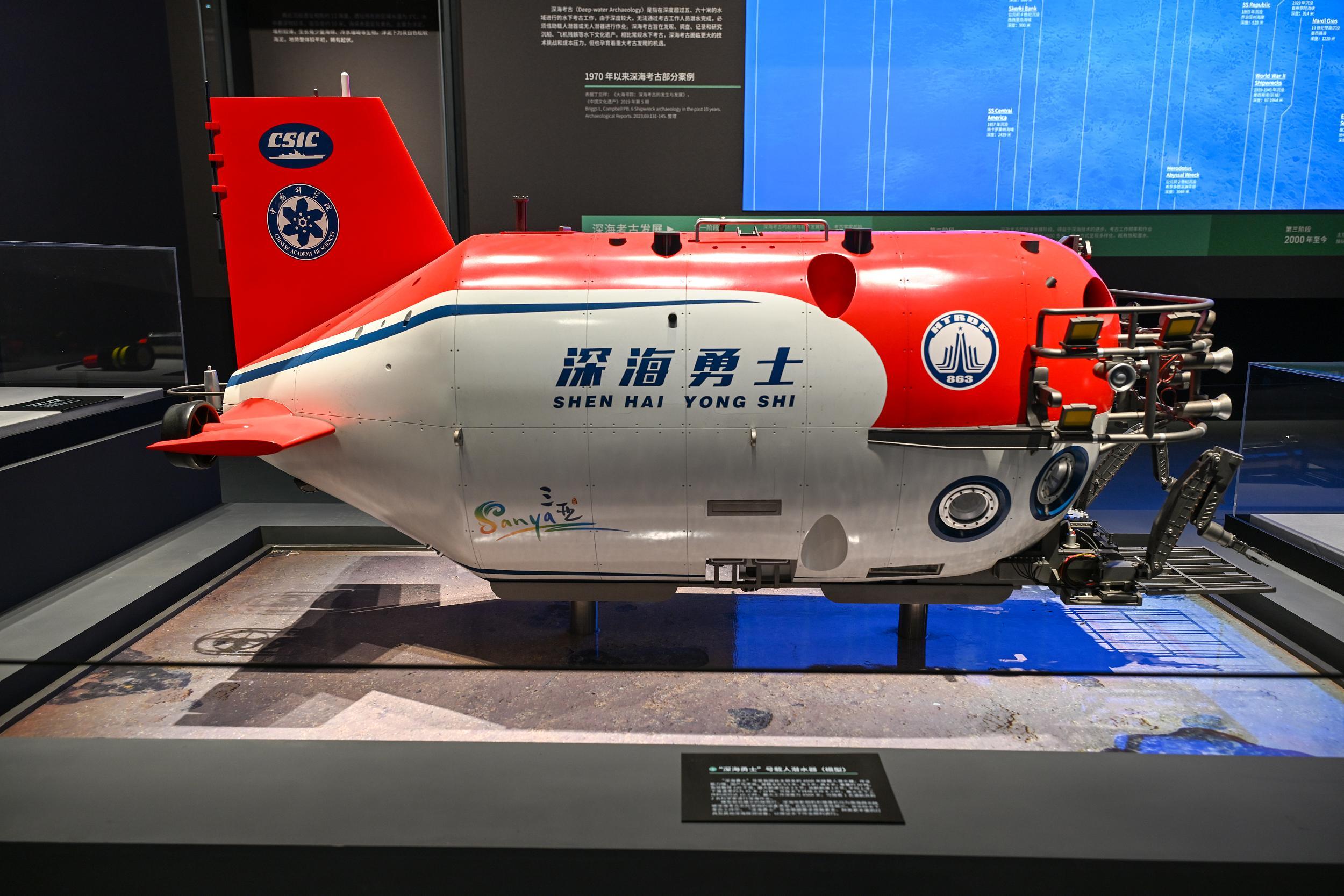
Furthermore, archaeologists deployed the Deep Sea Warrior, a manned submersible independently developed by China with a maximum diving depth of 4,500 meters, to conduct underwater operations. The archaeologists aboard the Deep Sea Warrior then descended to a depth of 1,500 meters to conduct thorough investigations and record and study the site, as well as extract artifacts and samples.
As soon as the Deep Sea Warrior reached the bottom of the planned route, its lights were switched on. Two robotic arms, each with a robotic hand at the end, were connected to the outside of the manned submersible. One of these robotic hands, covered in a flexible material, carefully extracted artifacts that had lain buried for hundreds of years.
Due to the environment being drastically different once the artifacts had surfaced, without proper treatment, they would quickly crumble.
The high salinity of the deep sea, coupled with chloride ions filling the pores of ceramics, causes repeated crystallization and dissolution due to rapid changes in temperature and humidity. Therefore, the immediate priority for newly recovered artifacts is cleaning and desalination.
A comprehensive approach is required for cleaning, utilizing physical scrubbing and chemical solvent soaking depending on the artifact's material, glaze and degree of contamination. This ensures that the historical information and artistic value of the artifact are not damaged when removing the dirt.
After cleaning comes desalination. Cultural relic conservationists soak the artifacts in deionized water and use desalination technology to gradually remove the salt that has seeped into the ceramics. This process often takes several months, or even longer.