

Reporter's Diary: Arabic Journalist Improves Reporting with Chinese AI Glasses
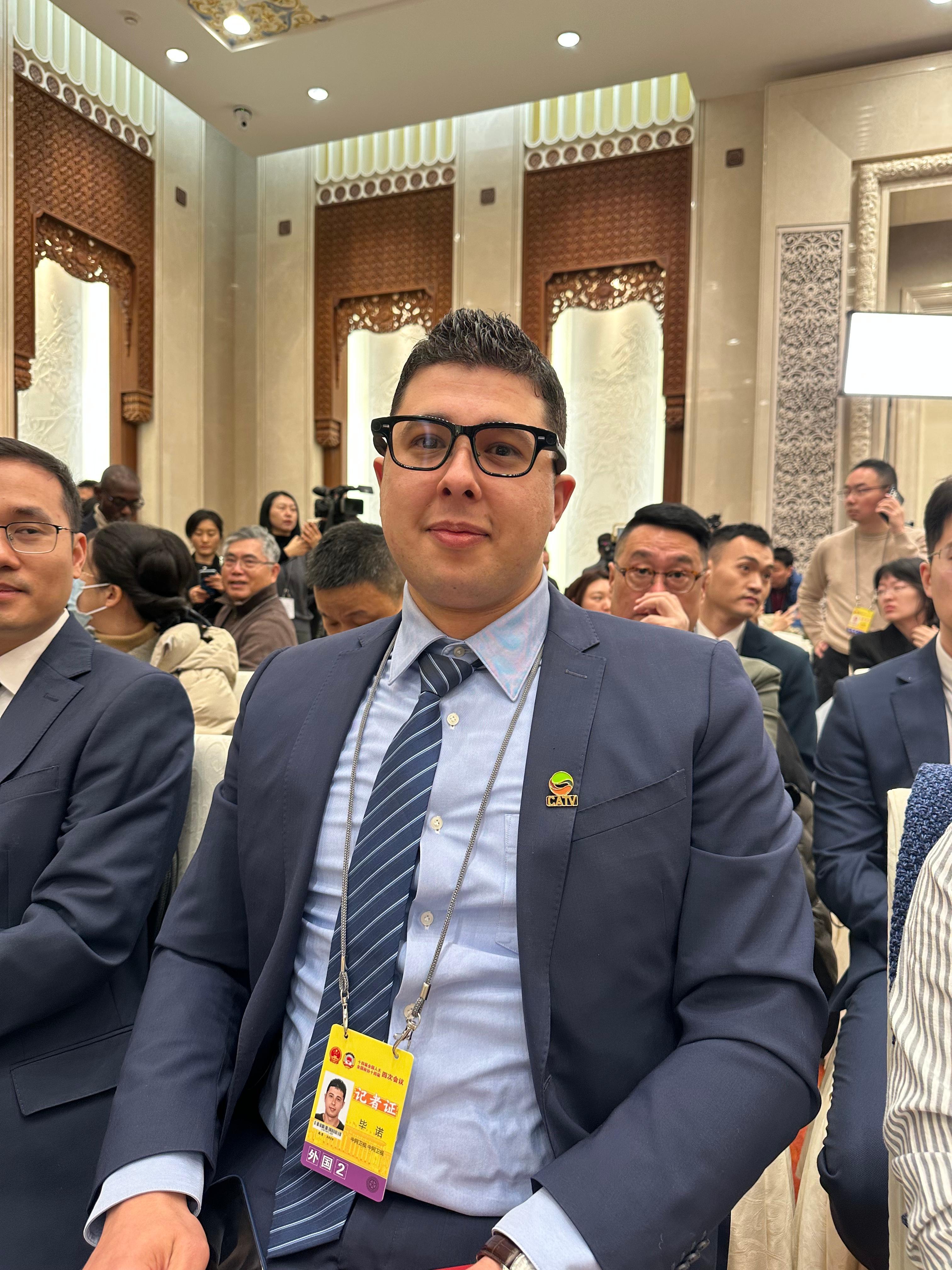
On the afternoon of May 3, ahead of the press conference for the fourth session of the National Committee of the Chinese People's Political Consultative Conference (CPPCC), the conference room was abuzz with anticipation and activities as journalists readied their equipment and discussed the possible policy decisions to be made at the Two Sessions.
In stark contrast to his busy colleagues, the Arabic reporter from China-Arab TV, more popular here by his Chinese name Bi Nuo, was calm and composed, leisurely surveying his surroundings from his seat through his black-rimmed glasses.
"Are you wearing AI glasses?" I asked curiously.
"Yes, they're incredibly useful to me — a true divine assist for my coverage of the conference." As he spoke, he handed me the lightweight glasses and invited me to try them out.
The moment I put them on, a clear virtual interface appeared before my eyes. As Bi Nuo spoke to me in fluent Chinese, lines of Arabic subtitles appeared in real time.
Seeing my surprised expression, he explained that although he has been in China for many years, he still sometimes struggles to understand certain Chinese idioms and professional expressions. With these AI glasses, however, he can understand the speeches at the conference more accurately, which significantly improves his reporting efficiency.
During last year's Two Sessions, he had used other smart devices, but they were cumbersome and had translation delays, which often disrupted his reporting pace.
"Compared to those, the AI glasses made in China are much better. They can translate 89 languages in real time," he said.
When the press conference began, as the spokesperson walked onto the stage, Bi Nuo put on the glasses, touched the switch, and began reporting.
This article is edited by BI Weizi.