
Guangdong Building Robot Industry Cluster
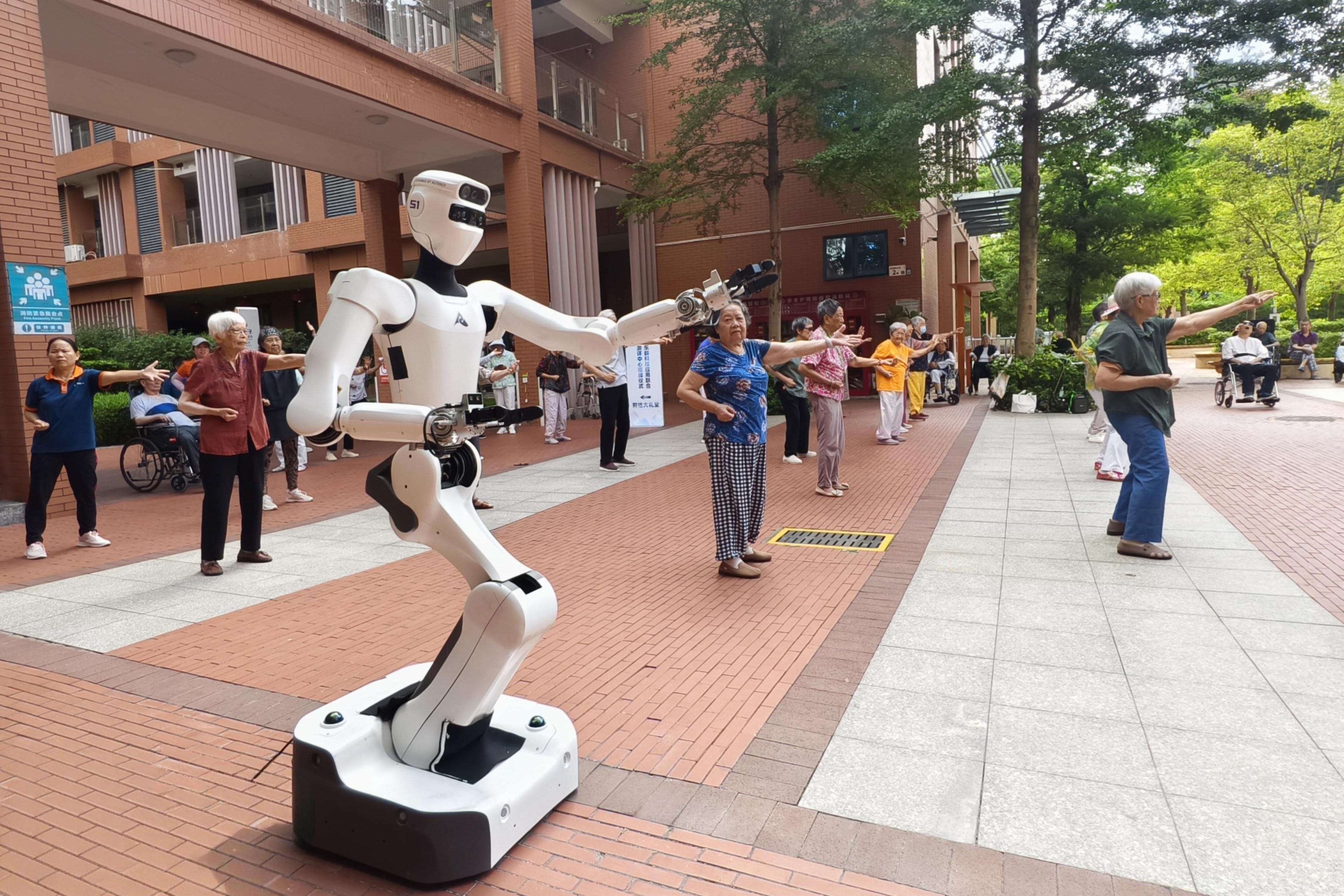
In Guangdong province in south China, human-robot collaboration is reshaping a new production landscape.
Flexible welding production lines for new energy vehicle manufacturing, 100 percent robot-operated, have ushered in a production cycle of only 74 seconds. Embodied intelligent high-end welding industrial robots have increased single-shift production capacity in the auto parts sector by 50 percent. The multi-connected robotic automatic assembly production line for air conditioners has achieved a one-time product qualification rate of 99.3 percent.
The 2026 government work report proposes fostering the industries of the future such as future energy, quantum technology, embodied intelligence, brain-computer interfaces and 6G.
As a major robot manufacturing province, Guangdong has ranked first in China in the output of industrial robots for six consecutive years. Its robot industry leads the country in both application breadth and penetration rate.
For example, in the medical field, Shenzhen Edge Medical's independently developed single-port laparoscopic surgical robot can complete complex surgeries with only one incision, significantly reducing trauma to patients. The traditional multi-port laparoscopic surgical robots require four to six incisions.
The launch of a humanoid robot with a "distributed heterogeneous multi-machine collaborative operating system based on open-source HarmonyOS" will expand application scenarios from single functions to cross-domain collaboration.
Large-scale and multi-scenario application of robots also depends on local policy support. Data shows that since 2018, Guangdong has launched five batches of special projects on "new generation AI" under its key field R&D plan, investing nearly 1.5 billion RMB.
Coordinating with major and key special projects such as intelligent robots, it has built a scientific R&D system covering basic research, technological R&D and innovative application at multiple levels.
In 2025, Shenzhen released an action plan for an additional special investment of 4.5 billion RMB to support the development of the AI and robot industries.
"The Guangdong-Hong Kong-Macao Greater Bay Area is the only place in the world with a complete supply chain system for robotics. The iteration speed here is 10 times that of Silicon Valley, while the cost is only one-tenth of Silicon Valley's," said Li Zexiang, founder of XbotPark, an accelerator and incubator program, dean of Shenzhen InnoX Academy, an engineering technology innovation hub, and professor at the Hong Kong University of Science and Technology.
The recommendations for Guangdong's 15th Five-Year Plan point out the need for a large-scale application demonstration initiative for new technologies, new products and new scenarios, and promoting embodied intelligence and 6G for new economic growth points.
"Next, Guangdong will focus on technological R&D and application empowerment to further promote leaping development of the robot industry," Wu Hong, deputy director of the Department of Industry and Information Technology of Guangdong, said.