
Fuzhou's Tech Evolution Enables New Quality Productive Forces
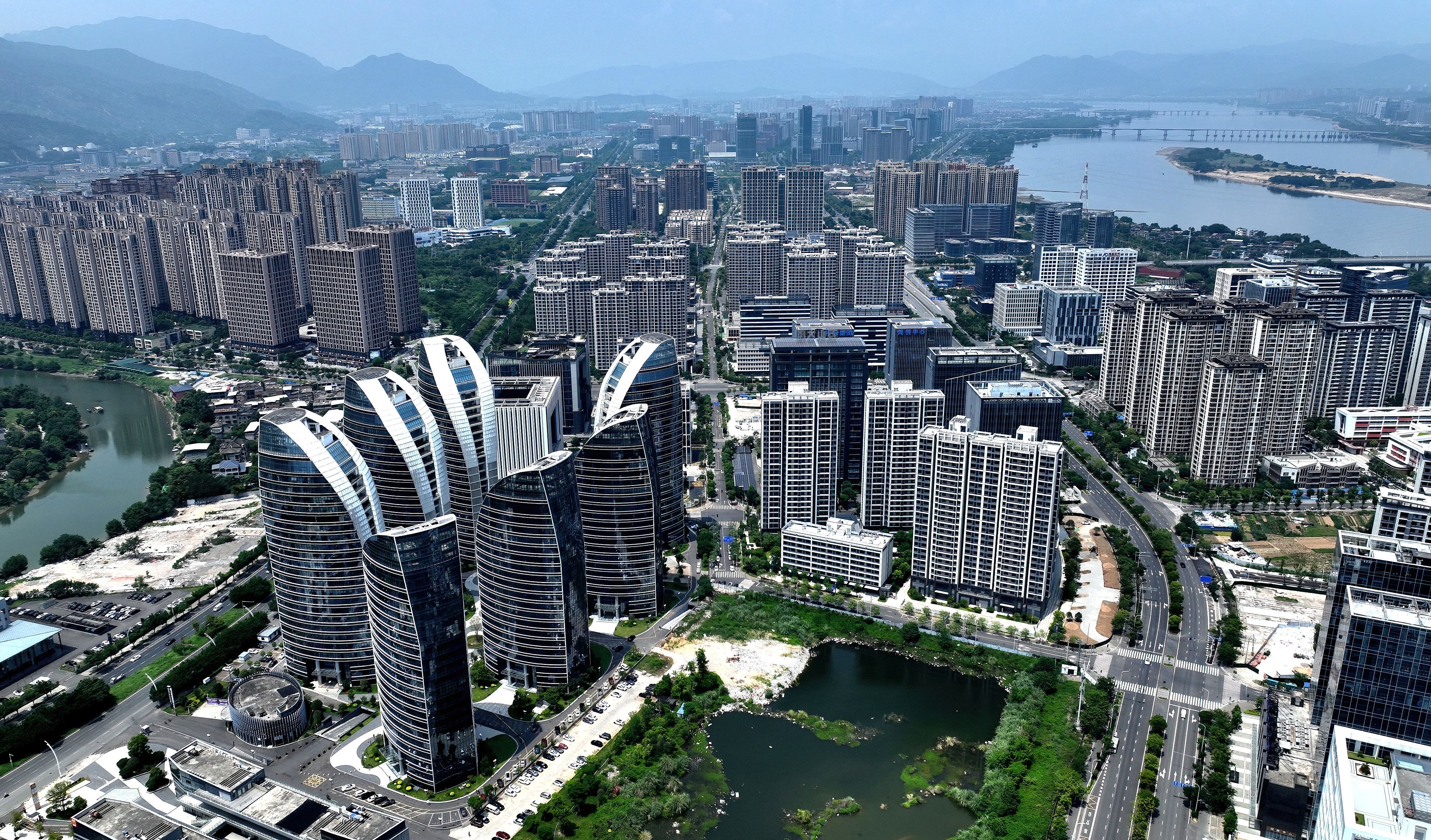
Fuzhou has recently issued a range of policies to stimulate scientific and technological innovation, including encouraging all business sectors to increase R&D investment, and support the transfer and transformation of scientific and technological achievements from universities to practical application.
With the construction of a full-chain support system ranging from original innovation to industrial transformation, the city is forging a "Fuzhou Track" for new quality productive forces, injecting new momentum into building a high-level innovative provincial capital.
Strengthening technological supply
In the past, the global LED industry was monopolized by foreign "phosphor glue technology." In the Fuzhou Hi-tech Industrial Development Zone, a research team led by Hong Maochun, an academician of the Chinese Academy of Sciences and the director of the Mindu Innovation Laboratory, successfully developed ultra-high-power LED phosphor ceramic engineering and LED packaging technologies with complete independent intellectual property rights, after more than two years of research. This led to the launch of the world's first kilowatt-level KCOB light source module, overcoming technical barriers set by the international community in the high-power LED lighting sector.
This new product boasts an extremely long service life — exceeding 50,000 hours without light decay — and costs half that of traditional products. Consequently, it has not only been deployed at Fuzhou's Mawei Port but also successfully entered international markets including Japan, South Korea and the U.S., enabling Chinese light sources to go global.
Established in 2019, the Mindu Innovation Laboratory is one of the first four provincial-level innovation laboratories in Fujian province, jointly built by the Haixi Institute of the Chinese Academy of Sciences and Fuzhou University.
Zheng Fakun, deputy director of the laboratory, said that the lab has set up 18 joint R&D centers with leading enterprises, universities and research institutes, made breakthroughs in more than 80 key technologies, incubated over 30 tech enterprises, and generated an added value of more than 30 billion RMB in the industrial chain.
To promote the development of national-level platforms such as the Mindu Innovation Laboratory, Fuzhou has introduced a series of measures to support the upgrading of high-level scientific research platforms, through a combination of recognition rewards and performance subsidies.
For leading enterprises newly approved to establish national-level scientific research platforms, a municipal incentive of five million RMB will be provided in addition to the provincial incentive of 10 million RMB. For newly recognized municipal-level proof-of-concept centers and public industrial technology R&D service platforms, a one-time incentive of up to 500,000 RMB will be granted.
Building innovation clusters
Currently, Fuzhou is accelerating the growth of strategic emerging industries, proactively planning for future industries, and improving the overall efficiency of its regional sci-tech innovation system.
Meanwhile, to boost its universities' high-quality research outputs to the market, Fuzhou plans to establish a one-billion-RMB sci-tech achievement transformation fund. The fund will offer a maximum subsidy of two million RMB for enterprises who buy sci-tech achievements from universities.
According to the city's measures for increasing R&D investment, for technology-based enterprises that meet annual R&D funding requirements and achieve growth, Fuzhou will provide municipal matching funds of up to three million RMB, on top of provincial incentives (up to six million RMB). Subsidies equivalent to 30 percent of R&D equipment investment will be offered to newly recognized municipal-level innovation consortia, with a ceiling of five million RMB.
This year's Fuzhou Government Work Report calls for all-out efforts to develop the "358X" industrial clusters: "3" refers to three pillar industries, including the modern chemical industry, intelligent vehicles and optoelectronic information; "5" represents five supporting sectors such as textiles and chemical fiber, and machinery manufacturing; "8" stands for eight strategic emerging industries including artificial intelligence and biomedicine.
Central to the city's "358X" industrial clusters, including next-generation information technology, high-end equipment and new materials, the Sci-Tech Innovation Corridor has established 197 distinctive innovation and entrepreneurship carriers such as Boshi Entrepreneurship Park, which accelerates the clustering of emerging industries across various districts, according to Wang Bobin, director of the Fuzhou Municipal Bureau of Science and Technology.