

China's Icebreaker Xuelong 2 Bolsters Sci-tech Exchanges
By WANG Xiaoxia & BI Wenting
China's 42nd Antarctic scientific expedition, using the icebreaker Xuelong 2 (Snow Dragon 2) includes an autumn joint voyage in the Prydz Bay to explore the mysteries of Antarctic ecology and global climate change. The joint voyage consists of international scientists from five other countries, such as India, South Korea and Australia.They have shared their insights with the S&T Daily reporter onboard.
A precious opportunity
"As an oceanographer, I had always wished to board Xuelong 2," said Youngju Lee, a senior researcher from the Korea Polar Research Institute (KOPRI). Lee was aiming to clarify the community structure and biomass of the phytoplankton in the Prydz Bay during the transition from autumn to winter.
Generally, Antarctic scientific research activities are conducted in summer. Conequently, there is a knowledge gap about the ecosystem during the transition from autumn to winter.
Millie Goddard-Dwyer, a researcher from the Institute for Marine and Antarctic Studies at the University of Tasmania, Australia, said this expedition offered a rare opportunity to conduct experiments in autumn, when historically, sampling data is severely insufficient.
Dwyer worked closely with Chinese expedition member Ying Yiping, sharing live samples of the Antarctic krill, which is extremely difficult to catch. She called on young scientists to seek cooperation with countries like China that have advanced platforms.
A collaborative research platform
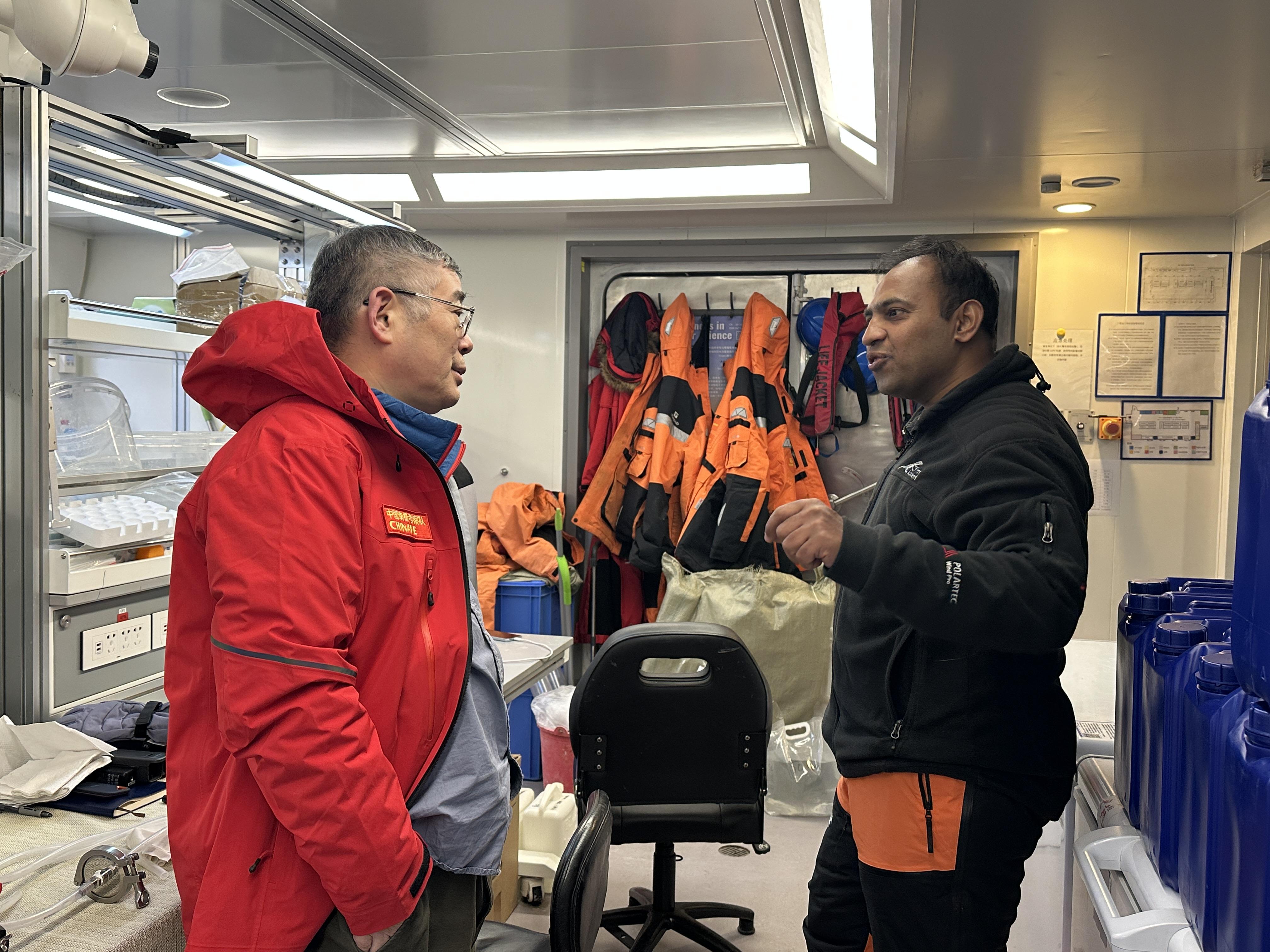
In Xuelong 2's mobile international laboratory, scientists of different nationalities and backgrounds worked in close collaboration, building an efficient "cooperation chain."
Lee said under the guidance of Professor Zhou Meng, chief scientific advisor of the joint voyage, and with the assistance of experts from multiple countries, she successfully observed the large-scale ice algae bloom in the Prydz Bay. Chinese scientists were always ready to help make the research proceed smoothly, she said.
Shramik Maruti Patil, a scientist from the National Centre for Polar and Ocean Research of India, was impressed by the well-prepared Chinese researchers who assisted international participants in sampling and analysis.
Patil praised the open platform established by China, saying it is conducive for scientists from different fields to jointly solve the major scientific problems identified by the Scientific Committee on Antarctic Research. He looks forward to participating in more joint projects, especially expeditions in specific fields such as physical oceanography and the cryosphere.
Benefiting polar governance
International exchanges are crucial for sharing knowledge and deepening understanding of the unique Antarctica region, Dwyer said.
Understanding Antarctica is the foundation for protecting and utilizing it. The continent holds significant strategic importance in global ecological balance, climate regulation and sustainable utilization, said Chen Jianfang, deputy leader of the expedition and chief scientist of the joint voyage.
The joint voyage provided a platform for in-depth exchanges among researchers from various countries. It reflects China's effort to build an open, inclusive and mutually beneficial polar scientific research environment, and practice the concept of a community with a shared future for mankind, Chen added.