
Building Smart Shield Against Natural Disasters —— China-Pakistan Belt and Road Joint Laboratory on Smart Disaster Prevention of Major Infrastructures
When the worst earthquake in Pakistan's history occurred, Syed Shah was only in third grade. But the memory remains indelibly etched in his mind. "The earth was roaring, the sky spinning, walls cracking, and buildings collapsing. I could hear nothing but crying. I was terrified."
The powerful 7.8-magnitude earthquake struck northern Pakistan on October 8, 2005. The disaster claimed approximately 73,000 lives and caused the collapse of over 600,000 homes across the country.
The earthquake also altered the life trajectory of Khan Shahzada, then a junior engineer at the Pakistan Water and Power Development Authority, working alongside Chinese contractors. "Witnessing the tragic aftermath of the earthquake firsthand prompted me to shift my career focus toward earthquake engineering," Shahzada, now a professor at the University of Engineering and Technology, Peshawar, said.
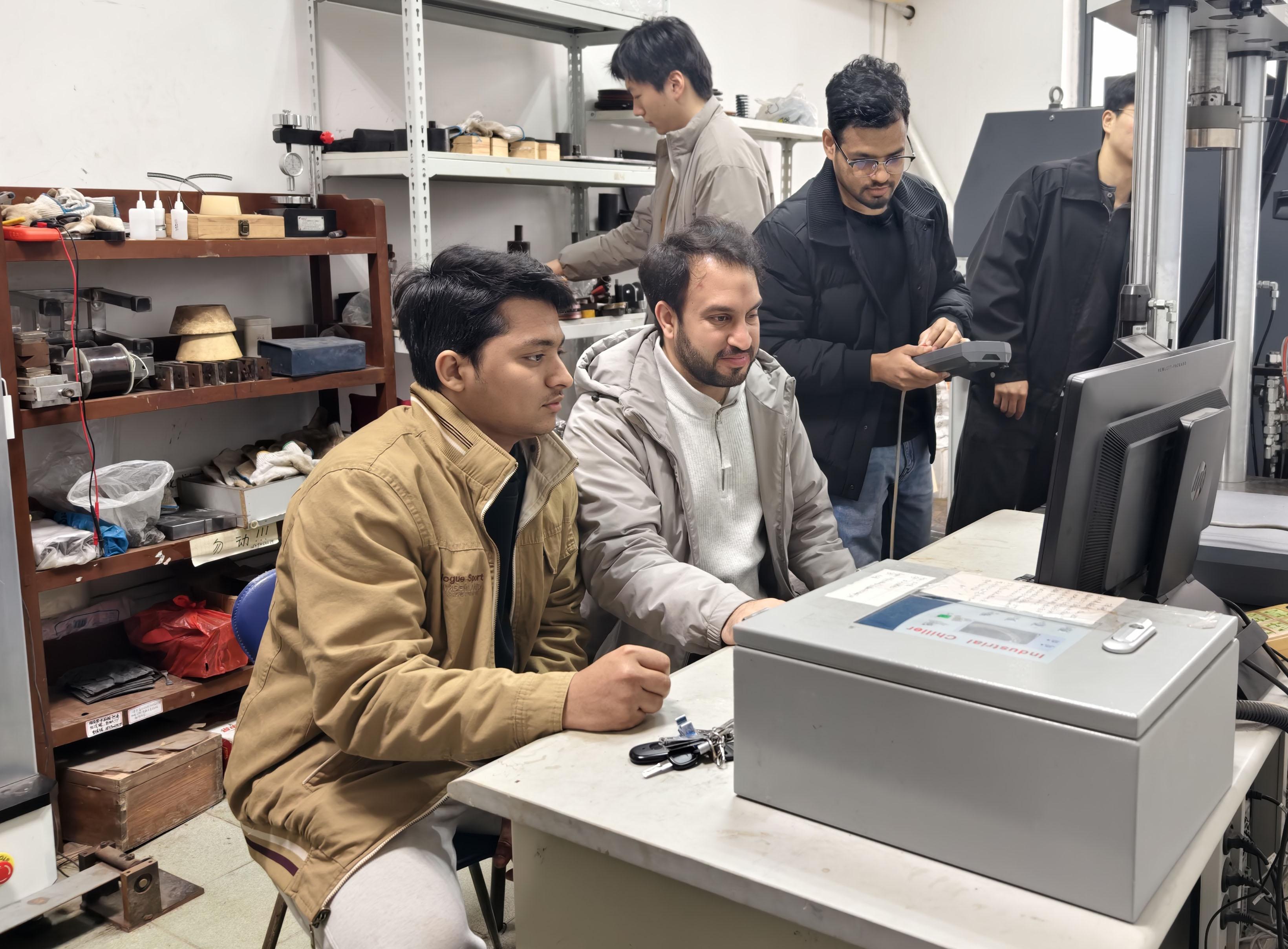
Today, their life trajectories have converged at the China-Pakistan Belt and Road Joint Laboratory on Smart Disaster Prevention of Major Infrastructures. Some are pursuing their studies here, while others are conducting research.
Tackling shared needs
"The intention behind establishing the joint lab was to better address natural disasters like earthquakes that both China and Pakistan face," said Professor Xu Zhaodong of Southeast University. Both countries are located on the Eurasian Seismic Belt, which accounts for approximately 15 percent of the world's earthquakes.
A report released in 2023 shows that since 2001, earthquakes have become the deadliest type of natural disaster for Belt and Road Initiative (BRI) partner countries.
"A significant number of BRI partner countries are located in seismically active zones or regions prone to typhoons, while incidents such as fires also occur periodically. According to available estimates, the cumulative annual economic losses resulting from such disasters across these countries over the past two decades have exceeded one trillion RMB," Khan Muhammad, counsellor for scientific and technological affairs, Embassy of Pakistan in China, said.
"The destruction of major infrastructure under the impact of multiple hazards, such as earthquakes and storms, is the direct cause of immense economic loss and casualties," Xu said.
Xu pointed out that the field of disaster prevention and mitigation for major infrastructure currently faces several urgent challenges: limited understanding of cascading multi-disaster mechanisms, lack of advanced big data-driven monitoring systems, and constraints in effective emergency response.
"Faced with shared needs of disaster prevention and mitigation, it is only natural for China and Pakistan to establish a cooperation platform," Muhammad said. He added that the joint lab was founded against this backdrop, with the goal of enhancing disaster management capabilities through sci-tech innovation and knowledge sharing.
Consolidating the foundation of cooperation
As early as 2014, the two sides conducted joint research on viscoelastic damping and resilience enhancement technology for post-earthquake structures, and completed Pakistan's first viscoelastic civil damping project at Vison High School.
"These early collaborations laid a solid foundation for the expansion of partner institutions and ongoing academic and technical exchanges between the two sides," Muhammad said.
"Since the establishment of the joint lab, the two sides have developed a regular exchange mechanism, leading to deeper cooperation in areas such as joint R&D, talent cultivation, standard formulation, and the promotion of applicable technologies," Chen Zhongfan, professor of Southeast University, said.
"The joint lab provides world-class facilities and cutting-edge technologies, helping us move toward a higher level of smart disaster prevention," Shahzada said. Through this platform, he secured an open fund project and is currently developing a construction guideline for stone masonry structures in Pakistan.
"Looking ahead, we plan to further promote the localization and implementation of Chinese technical standards, jointly formulate standards for seismic resistance, flood control, and smart monitoring, and facilitate the pilot application of Chinese technologies in major projects in Pakistan," Xu said.
Planting friendship trees
In September 2023, during the Chinese team's visit to Pakistan, both sides jointly planted three saplings on the campus of the International Islamic University in Islamabad.
"Today, the saplings we planted have grown, just as the fruits of our cooperation continue to multiply," Chen said. "By the time we see these 'friendship trees' again, our collaboration will have reached a new height."
The joint lab is cultivating more interdisciplinary technical talent in the field of smart disaster prevention for the two sides.
"As the host institution of the joint lab, we use smart disaster prevention as an entry point to deeply integrate civil disaster prevention and mitigation with multiple disciplines such as AI, big data, and information management," said Guo Tong, head of the School of Civil Engineering at Southeast University. "This provides the joint lab with a cutting-edge interdisciplinary theoretical and technical environment, as well as comprehensive support for talent cultivation."
Shah, a survivor of the earthquake 20 years ago, is studying smart disaster prevention technology at Southeast University. "After completing my master's degree this year, I plan to pursue my PhD here," Shah said. "In the future, I hope to apply the knowledge I have gained here in disaster prevention and mitigation efforts in my hometown."