Sci-tech Labs Promote Global Development Initiative
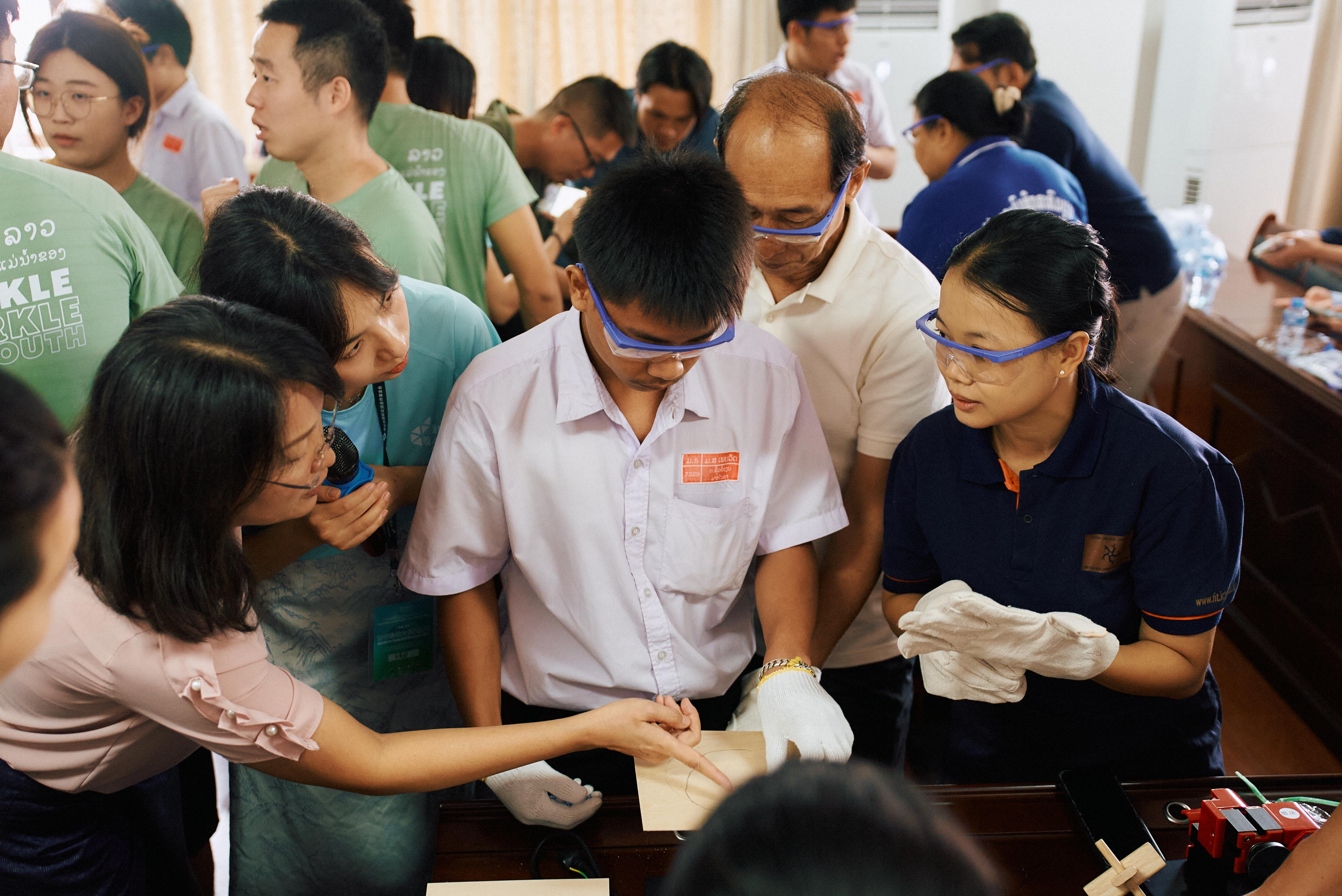
As this year marks the fifth anniversary of the Global Development Initiative (GDI), China's efforts to support education cooperation are gaining momentum. From woodworking equipment to 3D printers and robotic dogs, Chinese enterprises have donated teaching materials for science and technology labs to schools in Laos, Papua New Guinea, Malaysia, and a university in Togo, sparking local students' interest in exploring science and technology.
Shenzhen Foundation for International Exchange and Cooperation, which coordinates the donations and recipients, initiated this sci-tech lab donation project in 2024. Science and Technology Daily recently spoke with Li Dan, executive secretary general of the foundation.
In July 2024, the foundation delivered the first batch of teaching materials, including woodworking tools to the China-aided Phiawath Complete Secondary School in the Lao capital Vientiane.
Why woodworking equipment?
Li said the foundation visited Southeast Asian countries before the donation and went to the school. After talking with the headmaster and teachers, the foundation found that the school needed woodworking tools and machinery, such as saws, planes, and drills, for cutting, planing, and shaping wood. Therefore, the foundation decided to deliver woodworking equipment to help enhance students' operational capability via handwork.
Feedback from the school said the students use the equipment extensively and the interaction in class is also good. Li said the foundation assesses the needs of the recipient organizations to ensure the donated goods meet those needs.
Donations also include high-tech equipment like 3D printers to prepare students for the future. "Education is about the future. It takes 10 years to grow trees, but a hundred years to cultivate people. We wish to start with the younger generation, fostering their scientific and technological thinking so they can better prepare for the future," Li said.
The foundation also organizes demonstration courses to help teachers and students use the donated equipment, combining theoretical explanations with hands-on operation.
For Université de Lomé in Togo, a French-speaking state, which received donated robots, 3D printers and subtractive equipment, the foundation asked the donor to make demonstration videos and added French subtitles so that the teachers and students could understand the videos.
The foundation also added a prefabricated modular classroom to serve as a sci-tech lab for each of the two programs in Malaysia and Togo. With a shorter construction cycle and reduced resource waste, this type of prefabricated modular classroom employs high-efficiency and eco-friendly materials to lower both building energy consumption and the carbon footprint of transportation. Renewable resource facilities like photovoltaic panels further decrease carbon emissions and reliance on traditional energy.
"Our approach to this project is not only to ensure its successful completion on the ground, but also to make it a sustainable process that truly empowers local people with the skills to help themselves," Li said.
The foundation invited the headmaster of Phiawath Secondary School to visit Shenzhen and the school signed a friendly cooperation agreement with Shenzhen Hongling Middle School.
The donors in this project also share the philosophy that public welfare assistance is not merely a one-off donation of items. When teachers and students at SJKC Nan Kai in Kuala Lumpur, encountered problems while using the robots, the donor offered technical support.
It is worth noting that all donations came from enterprises, and most of them are in Shenzhen. The city has a large cluster of tech enterprises and abundant tech products, which can provide strong support for improving people's livelihoods. "I've summarized this model of donation as 'sourced from the public and used for the benefit of the public,'" Li said.
Although there are challenges while implementing the sci-tech lab project, Li is proud to be able to mobilize private-sector resources to promote people-to-people bonds within the framework of GDI through small but meaningful projects that benefit people.
The projects in Laos and Papua New Guinea have been included in the Achievements Pool of the Global Development Project Pool maintained by China International Development Cooperation Agency, while the projects in Malaysia and Togo have been included in the Incubation Pool.
Li said the next step is to launch initiatives in Thailand and the United Arab Emirates, continuing to promote the development of science and technology education within the GDI framework.