

ICBS 2026 Announces Inaugural Medal Winners
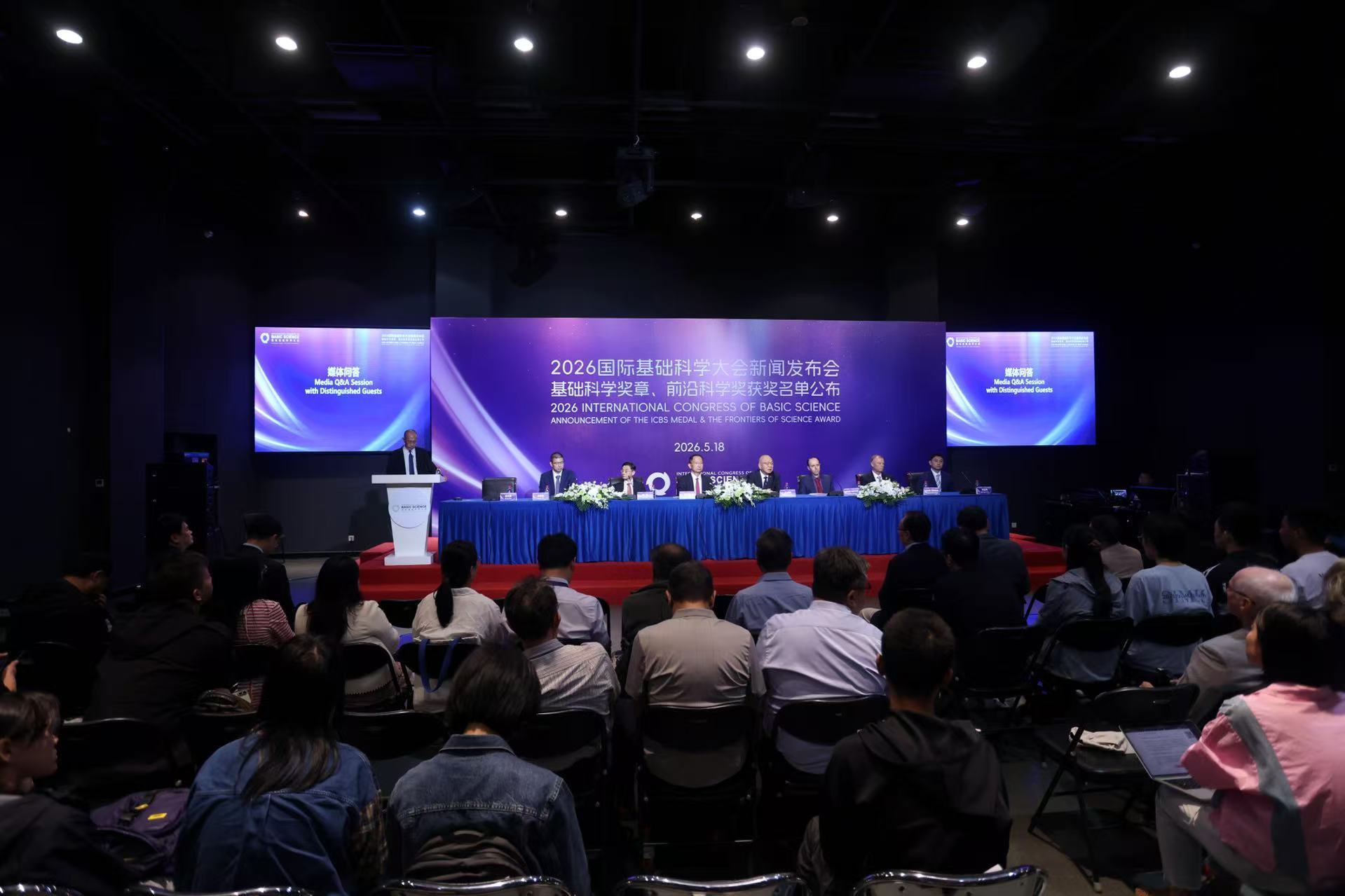
It was a significant moment for basic science on May 18 when the 2026 International Congress of Basic Science (ICBS) announced the inaugural ICBS Medal and the Frontiers of Science Award winners at Tsinghua University.
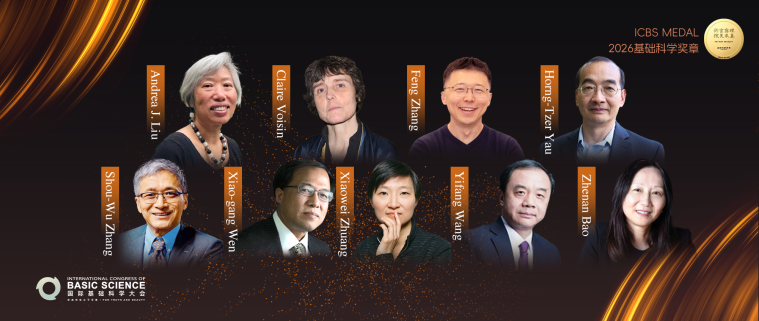
Nine distinguished scientists from around the world received the ICBS Medal: Claire Voisin, Horng-Tzer Yau, and Shou-Wu Zhang in mathematics; Andrea J. Liu, Yifang Wang, and Xiao-Gang Wen in physics; and Zhenan Bao, Xiaowei Zhuang, and Feng Zhang in engineering.
In addition, 118 high-impact papers were honored with the Frontiers of Science Award, highlighting breakthrough achievements and the dynamic growth of global basic science research.
The ICBS Medal, instituted this year, honors scientists who have achieved revolutionary, groundbreaking results in basic science and made exceptional contributions to scientific progress. The award covers mathematics, physics, and engineering, with three medals in each field named after nine science giants: Emmy Noether, Shiing-Shen Chern, and Andrew Wiles (mathematics); Marie Curie, Samuel C.C. Ting, and David Gross (physics); and Chien-Shiung Wu, Steven Chu, and Charles K. Kao (engineering).
ICBS president Shing-Tung Yau, Fields Medalist and Tsinghua professor Caucher Birkar, Cao Jun, director of the Institute of High Energy Physics under the Chinese Academy of Sciences, and Huajian Gao, dean of the Institute of Cross-Disciplinary Engineering Sciences at Tsinghua and also a member of the U.S. National Academy of Engineering, gave their insights into the laureates' pioneering contributions.
Yau explained the motivation for establishing the ICBS Medal: “In previous years, we presented lifetime achievement awards to the world’s greatest scientists, who were older because we needed to assess at least 30 years of impact. Now, we are honoring younger scientists whose influence has been clear for at least a decade.”
The nine laureates honored this year are relatively younger but their impact, Yau said, is “unmistakably far-reaching.” “We hope to inspire many young scholars—not only in China but around the world—to learn from these medalists,” he added, hoping it would encourage Chinese mathematicians, physicists, and engineers.
Notably, one medal in each field is named after a renowned woman scientist. This year, four women—Claire Voisin, Andrea J. Liu, Zhenan Bao, and Xiaowei Zhuang—received the medals, demonstrating the outstanding strength of women in basic science and the scientific community’s high respect for women researchers.
Commenting on this, Nicolai Reshetikhin, a mathematical physicist and professor at Tsinghua University, said: “It’s really important to recognize the role of women in science because we have a diverse society, we have diverse power in our world. It used to be … confined to small countries; now it’s the whole world, and the same with the society itself.”
To ensure the authority and fairness of the selection process, the ICBS organizing committee invited scholars who have made significant contributions to scientific development worldwide to participate in the nomination and review. The 2026 nomination and review panels included leading scholars from dozens of countries and regions, such as China, the United States, the United Kingdom, France, Germany, Japan, and Switzerland.
Many are members of national academies of sciences or recipients of top international awards like the Fields Medal, Turing Award, and Wolf Prize, reflecting the congress’s commitment to academic rigor and international credibility.
Gao Huajian said: “Today, technology is advancing rapidly, and people place great value on applications and commercial benefits. Science does bring considerable commercial returns.” The ICBS plays an “irreplaceable role” in highlighting the long-term value of basic science: “By bringing mathematics, physics, and engineering together, it helps underline the deep and intimate connections among these three fields.”
Gao also said technological development is built upon the long-term accumulation of basic science. Many transformative technologies today, such as artificial intelligence, quantum technology, biotechnology, and drug discovery, are grounded in decades of foundational work in mathematics, physics, engineering, and chemistry.
“Thus, I think we need to send a message to society today: we must embrace a long-term scientific spirit. While valuing technological development and commercial benefits, we must also value basic research, tolerate long-term exploration, and promote cross-disciplinary integration,” he remarked.