

From Earth to Space: China-Pakistan Ties Expand
As China and Pakistan celebrate the 75th anniversary of their diplomatic relations this year, bilateral sci-tech cooperation is reaching new heights, with a Pakistani astronaut scheduled to join a mission to China's space station.
The two countries have made substantial achievements in sci-tech cooperation under various mechanisms, especially the China-Pakistan Economic Corridor, a flagship project under the Belt and Road Initiative.
Space cooperation reaches new heights
Aerospace is a key area for sci-tech cooperation. At a recent press conference, it was announced that two Pakistani astronauts are participating in training with Chinese taikonauts, and one of them will undertake a short-term mission to China's space station as a payload specialist.
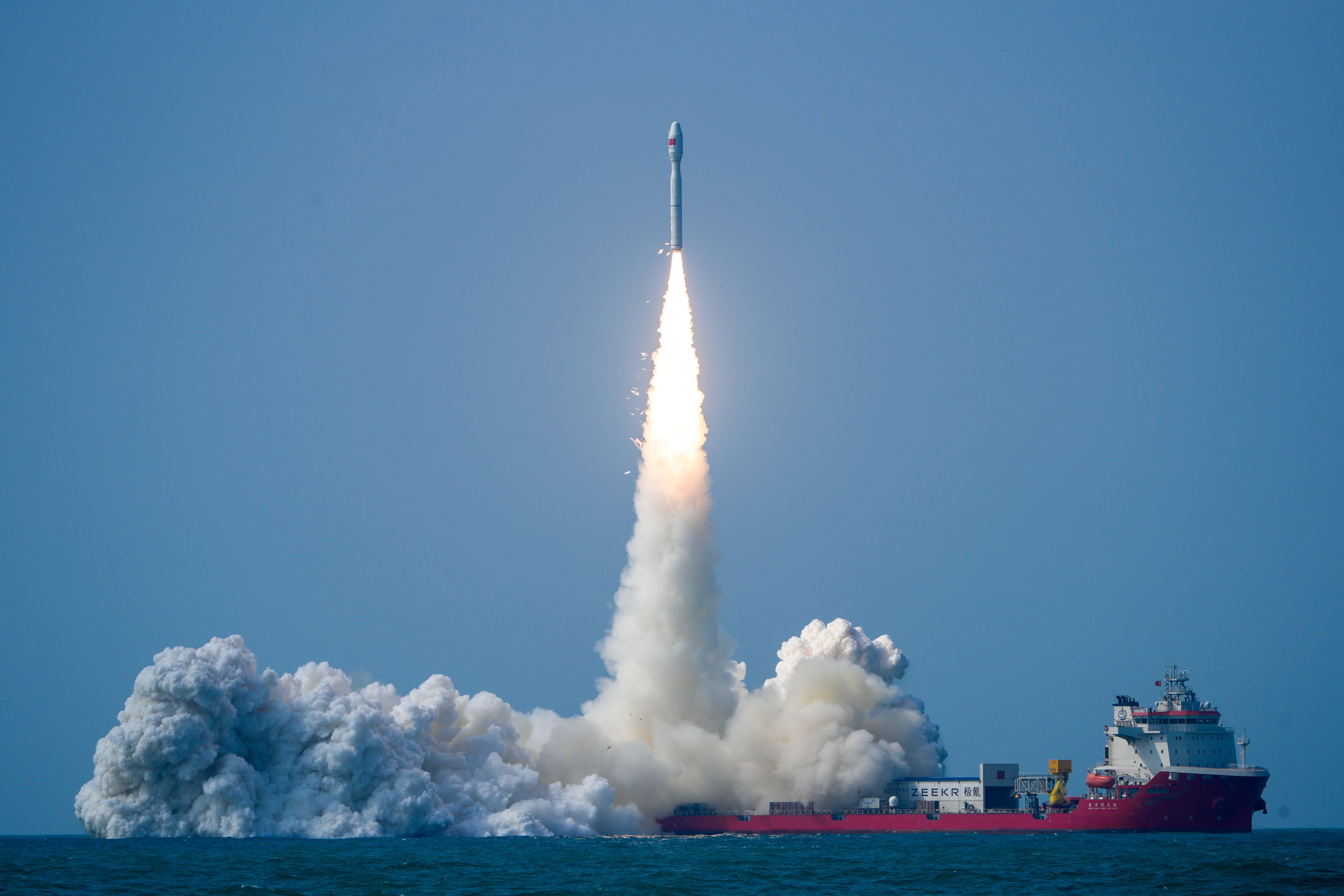
One month ago, China launched a Pakistani satellite, PRSC-EO3, from the Taiyuan Satellite Launch Center in northern Shanxi province. The launch marked the third mission supporting the PRSC-EO satellite constellation.
The latest developments are part of a long-standing partnership in space. Pakistan's first satellite Badr-1 was launched via China's Long March 2E rocket in 1990.
In 2023, Pakistan joined the International Lunar Research Station project initiated by China. In 2024, the Pakistani satellite ICUBE-Q, jointly developed by Pakistan's Institute of Space Technology and China's Shanghai Jiao Tong University, was launched into space as part of the Chang'e-6 mission and successfully captured images of the moon, marking Pakistan's first lunar exploration mission.
Cooperation benefits communities on ground
While space cooperation often attracts the most public attention, bilateral sci-tech collaboration has also delivered tangible benefits on the ground, particularly in disaster prevention and mitigation.
Developed by China Meteorological Administration (CMA), the "MAZU" early warning system, a cloud-based meteorological system designed to help countries better broadcast extreme weather, is deployed in Pakistan.
To cope with specific meteorological disasters such as glacial lake outburst floods, monsoon surges and torrential rains in Pakistan, the CMA and relevant departments in Pakistan jointly developed a customized version of the system.
Another example of growing cooperation on the ground is the China-Pakistan Joint Research Center on Earth Sciences (CPJRC), jointly established by the Chinese Academy of Sciences and Pakistan's Higher Education Commission in 2023.
The CPJRC focuses on such areas as natural disasters, ecological environment, resource development and sustainable development.
Its researchers proposed a digital platform to share disaster-related open data in a fully digital format, so as to enhance data accessibility and lower economic and technical barriers, providing a replicable model of data aggregation, open sharing, rapid response, and research promotion for underdeveloped regions.
New opportunities for broader cooperation
The achievements in both space exploration and disaster management have created new opportunities for broader cooperation in emerging fields.
During Pakistani Prime Minister Shehbaz Sharif's visit to China from May 23 to 26, the two countries issued a joint statement, agreeing to tap into the potential for cooperation. The areas include energy, digital economy, scientific and technological innovation, artificial intelligence, and information and communication.
They also agreed to scale up personnel training, advance trade liberalization, and jointly safeguard the stability and security of industrial and supply chains.
Cooperation in areas ranging from space exploration and Earth sciences to artificial intelligence and the digital economy will continue to expand in the future.