
Finding an 'Innovation Oasis' for Fundamental Physics
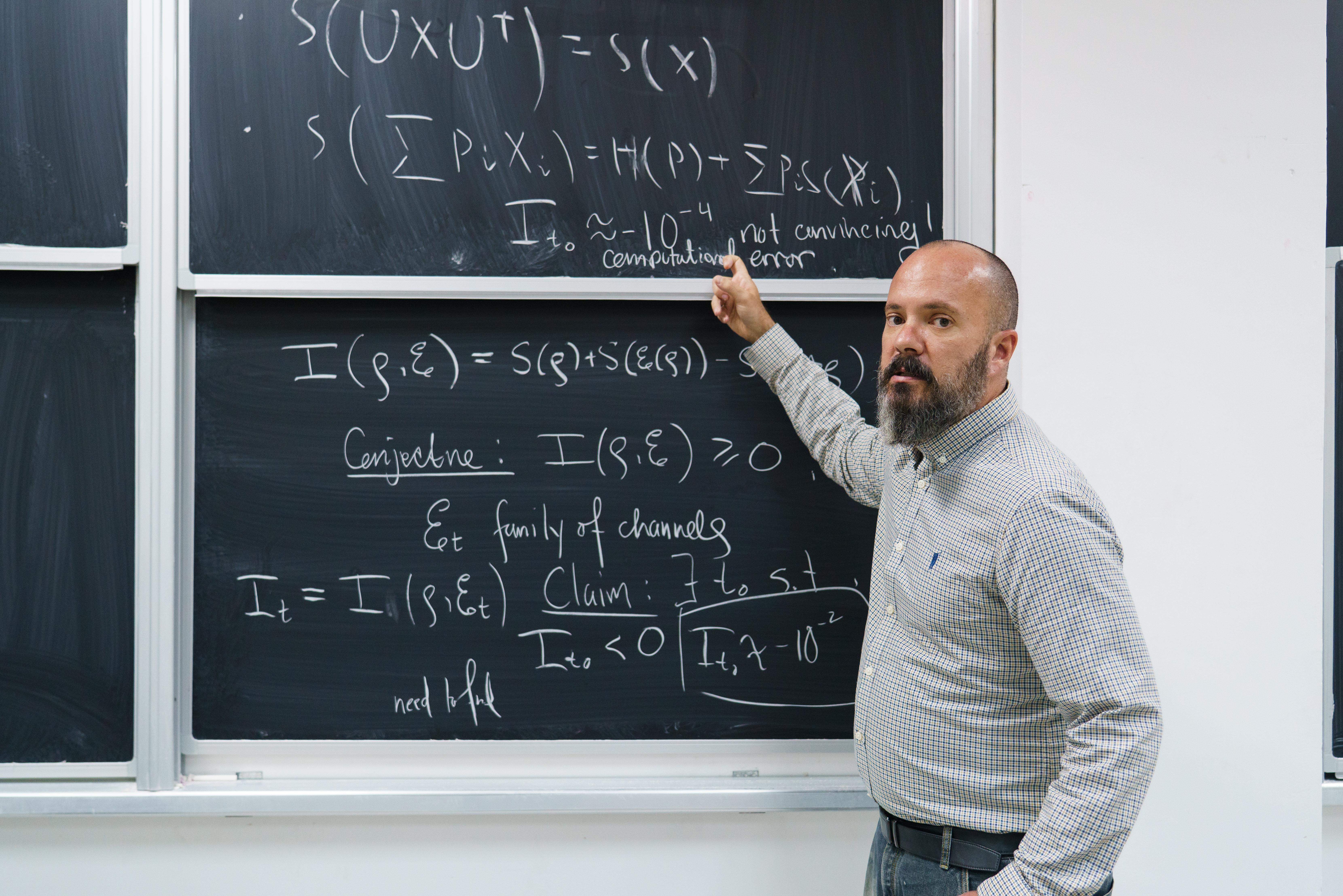
James Fullwood first came to China nearly 14 years ago. As a PhD student he collaborated with Fields Medalist Shing-Tung Yau on the geometry of string theory, and then took a postdoctoral position at The University of Hong Kong under Chinese Academician Ngaiming Mok. But it was a 2020 visit to Hainan University in south China that sealed his destiny. "I am originally from Miami, Florida, and I immediately felt at home with (provincial capital) Haikou's blue skies, clean air and tropical climate." In April 2024, he joined the faculty of the School of Mathematics and Statistics, finding an idyllic atmosphere for his research on fundamental physics.
Landing on a familiar shore
“I am very satisfied with my decision,”Fullwood says.“I have an idyllic atmosphere in which to carry out my research on fundamental physics, and the university has been very supportive of my academic endeavors every step of the way.”
His move also reflects a broader conviction about where science is headed. He watched funding for fundamental research and education shrink year after year in the United States, while China continues to invest.“Apart from a few top-tier institutions, I do not think the U.S. is an ideal place to carry out fundamental research.”
At Hainan University, he found a system built on trust.“The thing that I enjoy most is the autonomy I have in conducting research projects. As long as I continue to publish in top-tier journals at a consistent rate and acquire funding, I have the freedom to explore wherever it is that my mind takes me.”
The academic staff, he adds, is always helpful and accommodating, which he sees as crucial for a foreigner in China.
Teaching has grown into a two-way street of cultural discovery. While his students polish their academic English and absorb international teaching styles, Fullwood learns from their disciplined problem-solving and fresh perspectives on mathematics.“My classroom serves as a vibrant laboratory for cross-cultural integration. I am constantly learning.”
The small moments matter: a student explaining a local custom during a break, a colleague sharing insight into the local academic landscape. “This ongoing dialogue has built a bridge of mutual respect and shared purpose, proving that fundamental science is a universal language that transcends all borders.”
Beyond spacetime
Fullwood's research is driven by the "It from Qubit" paradigm, the foundational concept in theoretical physics proposing that all physical reality—matter, energy, space, and time—is not made of fundamental, solid "stuff," but emerges from the processing of quantum information.
"Spacetime is like the screen of your phone, an interface for completing tasks such as sending a text message. However, what's really happening takes place inside the transistors and micro-chips on the motherboard of the phone, which is the analog of the quantum realm." Two icons may sit at a certain distance on the screen, but inside the motherboard, there is no such distance. "And so it is with space and time. At the quantum level there is only information: It from qubit."
A central challenge over the past five years has been to fix a deep asymmetry in standard quantum theory. Space and time are treated differently: Spatial correlations are encoded in quantum states, but temporal correlations are handled case by case without such states. "This is a fundamental asymmetry which is at odds with the fundamental premise of relativity, which treats space and time on equal footing."
He and his collaborators derived what a "temporal quantum state" must be from simple mathematical assumptions, much as Einstein derived Special Relativity from the constancy of the speed of light and the equivalence of inertial frames. The work has shed new light on time-reversal symmetry, quasi-probability, quantum Bayesian inference, and state collapse upon measurement, and was published in Physical Review Letters.
Asked about breakthrough moments, Fullwood is measured. "Progress in science is often slow, and comes in little bits and pieces. Over time those bits and pieces come together and start to form something substantial." And there is a paradox he lives with: The more he knows, the more he knows he doesn't know. Still, the gradual deepening of understanding makes the effort worthwhile.
An open, free trade port
Island-wide special customs operations and free trade port policies have reshaped the logistics of scientific exchange in Hainan. Fullwood points to the 30-day visa-free policy. "This 'zero-friction' mobility is a significant competitive advantage for international cooperation. By removing the administrative burden of embassy and consulate visits, we can invite world-class collaborators and speakers with the same ease as arranging a domestic visit." Smoother channels for importing research equipment add to the effect, turning Hainan into what he calls an "innovation oasis."
To friends back home, he describes Hainan as a "tropical Silicon Valley," with Hainan University as the academic heart of the transformation. He tells them about the blend of cutting-edge research and the vibrant, welcoming environment. For international talents considering a move, his advice is straightforward. "Arrive with a spirit of radical openness and curiosity." The university's support, he says, is designed to let scholars focus on research and teaching. "By being patient and adaptable, you will find a remarkably hospitable environment that is eager to integrate global expertise into its ambitious vision for the future."
His own expectations are simple. Asked for three words that capture Hainan University and the Hainan Free Trade Port for him, he says: "Opportunity. Vision. Support." Then he adds a fourth – “Bright.” That’s the future of Hainan University.