

'The Speed of Validation in China Is Immensely Productive'
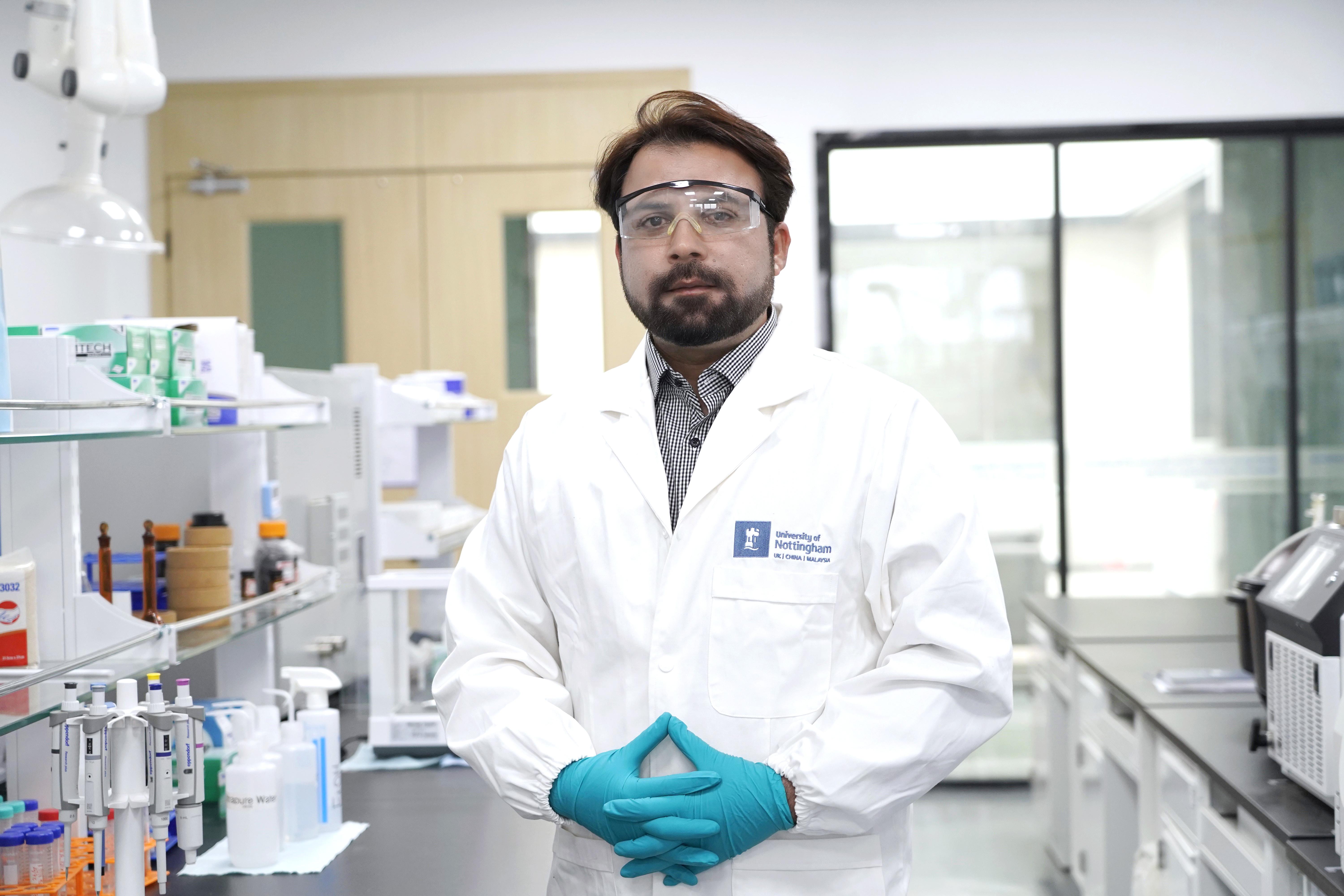
That is how Dr Imran Mahmood Khan, assistant professor in smart food at the University of Nottingham Ningbo China (UNNC), sums up what surprised him most about working in China's research ecosystem: “The speed of validation in China drives immense productivity.” His team develops test strips that detect mold toxins in grain. They also design nanomaterials that kill bacteria with heat, and materials that could be used for cancer therapy. The applications vary, butthe underlying principle does not.
One principle, many battlefields
Khan considers his most impactful achievement to be the translation of functional nanomaterials into practical, userfriendly food safety tools. His team has developed a strip-based point-of-care testing (POCT) device that detects aflatoxin B1 and citrinin in cereals and feed samples with the naked eye – no lab equipment required. "We took sophisticatedaptamer recognition and squeezed it onto a paper strip that costs pennies," he says. "That is the real victory – making high-tech invisible to the end-user."But his lab does not stop at detection. They have also created nanocompositesthat bind tobacteria and inactivate them under near-infrared light. "If you can recognize a target, you can either report it or attack it. We chose to do both."Looking ahead, he predicts greater convergence between food safety and biomedical technologies – intelligent food packaging with built-in antimicrobial activity, portable devices that both detect contaminants and treat them, andtheranostic materials that identify hazards and neutralize them in one go.
Publish or perish? Solve or serve
Khan supervises a culturally diverse team at UNNC, with members from Pakistan, China, India, Italy, and beyond. He sees this diversity as a strength, bringing together different perspectives on materials, food science, engineering, and real-world applications. "A culturally diverse team offers a multiplicity of perspectives," he remarks. "Some focus on materials, others on food science, engineering, or application scenarios. Such collaboration often sparks novel ideas."
His mentoring style encourages open discussion and respect for varied communication styles, while keeping the team united around clear objectives and rigorous data standards.
When it comes to the pressure young researchers face between publishing papers and solving real problems, his advice is blunt. "I tell my students three things," he says. "Research questions must originate from real-world needs; data must be reproducible; and publications represent only one form of scientific output. High-quality research does not chase trends or high metrics alone; it strives to make complex technologies simple, robust, and cost-effective, ultimately enabling end-user adoption."
Speed that surprises
Having moved from Pakistan to China for his postdoctoral training and now serving as faculty, Khan has witnessed first-hand the transformation of China's scientific landscape. What surprises him most is not the funding or the gleaming instruments – though those are impressive – but what he calls the speed of validation.
"In some countries, industry-academia collaboration means a yearly meeting and a report," he says. "Here, companies want to test your sensor in their production line within months. They provide real samples, real operators, and real complaints about cost and stability. That pressure is uncomfortable but immensely productive."
He attributes China's scientific progress to sustained investment, talent cultivation, major research infrastructure, and strong application-driven demand: "China's large market, complete industrial chain, and abundant real-world problem scenarios motivate researchers to test ideas in practical environments more quickly thereby fostering interdisciplinary collaboration across materials science, engineering, food science, and medicine."
Platforms and the last mile
He singles out China's large-scale interdisciplinary platforms and industry-academia collaboration models as especially effective. "For applied fields such as smart food systems and biosensing, a single laboratory cannot independently address materials, instrumentation, sample handling, algorithm development, and standard validation," he explains. "Large platforms connect these components, while industrial partners help assess whether technology is truly usable, durable, and scalable for production."
He has noticed a shift in research evaluation over the years, with growing emphasis on quality, impact, and practical value, alongside more open and shared lab facilities. That has changed his own approach: "I now consider not only novel materials and high sensitivity, but also sample pretreatment, stability, cost, batch fabrication, and compatibility with existing standards at an earlier stage."
That said, he sees room for improvement – stronger long-term support for fundamental research, more standardized validation systems, and earlier industry involvement. "Design with real samples, real operators, and real costs in mind," he says.
Regarding international collaboration, he reflects that sharing platforms, samples, and application scenarios offers huge opportunities, but communication costs, evaluation differences, and intellectual property norms remain challenges.
He mentions a China-Pakistan project on mycotoxin testing as a case in point: "Our cross-border team applied a strip-based POCT device to address a common challenge – rapid, onsite mycotoxin screening in cereals – delivering a practical, verifiable solution for food safety surveillance."