

Investing in Sci-tech Manpower Brings Big Returns
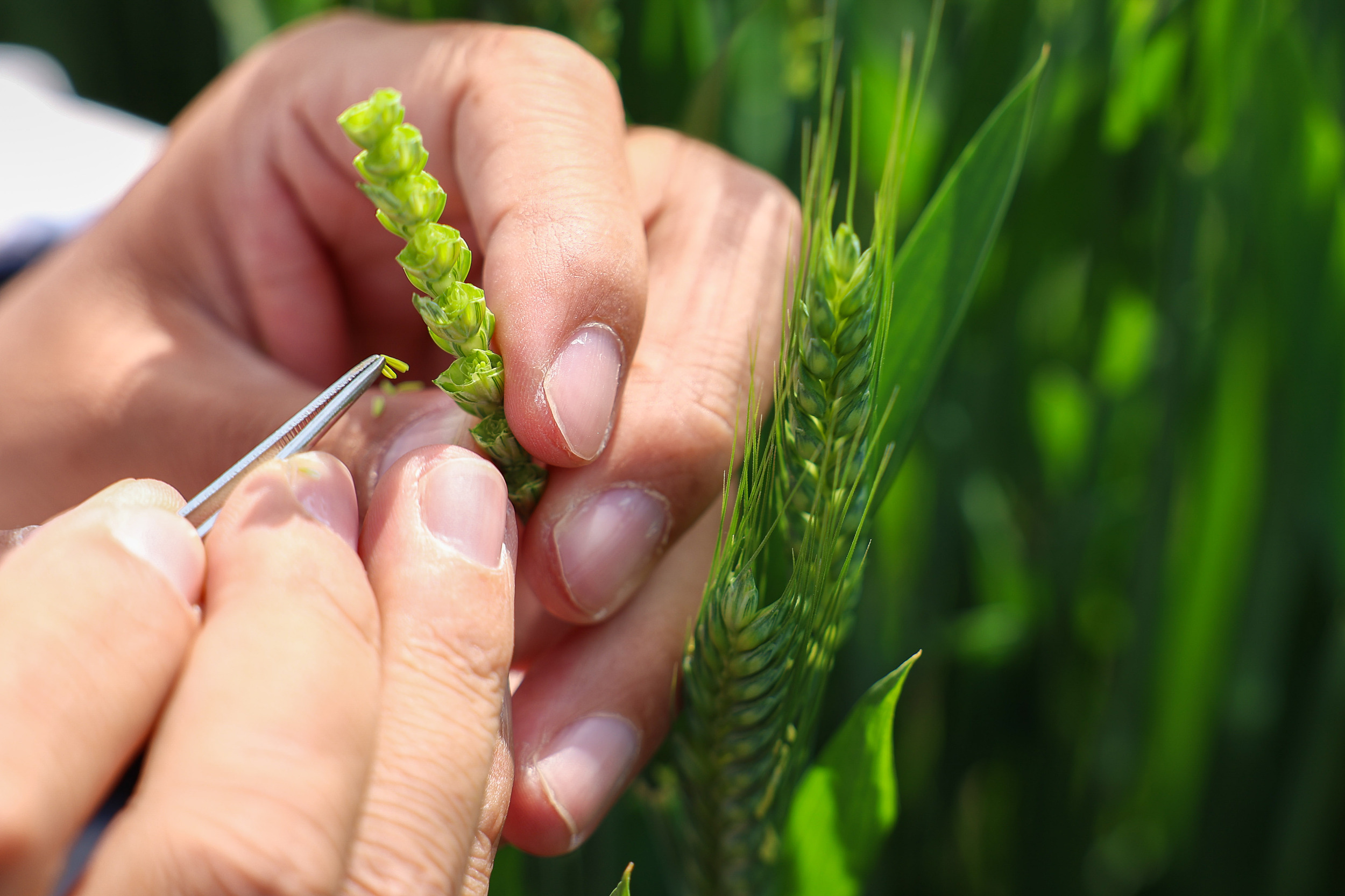
Scientists demale wheat at the wheat breeding test field in Xiangyang, Hubei province, April 10, 2023. (PHOTO: VCG)
By Staff Reporters
China ranks first worldwide in the number of full-time equivalent research and development (R&D) personnel. This was confirmed by a report from the Ministry of Science and Technology released on December 15. Published every two years, the report summarizes the latest developments of the country's sci-tech personnel.
As a common international index used to compare scientific and technological manpower input, the number of full-time equivalent R&D personnel in China has increased from 3.25 million in 2012 to 6.35 million in 2022, the report said.
It added that the international academic influence of China's top sci-tech experts has continued to grow, and the number of Chinese scientists added to the global list of highly cited researchers had increased from 111 in 2014, to 1,169 in 2022, ranking second globally.
Contribution to world-class science
According to Nature Index following an upward trajectory of scientific productivity that has been gathering steam for decades, China has reached a new milestone. In 2022, for the first time, the country had the highest share score in Nature Index for the natural sciences, surpassing the U. S.
This is not the first time that China has been assessed as the leader on measures of scientific productivity. In 2017, it overtook the U.S. in the total number of scientific publications, according to the US National Science Foundation (NSF). And in 2022, Japan's National Institute of Science and Technology Policy reported that China had surpassed the U.S. in a key metric that aims to estimate performance in high-quality science: the contribution to papers that rank in the top one percent most-cited publications.
Hamish Coates, a higher-education researcher at Tsinghua University in Beijing, said the past seven years of China's journey towards becoming a scientific superpower have highlighted the "strength of its innovation ecosystem." Chinese research remains under-valued, said Coates, adding that in Western universities, there are many people who have had passing or superficial engagements with higher education in China or Asia more generally, and have yet to grasp the transformations in play.
Effort and resources drive sci-tech industry
As Nature Index reported, the effort and resources behind Chinese science are immense. China's shift towards addressing urgent environmental challenges, such as air and water pollution, green-energy transition and biodiversity loss, has been a major win for researchers. In 2022, China surpassed the U.S. as the leading nation in the earth and environmental sciences (E&E) according to Nature Index, owing, in no small part, to the funding and resources the country has poured into fields including the atmospheric sciences, geology and materials science.
When it comes to China's dominance in E&E research, increased funding is only part of the story. Greater numbers of Chinese scientists returning from training abroad have helped uplift the sci-tech sector. Nature Index says China's percentage increase in E&E between 2015 and 2022 was the highest among its rise in the four natural-sciences subject areas covered by the database. The country's share in E&E in 2022 was more than six times that of the UK.