

Deep Sea, Hot Data: China's Cool Fix
As people immerse themselves in the convenience of AI in 2026, the data centers powering it are nearly "overheating." The ultimate bottleneck in computing power is energy. Traditional facilities spend about 40 percent of their electricity consumption just running air conditioning to cool the servers.
To tackle this challenge, China has devised a bold solution: sinking data centers into the sea. Recently, the world's first commercial underwater data center powered by an offshore wind farm began operation in Shanghai.
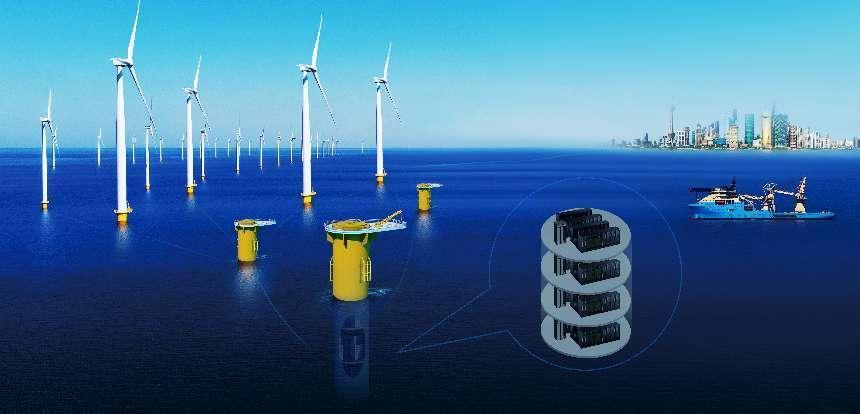
Imagine a giant "steel cube" weighing 1,950 tonnes (equivalent to 1,300 compact cars) precisely positioned on the seabed at a depth of 10 meters, with thousands of servers running day and night. With an average annual water temperature of just 15°C in this sea area, the facility uses seawater to dissipate heat directly, consuming not a single drop of fresh water for cooling.
A core industry metric for energy efficiency is power usage effectiveness (PUE), which is calculated by dividing the total electricity consumed by the facility by the power used solely by IT equipment (servers, storage and networking). If the PUE is two, it means that for every one kWh servers use for computing, another one kWh is wasted on cooling and maintenance.
Ideally, the PUE should be one, indicating zero waste. While reaching exactly one is impossible in reality, modern technology allows us to get infinitely close.
Traditional land-based data centers typically have a PUE between 1.4 and 1.6; but this subsea facility boasts an astonishingly low PUE of less than 1.15.
Located just 500 meters away from the shore, over 50 wind turbines stand tall. This 200-megawatt offshore wind farm generates over 500 million kWh of electricity annually, feeding clean power directly to the center and achieving a green power supply rate exceeding 95 percent.
At full capacity, the facility will save 61 million kWh of electricity annually, equivalent to the carbon absorption of 1.6 million trees. Furthermore, while a land-based facility of the same scale would require 2,000 square meters, this subsea center occupies only 200 square meters, which is a true feat of "spatial magic."
Currently, computing clusters from major players like China Telecom have already come online. The short videos people scroll through, the online games people play, and even AI data processing for multinational corporations may all be powered by this "underwater brain," delivering ultra-low latency computing.
Moving forward, this model of "seeking computing power from the sea" will be scaled up across other coastal regions in China. The digital world of the future is poised to grow under the guardianship of the deep sea.