

More International Sci-tech Organizations Choose China
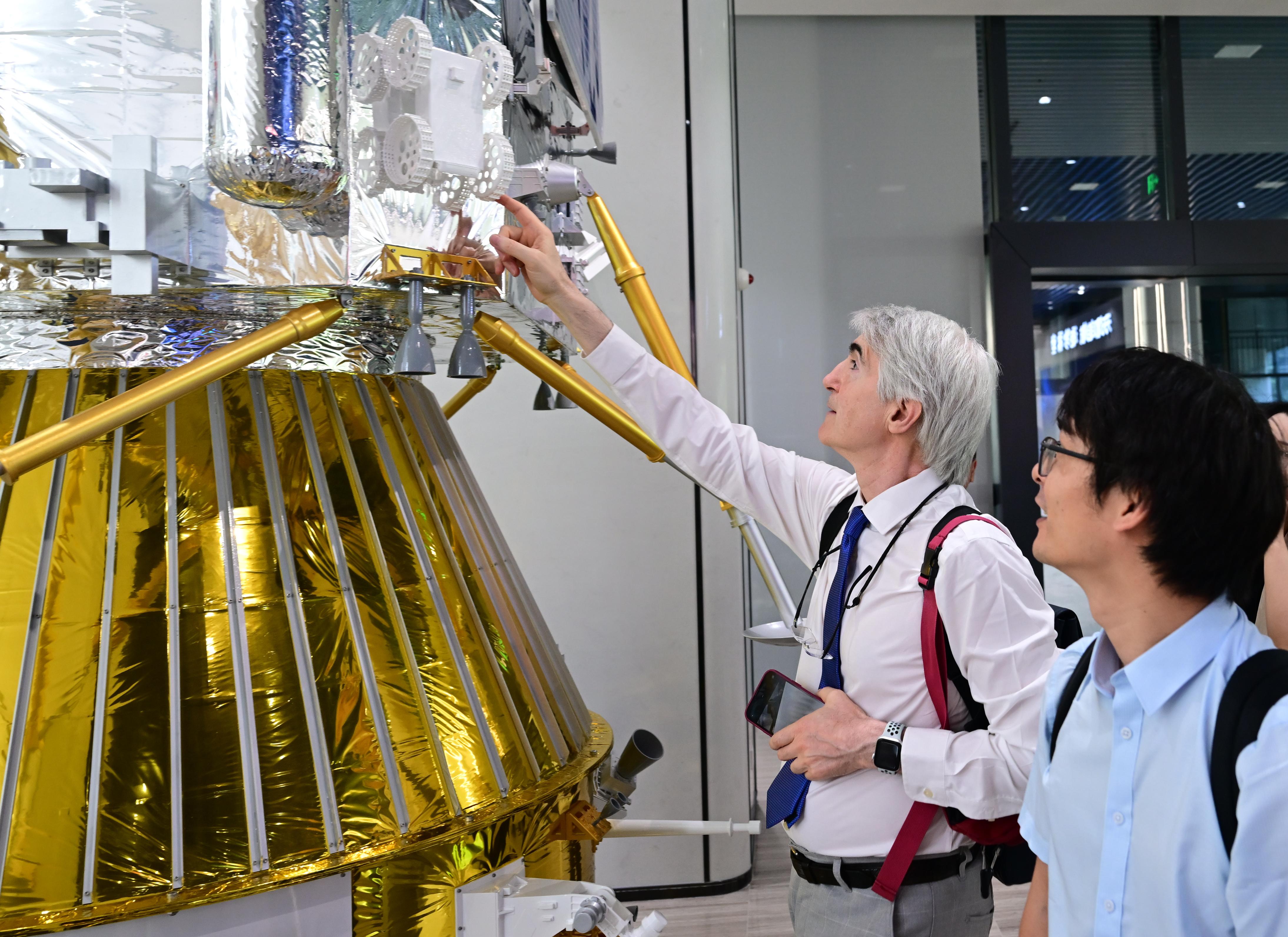
China's first Cluster for Headquarters of International Science and Technology Organizations recently launched the construction of a functional expansion zone at the Donghu International Center in Chaoyang district, Beijing.
In the three years since its establishment in 2023, the cluster has attracted 16 international sci-tech organizations. Beijing is now home to 55 international sci-tech organizations, the most in China.
In April, Shanghai introduced a global science and technology partnership plan, advancing the introduction and cultivation of international sci-tech organizations.
In May, the International Society of Sensing Technology (ISST) was inaugurated in Chengdu in southwest Sichuan province.
This is only a glimpse of a trend: An increasing number of international sci-tech organizations are choosing to set up their global headquarters or core secretariats in China, where they deeply interact with the local R&D chains, large-scale scientific facilities and regional innovation systems.
The reason behind this phenomenon is that China has a huge number of application scenarios, complete industrial chain support and real-world proving ground for sci-tech innovation, according to Li Fei, associate researcher at the Institute of China's Science, Technology and Education Policy, Zhejiang University.
This was echoed by Yu Xiaozhou, chair of the Space University Administrative Committee of the International Astronautical Federation (IAF) and a professor at Dalian University of Technology.
China has diversified geological scenarios, large volumes of industry operation data and long-term observation data. "This real-world support serves as an indispensable practical platform for achieving theoretical breakthroughs and technological advancements in cutting-edge basic research worldwide. It is also the fundamental reason why the IAF places such high value on China and is willing to engage in global cooperation with us," Yu said.
In addition to test fields for geological and space sectors, China's full industrial chain ecosystem in digital technology and advanced manufacturing sectors is also a key factor for attracting international sci-tech organizations to China.
Chen Kai, vice president of ISST and dean of the School of Automation Engineering, University of Electronic Science and Technology of China, said intelligent sensing technology highly depends on interdisciplinary and cross-industry coordination. The ISST chose to establish its headquarters in Chengdu because of the city's research gathering capacity and industrial foundation in this field.
In Li's opinion, China's unique attraction lies in the global scientific research communities where scientists, engineers and entrepreneurs deeply integrate. In such environment, researchers can turn China's advantages in scenarios into sources that promote theoretical breakthroughs in global basic research, thus making international sci-tech organizations play a better role and realize their values.
Apart from promoting the development of basic research and sci-tech innovation industries, the accelerated gathering of international sci-tech organizations also plays an increasingly important role in global sci-tech governance.
According to Li, global scientific innovation faces the risks of fragmentation and bloc-based competition, and the sci-tech governance system needs to be reformed. Under such circumstances, the international sci-tech organizations settling in China serve as hubs for non-biased, transnational and cross-bloc collaboration in basic research.