

A Strong Country in Sci-tech Construction Enters Fast Lane
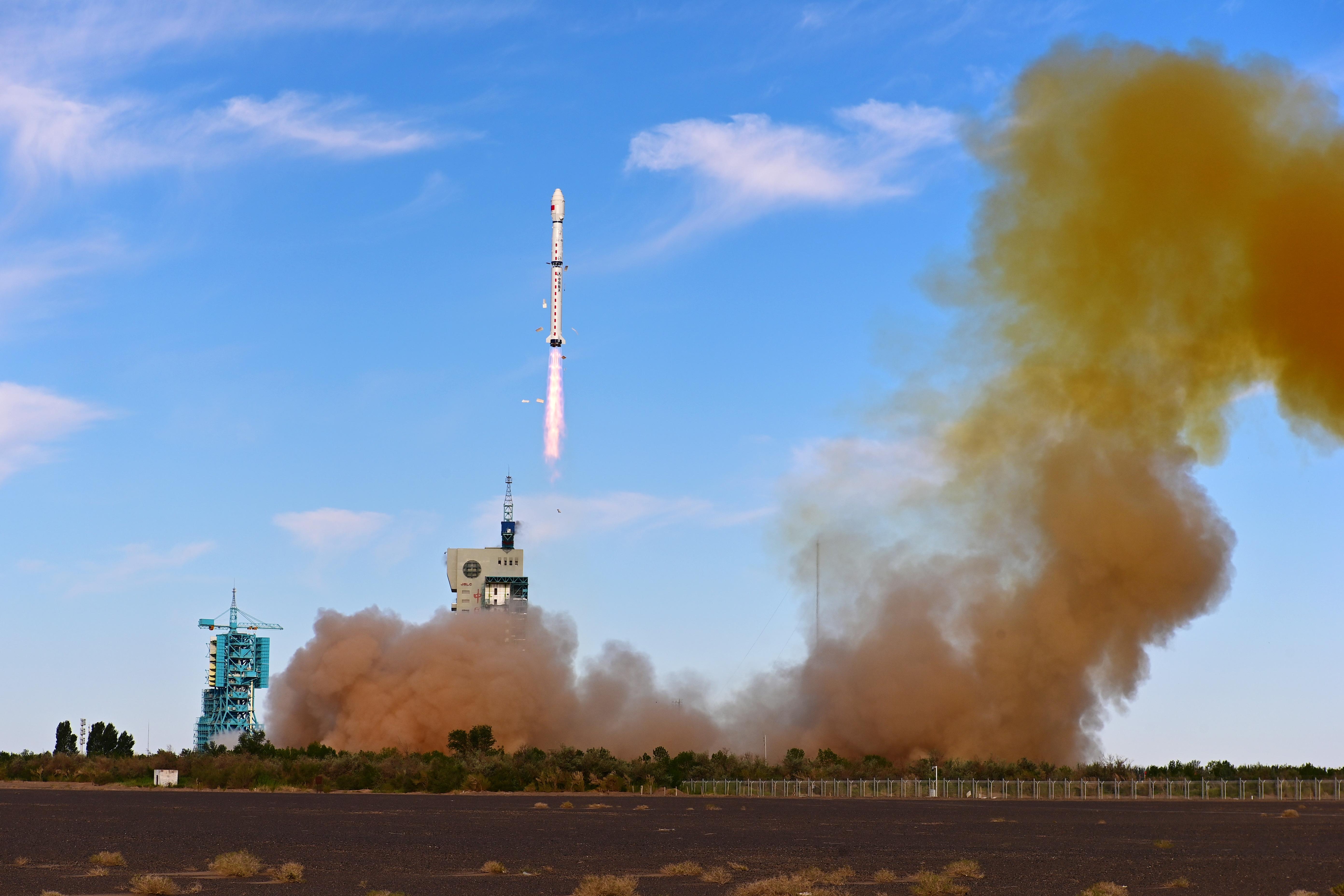
Since the national sci-tech conference in June 2024 underscored the importance of sci-tech modernization and innovation in pursuing Chinese modernization and high-quality development, China has entered the fast lane in building a strong country in science and technology. Its sci-tech strength has achieved overall improvement, and its innovation momentum has shifted from scaling up to a leap in quality and efficiency. The overall efficiency of the national innovation system continues to rise.
Original breakthroughs
Basic research funding rose from about 250.1 billion RMB in 2024 to 277.8 billion RMB in 2025, exceeding 7 percent of total R&D expenditure for the first time. This marks a steady increase in upstream investment, shifting the focus from quantity to quality in foundational science.
The CO2-to-starch synthesis developed by the Tianjin Institute of Industrial Biotechnology, Chinese Academy of Sciences, has moved from the laboratory toward industrialization — a "0-to-1" breakthrough in synthetic biology and a clear case of basic research translating into industrial applications.
In computing, Jiuzhang-4 runs 1,054 times faster than the world's fastest supercomputer on specific mathematical problems. The Jiangmen Underground Neutrino Observatory has improved measurement precision for two neutrino oscillation parameters by over 1.5 times compared to previous international best levels. Chang'e-6 has decoded the moon's far-side evolutionary history, reshaping the framework of solar system evolution research.
These achievements demonstrate that basic research is no longer confined to academic inquiry but is increasingly serving as a solid foundation for fostering new quality productive forces.
Breakthroughs in core tech
The China National Nuclear Corporation has achieved independent mass production of the silicon-28 isotope with an abundance exceeding 99.99 percent. This breakthrough will facilitate independent development of core materials for silicon-based quantum computing in China. Stable isotopes also hold strategic value in precision radiotherapy, nuclear security traceability, and fundamental physics research.
In integrated circuits, a complete industrial chain covering design, manufacturing, packaging and testing, equipment, and materials has taken shape. Domestically developed ultra-wide band photonic chips are providing foundational support for 6G space-air-ground integrated communications. A 35.6-tesla full-superconducting magnet has set a new world record for steady-state magnetic fields, offering technical support for materials science, life sciences, and nuclear fusion research.
In new energy, multiple world records for photovoltaic cell efficiency have been set. In AI, several Chinese large language models have surpassed 95 percent accuracy, matching or approaching international leaders. Humanoid robots have moved beyond prototypes into deployment in automotive manufacturing and power grid inspections. In invasive brain-computer interfaces, China has become the second country after the U.S. to enter clinical trial.
Each breakthrough strengthens a link in the industrial chain, and these cumulative advances are coalescing into a tangible driver of new quality productive forces.
Institutional reforms
The Central Science and Technology Commission has strengthened overall coordination across strategic planning, policy measures, major tasks, research capabilities, resource platforms, and regional innovation.
Coordination between science and technology policies and fiscal, tax, and financial policies has become more efficient. In 2025, tax reductions, fee cuts, and rebates supporting innovation and manufacturing exceeded 2.8 trillion RMB, while R&D super-deduction policies were expanded and refined.
The talent evaluation system has shifted away from sole focus on papers, titles, and awards, toward criteria based on innovation value, capability, and contribution. Researchers have been given greater autonomy in sharing proceeds from the commercialization of their outcomes. Mechanisms such as "open competition for key research projects" and "racing" systems have been adopted to encourage scientists to pursue high-risk, high-reward exploration. These changes have gradually established a foundational institutional framework that supports comprehensive innovation.
By 2025, China's full-time R&D personnel reached 7.95 million person-years, ranking first globally. China ranked second worldwide in the number of highly cited researchers. These metrics reflect a systemic shift in innovation capacity. From upstream basic research to downstream industrial application, and from institutional restructuring to talent empowerment, these changes are collectively accelerating China's progress toward high-level self-reliance in science and technology.