

Agri-tech Innovation Secures Grain Supplies
Technological innovation is transforming China's entire food production chain. Smart irrigation districts in the Sanjiang Plain, intelligent wheat fields in the North China Plain, and breakthroughs in superior seeds in the Central Plains are just some examples of a sweeping farming revolution.
By developing new quality productive forces, the ongoing tech innovation ensures the sustainability of China's granary along with a more stable and higher-quality food supply.
Smart irrigation
Rice in the Sanjiang Plain is currently entering its critical tillering stage, dramatically increasing the demand on field irrigation.
The Qinglongshan Irrigation District there now uses a digital twin system with real-time data on water levels, soil moisture and weather. Adopting intelligent algorithms, it precisely simulates the entire water conveyance process, and facilitates smart irrigation across thousands of kilometers.
"Previously, manual patrols across the entire district were inefficient, had many blind spots, and struggled with emergencies. Now, with drones and smart devices, we can complete a full-area inspection in one day. Data triggers real-time alerts, we identify and handle problems immediately, and management efficiency has doubled," said Liu Xiaoliang, an employee of Beidahuang Heilongjiang Jiansanjiang Water Investment Co., Ltd.
The practical application of smart water management has not only improved district management but also brought tangible "tech-driven farming" benefits to farmers.
For farmer Sun Zhenlei, a smartphone app has transformed irrigation. "Before, I ran back and forth to open gates. Now I control them remotely. It saves time and keeps water levels consistent," he said. Smart irrigation has moved farming from "relying on experience" to "relying on data."
Reducing harvest losses
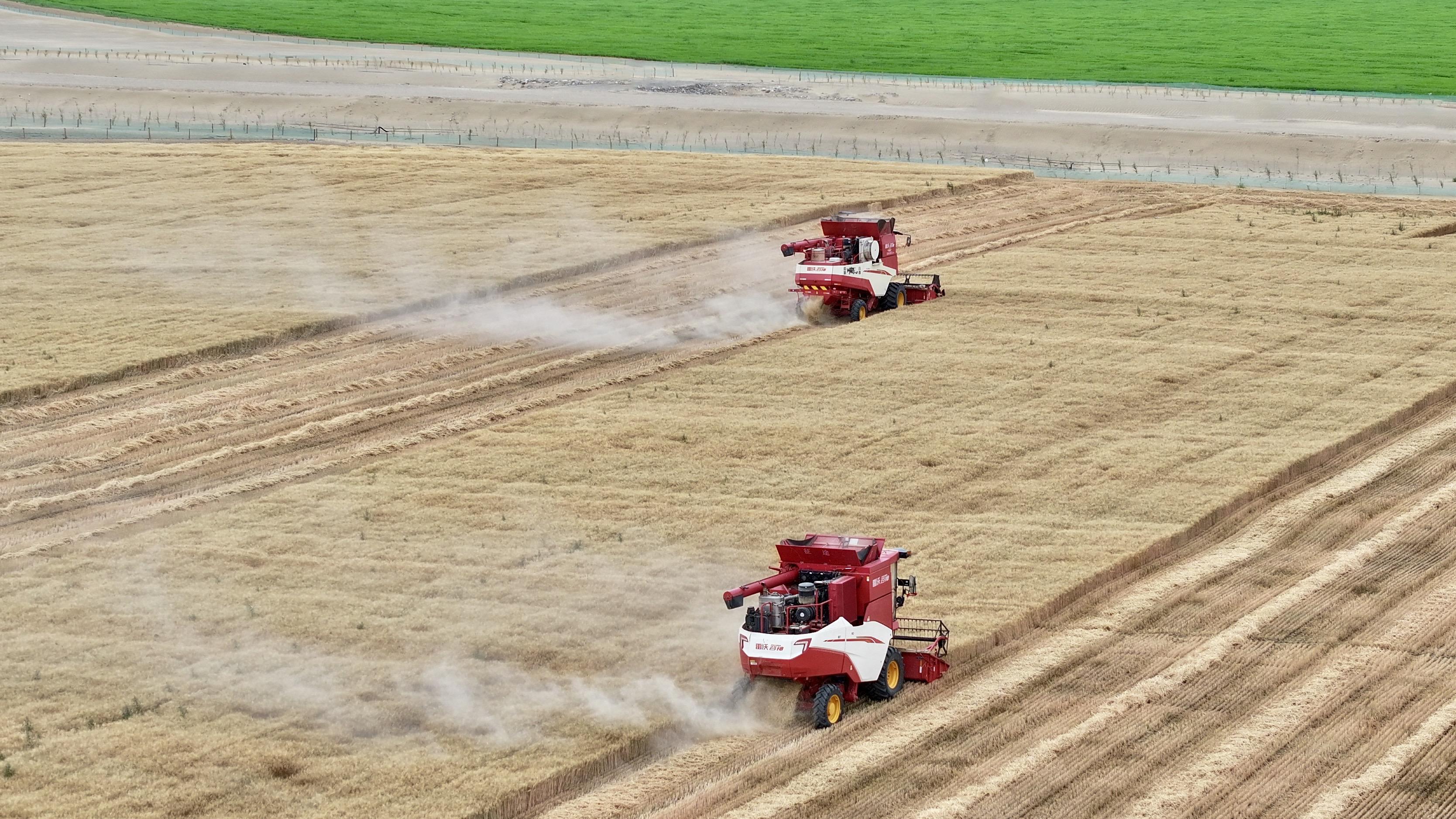
Recently, in the wheat fields of Xizheng village, Zhao county, Hebei province, five new wheat combine harvesters equipped with intelligent grain loss detection and calibration systems worked through the farmland.
"Reducing loss is increasing yield," said Zheng Longzhan, a senior engineer at the Hebei Provincial Agricultural Mechanization Technology Extension Station.
Nearby, the Baodi Grain Planting Cooperative is using intelligent grain drying and storage technology. "The front warehouse can hold 200 tons of wet grain, with automatic loading and unloading. It can dry 200 to 250 tons of wheat in 12 hours, using bio-oil as fuel, costing only 4-6 cents per kilogram," said cooperative director Wang Dongwei. Automated conveyors sort grain by moisture level and minimize breakage, to largely reduce grain losses.
Technological empowerment is reducing losses across the entire food production chain. The upgraded Weichai Lovol GM5125 harvester and other new models are operating in major wheat-producing regions like Shandong, Henan, and Hebei. Featuring high-precision sensors, the harvesters display real-time grain loss levels via green/yellow/red indicators. Operators adjust settings based on real data, keeping loss rates consistently below 0.8 percent.
"From seed cultivation to unmanned farms, Henan is using innovation to boost grain output," said Li Yong'en of the Henan Provincial Department of Science and Technology. Among the top 10 wheat, corn, and peanut varieties by national planting area, Henan-bred varieties account for four, six, and seven respectively. Henan consistently produces over 65 billion kilograms of grain annually, with improved seed varieties covering over 97 percent of main crop areas.
From field to granary technological innovation empowers the entire food production chain, ensuring China's food supply is more secure than its ever been.