
Abacus: Chinese Counting Symbol
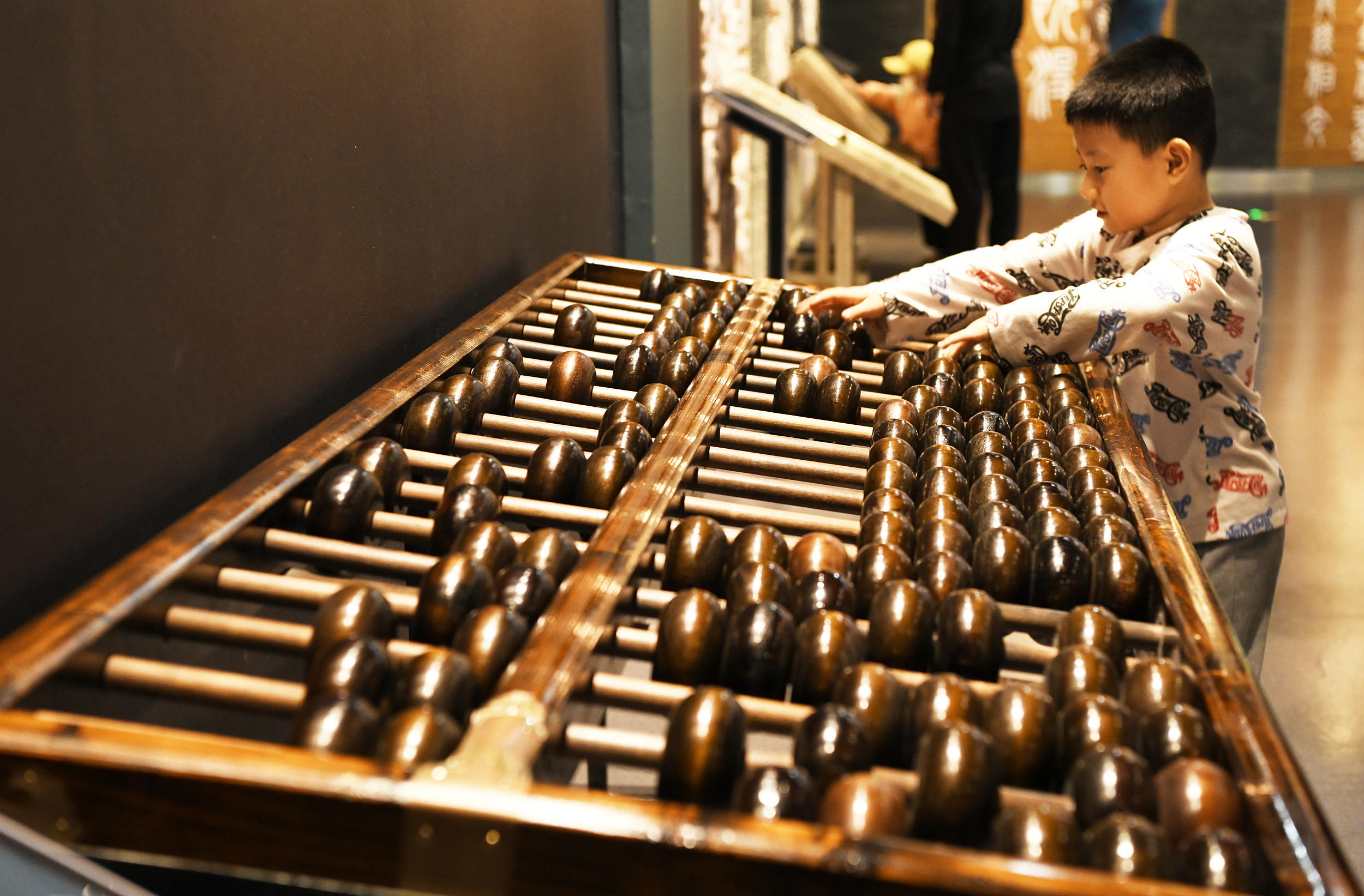
A child plays with a giant abacus at Mozi Memorial Hall in Tengzhou city, Shandong province. (PHOTO: VCG)
By ZONG Shihan
The abacus, a manually operated counting aid that originated in China, was hailed as "the fifth great invention in China" by Joseph Needham, a renowned British biochemist and historian. Before the advent of Arabic numerals, the abacus was a widely used counting tool globally.
For thousands of years, the ancient Chinese used simple objects for calculations in agriculture and commerce. Over time, counting rods replaced randomly picked up stones and bones used for calculations. Then, the abacus replaced counting rods, and finally the seven-bead abacus replaced the five-bead abacus.
The discovery of counting rods made of animal bones in ancient Han tomb indicates that as early as the Western Han Dynasty (206 BC- 24 AD), the Chinese used wooden or bones rods for calculations. However, the shape of the rods had to be constantly changed during calculations, which was very time-consuming. So they were gradually developed into the abacus.
The early abacus used small round beads instead of long rods, which were comparatively clumsy. The beads were strung into strings with rods, saving calculation time. Over time, the number of beads increased, leading to the seven-bead abacus from its five-bead predecessor to adapt to the hexadecimal system.
The existing abacuses have different shapes and are made of different materials. A typical abacus is mostly made of wood and consists of a series of beads arranged in a rectangular wooden frame. A crossbeam in the middle divides the beads into two parts. Each bead in the upper half represents five, and each bead in the lower half represents one. Each string of beads represents the values of ones, tens, hundreds, thousands, and tens of thousands from right to left.
As it was simple to make, affordable, and easy to use, the abacus was widely used in China, from where it gradually spread to countries and regions such as Korea, the U.S. and Southeast Asia.
In today's era of computers and other electronic devices, although few people use abacuses, it has become a symbol of counting in China. In recent years, it has often appeared on postage stamps and postcards. It is also part of some special occasions.
For instance, "Zhuazhou" is a traditional Chinese celebration of a child's first birthday when several objects are placed before the child to choose. The chosen object is supposed to indicate the child's future career. The abacus is among these objects, representing business or wealth.