
Ice Blocks Onboard, Fish Models in the Ocean
Inside a container kept at -18°C on the midship deck of the icebreaker Xuelong, there are 86 ice cores and four small ice blocks. Sun Kai, a member of China's 16th Arctic Ocean scientific expedition team, is bringing them to China for laboratory tests.
During operations at ice stations, Sun not only conducted in-situ borehole strength tests on Arctic sea ice but also collected an ice block 1.3 meters thick and 1.2 meters in length and width, weighing one tonne.
Ice blocks, different from ice cores, have a larger volume and can be used to conduct more complex mechanical tests, such as bending tests, Sun said. When an icebreaker navigates through level ice, bending is a primary mode of failure of sea ice.
It took a lot of effort to get the block out, with nearly four hours spent on cutting alone. Since the ice surface was not suitable for the experiment, Sun decided to hoist the block onto the midship deck, which was another arduous job. It was possible when the Xuelong penetrated a large floating ice area, located a suitable sampling spot near the ship, and moved the ice block with the help of a shipborne crane.
Once the block was aboard, Sun processed part of it into standard test specimens for sea ice bending and compression tests. He obtained first-hand data from physical and mechanical tests on sea ice under Arctic conditions. The four remaining ice cubes cut from the block each measuring 0.5 meters on each side, will be brought back to China as valuable Arctic sea ice samples for further analysis and testing.
The research team also deployed five fish models in the Arctic Ocean.
The Arctic has been undergoing rapid changes in recent years. Temperatures have risen as sea ice has melted, and biological activity is higher than before.
Samples collected can provide a snapshot of conditions only at a given time. But will the organisms beneath the ice, such as algae, die during the polar night? Or will they survive until the following spring, when they can see sunlight again and continue to reproduce?
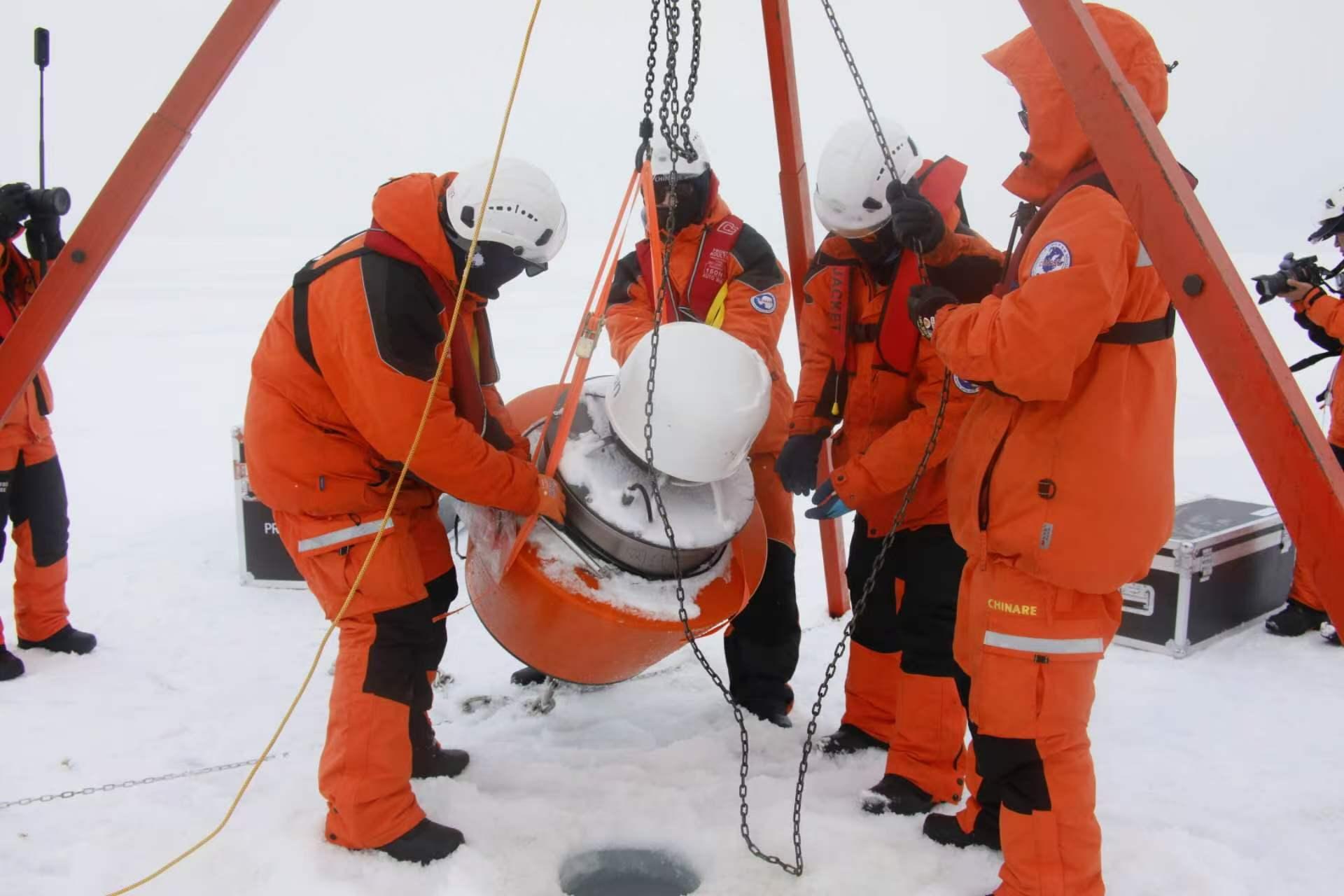
Researchers attached ballast weights to the bottom of the fish models and placed them three meters below the ice to test the deployed ecological unmanned ice station's optical imaging system.
The system can observe shallow-water fish and other ecological components beneath the ice. It integrates modules for basic ecological parameters, zooplankton imaging and fish finding, covering key marine ecological components in the Arctic Ocean. They include the atmosphere, sea ice, ocean and biological environment, as well as key polar biological populations.
The system collects data on basic environmental conditions and key biological populations at fixed depths within the upper 200 meters beneath the ice, enabling long-term, intelligent monitoring of shallow-water fish and other ecological components beneath the ice in the central Arctic Ocean. This is important equipment support for research into the evolution of polar marine ecosystems.