

Promoting Embodied AI Tech and Context Application
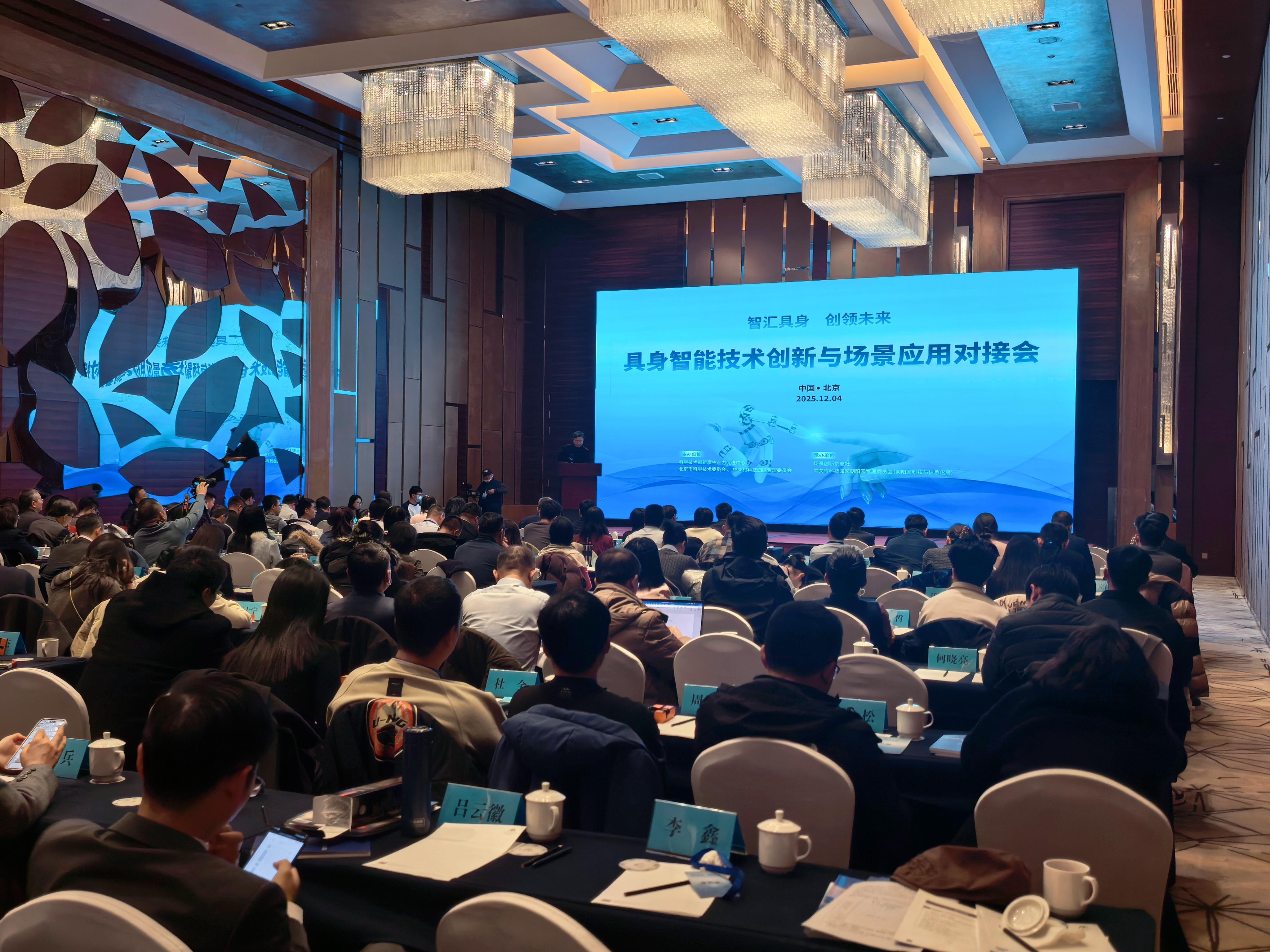
On December 4, a conference on the technology innovation and context applications of embodied AI held in Beijing discussed the high-quality development path of the embodied AI industry, with a focus on breakthroughs in technological innovation, deep adaptation to contexts and the establishment of an industrial ecosystem.
Drawing nearly 200 representatives from the government, industry, academia, research institutions and end-users in the embodied AI field, the conference was jointly hosted by New Quality Productive Forces Promotion Center of the Ministry of Science and Technology, and Beijing Municipal Science and Technology Commission, Administrative Commission of the Zhongguancun Science Park.
It was organized by the Context Innovation magazine and the Administrative Commission of Chaoyang Park of the Zhongguancun Science Park.
Experts such as Wang Yaonan, academician of the Chinese Academy of Engineering, Song Shiji, professor at the Department of Automation of Tsinghua University, and Wang Haihua, vice president of Beijing Innovation Center of Humanoid Robotics Co., interpreted cutting-edge technological trends and the latest research results in the embodied AI sector.
Eight cases selected by experts covering fields like industrial manufacturing, modern agriculture, elderly care, and safety and emergency response demonstrated the innovative application of embodied AI in the real world.
Experts evaluated these cases from the perspective of technological innovation, performance effectiveness, demonstration potential and scenario adaptability. They offered targeted suggestions for optimizing the cases, facilitating the commercialization of technological achievements.
In addition, more than 20 embodied AI enterprises presented their products on site, including an integrated physiotherapy bed and an AI-powered traditional Chinese medicine diagnosis robot.
Xing Huaibin, director of the New Quality Productive Forces Promotion Center, said AI has become a crucial engine driving the development of new quality productive forces. Embodied AI, an important frontier direction, has realized deep integration of cognitive intelligence and physical entities. It is rapidly transitioning from laboratory research to industrial implementation, demonstrating robust development momentum and broad application prospects.
In the future, the center will continue to track and collect cutting-edge technological information, strengthen analysis and assessment of the commercialization and application of frontier technological achievements, and conduct precise matching between supply of sci-tech achievements and demand for innovation. It will accelerate the efficient commercialization and application of sci-tech achievements.
Wang Junming, member of the editorial board of Science and Technology Daily and president of Context Innovation magazine, said the key to context-driven development of embodied AI lies in advancing it from "laboratory technology" to "scalable application."
Embodied AI's "perception-decision-action" capability can optimize resource allocation through real-time data, and transform "contexts" into hubs connecting technology and industry. With onsite verification, data feedback, model iteration and scalable service, it can drive continuous emergence of new productive forces, Wang said.
The conference aligned with the requirements outlined in the guidelines released by the General Office of the State Council in November on accelerating scenario cultivation and opening up and promoting large-scale application of new scenarios.
It built a bridge between technologies and applications, and fostered a shared vision for the industry's development.