

Future Industries Power Next Development Phase
With the world entering a new era of technological and industrial transformation, future industries are key to long-term advantage — and China is moving fast to build them.
Reinforcing the digital foundation
Quantum technology and 6G are widely regarded as the pillars of the next-generation digital infrastructure. On January 21, the Ministry of Industry and Information Technology (MIIT) announced the launch of the second phase of 6G technology trials, laying the groundwork for commercial deployment before 2030.
China currently accounts for 42 percent of the world's declared standard-essential patents for 6G, ranking first globally.
Quantum computing is moving steadily out of laboratories and into real-world applications. According to a recent report by the China Academy of Information and Communications Technology, more than 800 quantum information enterprises have been established worldwide, over 140 of them in China.
"China's quantum technology has long been at the global forefront, and its application scenarios are continuing to expand," said Guo Guoping, professor at the University of Science and Technology of China.
However, the commercialization of quantum technology still faces challenges in core components, system integration, and the maturity of industrial ecosystems.
"Overcoming these obstacles requires driving technological iteration through pilot projects in real-world scenarios, while simultaneously building an independent and controllable manufacturing chain and developer ecosystem," Guo said.
"To enable these foundational industries to provide sustained support and broad spillover effects, long-term efforts are needed across technological R&D, capital investment, and standards-setting," said Yang Zhen, associate research fellow at the Institute of Industrial Economics of the Chinese Academy of Social Sciences.
Reshaping the material base
Alongside digital technologies, breakthroughs in energy and materials are redefining the physical foundations of industrial development. The energy transition driven by green hydrogen and the materials revolution centered on synthetic biomanufacturing are jointly reshaping global industrial structures, with implications for national energy security and resource autonomy.
China has already established a strong position in the hydrogen energy sector. Nationwide, 380 hydrogen refueling stations have been built, accounting for about 40 percent of the global total. By 2025, the global hydrogen market is expected to reach 320 billion USD, with China contributing more than 35 percent.
"The global fusion industry is developing rapidly, and China is showing particularly strong momentum," said Liu Zhihong, secretary-general of the Anhui Province Fusion Industry Federation.
China's fusion energy development model is also evolving. What was once dominated by state-led "national teams" is now increasingly driven by a combination of public institutions and private capital. Controlled nuclear fusion is currently at a critical transition point from laboratory research to engineering and commercialization, with expectations that the first fusion-powered electricity could be realized around 2030.
In biomanufacturing, growth has been equally striking. MIIT data shows that the global biomanufacturing market has surpassed 350 billion USD, with a compound annual growth rate exceeding 15 percent.
China's biomanufacturing sector has reached a scale of 1.1 trillion RMB, and its biotechnological fermentation products account for more than 70 percent of global output.
"Only by continuously tackling key technologies, building independent industrial chains, fostering innovation ecosystems, and conducting large-scale validation in representative scenarios can laboratory breakthroughs be transformed into powerful drivers of growth," said Yang.
Expanding the boundaries of intelligence
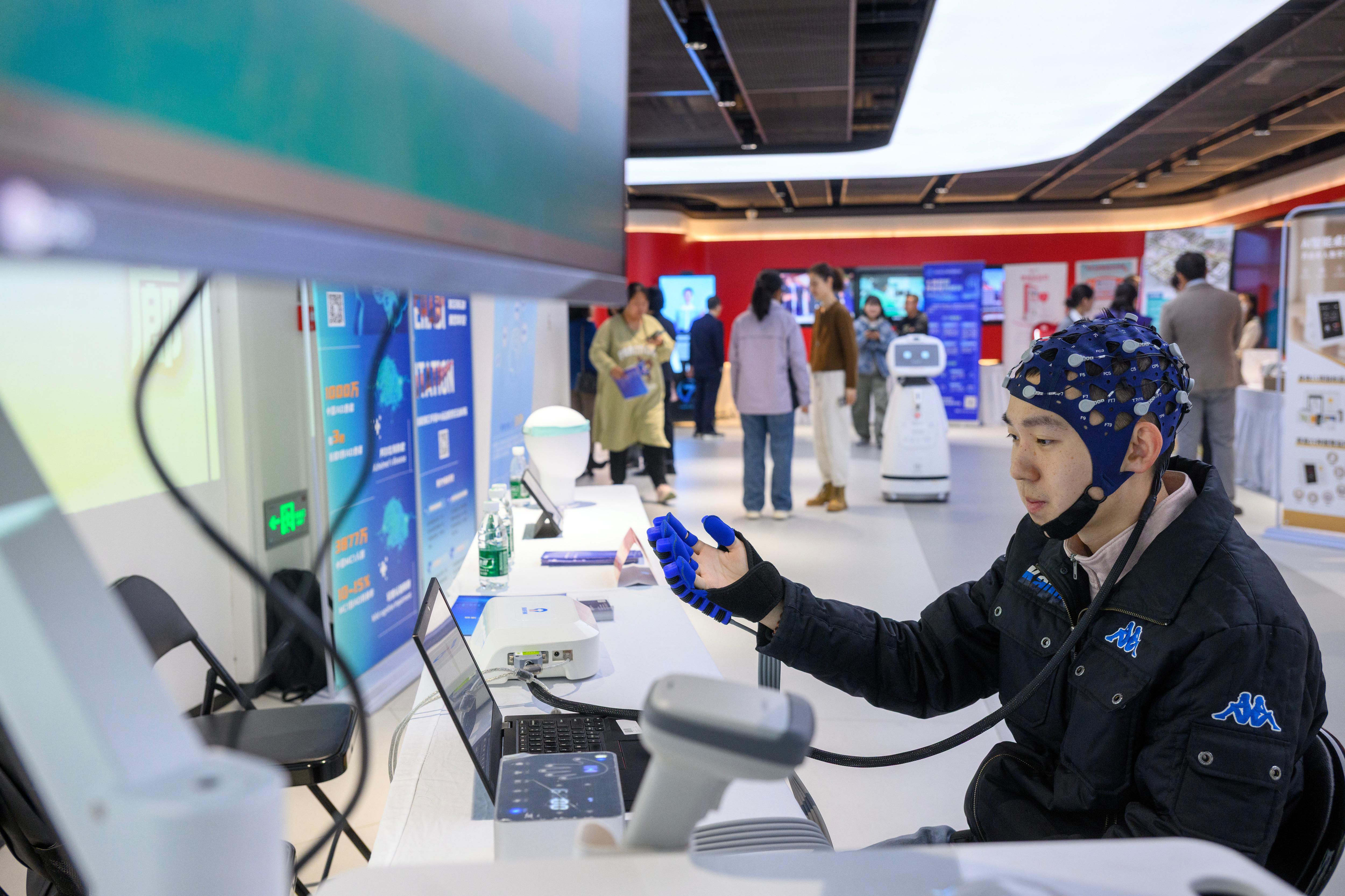
Breakthroughs in brain-computer interface (BCI) and embodied intelligence are redefining the relationship between humans, machines, and the physical world. Once confined to science fiction, the deep integration of AI, robotics, and human cognition is increasingly shaping real-world applications.
In a rehabilitation center in Tianjin, a 67-year-old stroke patient recently regained partial movement in his left arm with the help of the world's first interventional BCI clinical trial designed to restore motor function.
The system uses minimally invasive vascular surgery to install microelectrodes in target areas in the brain, enabling stable and precise neural signal acquisition without damaging the skull, according to Duan Feng, a professor at Nankai University who led the project.
Beyond technical challenges, ethical and safety considerations remain central. "The proximity of this technology to the human brain makes it fundamentally different from other industries," Duan said, warning against uncritical replication of conventional expansion models.
Embodied AI, by contrast, is already integrating rapidly into daily life. From robotic vacuum cleaners capable of sorting objects to humanoid robots performing power inspection tasks, applications are expanding across industries.
Still, experts caution that intelligence software has yet to fully match advances in hardware.
"Robots still face clear limitations in long-sequence behavior planning and cross-scenario generalization, while safety constraints remain largely physical," said Zhang Weinan, executive dean of the School of AI at Harbin Institute of Technology. "True industrial maturity will be marked by safety and reliability."