

JAT: Enabling Analytical Chemistry to 'See' Deeper
Detecting trace pollutants in environmental monitoring, tracking drug metabolism in the body for precision medicine, and elucidating the composition and structure of new materials — these seemingly unrelated applications all rely on the same discipline: analytical chemistry.
Analytical chemistry bridges the macroscopic and microscopic worlds, and is often called the "eyes" of science and technology. With these "eyes," people can distinguish objective facts from subjective conjectures through precise detection data. The more advanced the technology of the "eyes," the deeper our understanding of the world becomes. My team and I aim to enable these "eyes" to see even deeper, clearer and farther.
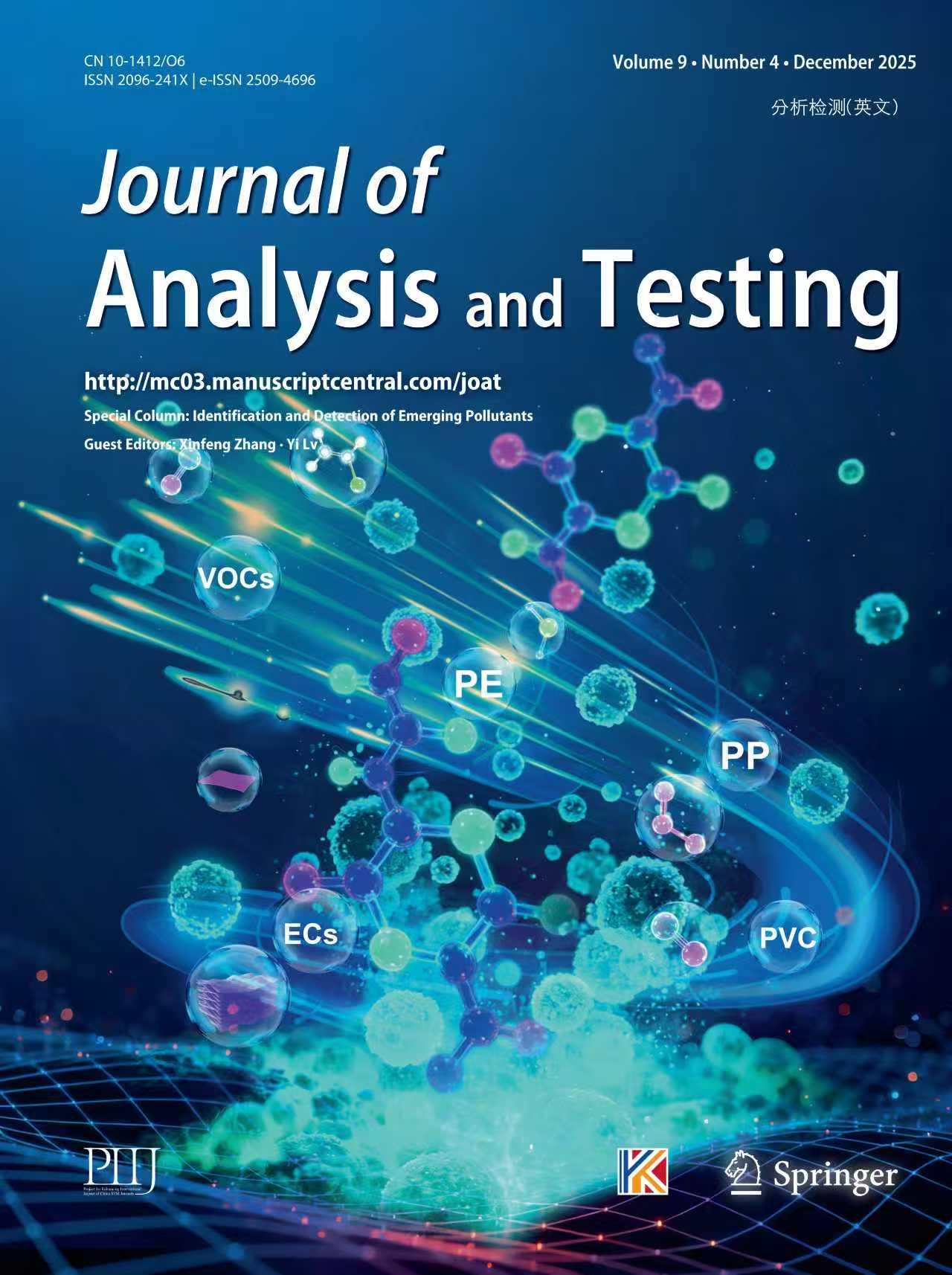
The Journal of Analysis and Testing (JAT), the first international English academic journal on analytical chemistry in China, was launched in 2017. The journal's academic influence has steadily increased. It is now ranked in the Q1 category of the Clarivate Journal Citation Reports and has become a pivotal journal in the international analytical chemistry field.
A simple, original aspiration has consistently driven our progress: to enable analytical chemistry to better address the challenges of our time.
Fulfilling academic missions
As awareness of the harm caused by emerging pollutants to society and the environment grows, the rapid identification and detection of these pollutants has emerged as a critical challenge in global environmental governance.
Our team held an in-depth discussion in 2024 and in 2025, we launched a special issue titled Identification and Detection of Emerging Pollutants to address the challenges of managing emerging pollutants. It featured cutting-edge research from renowned experts worldwide.
By integrating multidisciplinary approaches such as materials science, biotechnology and AI, this issue provided solutions to key bottlenecks in current detection methods, including slow response times, insufficient accuracy and difficulties in real-time monitoring, while advancing technological innovation in pollutant detection.
Promoting interdisciplinary collaboration
When diseases lurk deep within the human body, how can we detect them earlier, pinpoint their locations more accurately, and minimize harm to healthy tissues? This is a long-standing challenge in medicine, one where analytical chemistry can make a meaningful contribution.
Near-infrared I/II region optical technology, with its superior penetration capabilities and reduced side effects, enables deeper and clearer visualization within the body. Combined with photothermal or photosensitization effects, it facilitates targeted intervention in lesions, emerging as a key direction in next-generation precision medicine.
In 2023, we curated a special issue, Near-infrared I/II Theranostics, to systematically review this cutting-edge field, focusing on the interdisciplinary integration and innovation of chemistry, materials science, optical imaging and biomedicine.
The issue comprised multiple reviews and research papers authored by domestic university research teams. It elucidated how interdisciplinary collaboration can overcome the limitations of traditional diagnostics and treatments, addressing clinical pain points such as the difficulty in locating deep-seated lesions, the side effects of treatment, and the challenges posed by drug-resistant bacteria.
Although it will take time for these achievements to transition from laboratory to clinical practice and truly benefit patients, the path forward is now clear.
Driving disciplinary development
Reflecting on JAT's nine-year journey, I am increasingly convinced that analytical chemistry is valuable not only in advancing technology, but also in responding to the demands of the times. From environmental governance to precision medicine, and from new material development to energy transformation, analytical chemistry is moving from "backstage" to "frontstage."
Looking ahead, JAT will uphold the principles of "precision, interdisciplinary approach, practicality, and internationalization." We foster deep integration between analytical chemistry and fields such as biomedicine, materials science and environment and energy, thereby advancing scientific research from methodological innovation to industrial application.
We look forward to collaborating with scholars worldwide to advance our disciplines and contribute to scientific efforts to address global challenges.
The article is written by TU Hailing, the editor-in-chief of the Journal of Analysis and Testing.
Journal Review
Analytical chemistry, as a fundamental measurement science, serves as a key driver in advancing numerous cutting-edge technological fields. The rapid development of JAT is a vivid testament to the vitality and global influence of this discipline.
The success of JAT lies in its commitment to the concept of high-level internationalization in journal operations. By establishing an international editorial board and a rigorous peer-review process, the journal has created a platform for sharing knowledge, which fosters intellectual exchange and collaborative innovation among scientists worldwide.
JAT also proactively addresses global issues such as public health and environmental governance by organizing cutting-edge special issues to guide disciplinary directions. This demonstrates the high sense of responsibility of academic journals in serving the scientific community.
Looking ahead, I hope JAT will continue to strengthen its role as a hub for global communication in analytical chemistry, not only publishing high-level papers, but also inspiring new ideas and fostering new consensus.
—— Wang Haizhou, a member of the Chinese Academy of Engineering