

Resurrecting Relics with Cutting-edge Tech
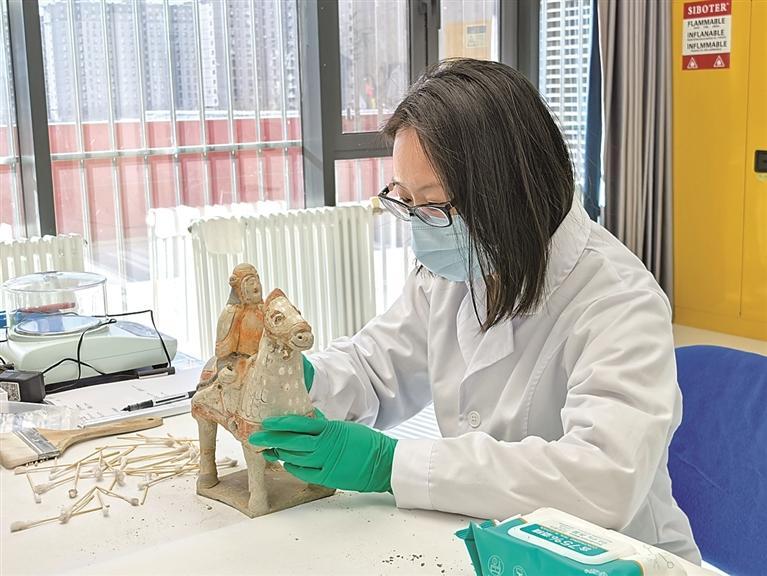
Often called an "artifact hospital," the Inner Mongolia Museum feels like a place where time seems to slow down. In the organic artifact restoration laboratory, conservator Shi Liqin is restoring a thousand-year-old embroidered leather bag from the Liao Dynasty (916-1125). Made of leather, textiles and bronze, the bag poses a significant challenge due to the different "temperaments" of its components.
The restoration began with removing the bronze buckle. As bronze and organic materials have vastly different moisture tolerances, any forceful separation could cause irreversible damage. Conservators devised a bespoke "rehydration" regimen to slowly reawaken the leather fibers under strictly controlled temperature and humidity to safely detach the buckle — a painstaking process that marked only the first step.
Shi then used a low-pressure vacuum cleaner to gently remove surface dust, which applies localized negative pressure to targeted areas. Smoothing every crease and supporting fragile sections demanded the utmost patience. As she explained, restoration follows no fixed timetable, as continuous monitoring and expert judgment determine each next step.
In this process, technology provides a foundation for precise diagnosis. Hua Lubin, head of the laboratory, explained that the team used X-ray diffractometers to analyze bronze patina and identify harmful corrosion. Fourier-transform infrared spectroscopy and gas chromatography-mass spectrometry help identify fiber types and dye components in textiles. In addition, some specialized analyses require external research institutions, as the team strives to decipher the historical narratives embedded within these artifacts.
In the inorganic laboratory, conservator Ji Yuanyuan works on a gilded silver saddle ornament from the Tang Dynasty. Facing extensive hard surface deposits, the team first used a handheld X-ray fluorescence spectrometer to analyze their composition. With surgeon-like precision, they spent nearly two months cleaning the saddle using scalpels, bamboo splinters and cotton swabs, restoring it to its original splendor.
All restorations adhere to strict protocols: minimal intervention, discernibility and reversibility. Each artifact undergoes a comprehensive process — from storage retrieval and data acquisition to pathology identification, analytical testing, custom treatment planning, repair execution and environmental intervention, which ensures the treasures are kept alive for future generations.