

China's AI Ecosystem Wins Over Young Experts from Europe
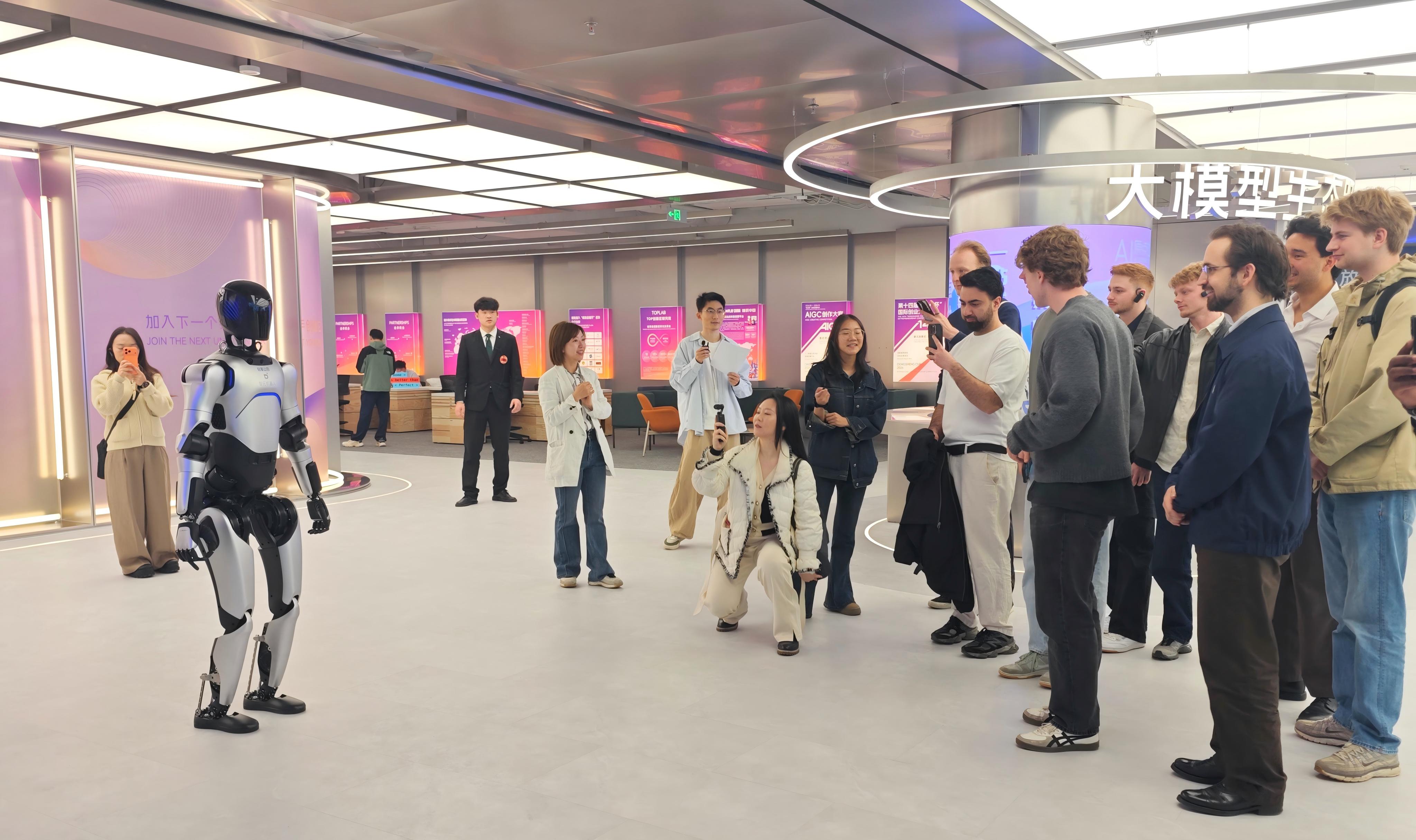
A group of young international experts from the UK, Austria and the Netherlands took part in an exchange event hosted by the World Association of Young Scientists (WAYS) from April 11 to 17. They visited Beijing and Huai'an in Jiangsu province in east China, toured a number of sci-tech institutions and enterprises, and held in-depth discussions on topics including AI, new materials and biomedicine.
Three participants from the Netherlands shared their observations on China's technological development and innovation ecosystem with Science and Technology Daily.
Outstanding advantages in AI development
In recent years, China's AI industry has been on a fast track with many achievements, particularly DeepSeek taking the world by storm. Friso H. Smedes from the University of Groningen, Mohammed Ali from Vrije University Amsterdam, and Petter Reijalt from Delft University of Technology said they use DeepSeek for research due to its effectiveness and favorable price.
In Beijing, they visited Kuaishou, one of China's most popular short-video and streaming platforms, where they could watch up close AI development in China. Ali and Smedes were impressed by the company's video generation model that can create complete movies. They were also impressed by its growing scale with over 10,000 employees based in Beijing.
Ali said this size is rarely seen in regular AI companies in the Netherlands, where only oil companies might have such a large workforce.
He pointed out that government support is a clear advantage for the rapid AI growth in China. He also emphasized China's 1.4 billion population, with its high number of PhD holders, provides abundant human resources for AI research and innovation.
Reijalt took note of China's massive data centers and computing power supported by a large number of GPUs. Infrastructure such as the large-scale data centers built by Alibaba, one of China's tech giants, is easily accessible. But that's not the case in his own country.
A well-integrated and supportive ecosystem
Observing a well-integrated system after visiting universities in Huai'an, Smedes said China's sci-tech innovation is "definitely going fast." Here, if a student comes up with an idea, the student can take courses at the AI faculty and try to develop projects.
This interdisciplinarity, combined with a friendly entrepreneurial environment — where people can start companies at universities and receive funding and even housing support — forms a promising ecosystem, he said.
Reijalt was also impressed by China's approach to nurturing talent and its supportive innovation environment. Compared with the Netherlands, where securing funding can be challenging, China offers strong opportunities for people with creative ideas to develop and implement them.
Exchanges foster cooperation
Ali and his team are developing an AI program for medical triage, designed to assist doctors by automating appointment booking and symptom inquiry through online chat or voice AI. He presented a roadshow in Huai'an to expand his network and understand the local market, and expects to explore cooperation opportunities with Chinese companies.
He stressed that greater communication is essential for deepening sci-tech exchanges among young talents from Europe, the U.S., and China. Young researchers should talk about the challenges they face and the solutions they propose, identify shared concerns, and conduct joint research. Collaboration will accelerate research and development progress compared to working separately.
Reijalt said exchange programs lower barriers for international cooperation by helping participants get to know each other. During the visit, he connected with researchers from Hong Kong and found potential cooperation opportunities. A mix of formal and informal activities, he emphasized, helps strengthen technological exchanges.