

Forum Discusses China's Governance Practices and Global Contributions
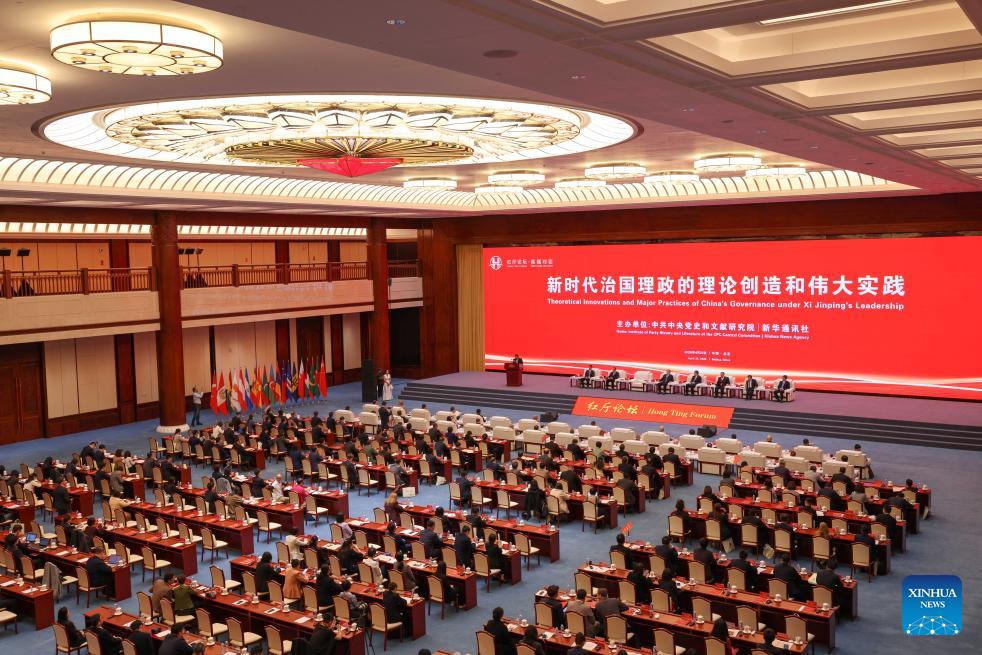
A high-level symposium in Beijing on April 23 brought together diplomats, think tank experts and media representatives from more than 30 countries to explore the theoretical innovations and practical achievements of China's governance in the new era. They discussed China's governance practices and theories, saying these offer valuable insights for the world.
Qu Qingshan, head of the Institute of Party History and Literature of the Communist Party of China (CPC) Central Committee, said China's governance in the new era has put the great rejuvenation of the Chinese nation on an irreversible historical process, opened up new frontiers in adapting Marxism to the Chinese context and the needs of the times, and put forward the concept of building a community with a shared future for humanity, which presents to the world a vision of common development, long-term stability and mutual learning among civilizations.
Fu Hua, president of Xinhua News Agency, said that since the 18th National Congress of the CPC in 2012, China's governance, with its distinct Chinese characteristics, style and ethos, has grown increasingly mature and well established.
He added that Xinhua stands ready to work with all parties to further explain the philosophy and methodology underpinning China's governance in the new era, and to better share governance experiences from China and other countries.
Fu noted that the most significant theoretical achievement in governance in the new era is the formation of Xi Jinping Thought on Socialism with Chinese Characteristics for a New Era, while the most notable practicalaccomplishment is the continued success of the two miracles of rapid economic growth and enduring social stability.
Lyu Yansong, Xinhua's editor-in-chief, presided over the opening ceremony of the forum, which featured three indepth discussions on promoting high-quality development to advance Chinese modernization, upholding and developing socialist culture with Chinese characteristics, and building a more fair and equitable global governance system.
This year marks the beginning of China's 15th Five-Year Plan (2026-2030). Many participants focused their discussions on the country's efforts to pursue high-quality development.
Wang Junwei, chairman of the academic and editorial committee at the Institute of Party History and Literature of the CPC Central Committee, emphasized that high-quality development is not only central to Chinese modernization but also a commitment to sharing development dividends with the world through high-level opening up.
Wang said that through high-quality cooperation in building the Belt and Road Initiative, China shares the benefits of major landmark projects as well as "small but beautiful" livelihood projects, creating opportunities for common development.
Echoing the sentiment that China's development model offers global public goods, international observers at the forum highlighted how the country's modernization path contributes to worldwide sustainability and technological progress.
Martin Charles, ambassador of Dominica to China, emphasized that China's high-quality development represents a profound transformation that extends far beyond its borders, offering a sustainable model for the world.
Highlighting the global significance of China's green transition, Charles said China is already the "world's largest producer and consumer of solar energy" and is heavily investing in wind power and electric vehicles, actions that are vital for the global fight against climate change.
He described China's innovation in emerging technologies, from AI to 5G, as a key driver of global progress. This development strategy would "benefit not just its own people, but the world at large."
Adding a cultural dimension to the discussions, Hala Metwally, an Arabic expert with Xinhua described the harmonious blend of tradition and modernity as a defining feature of China's progress.
She said ancient practices and modern life coexist seamlessly in China, demonstrating a cultural confidence that offers valuable insights for global communication. Chinese civilization possesses a distinct openness, capable of absorbing achievements from other cultures while maintaining its own character. This quality will continue to make positive contributions to global development.
The forum was co-hosted by the Institute of Party History and Literature of the CPC Central Committee and Xinhua.