
Submarine Cable Laying Gets Smart
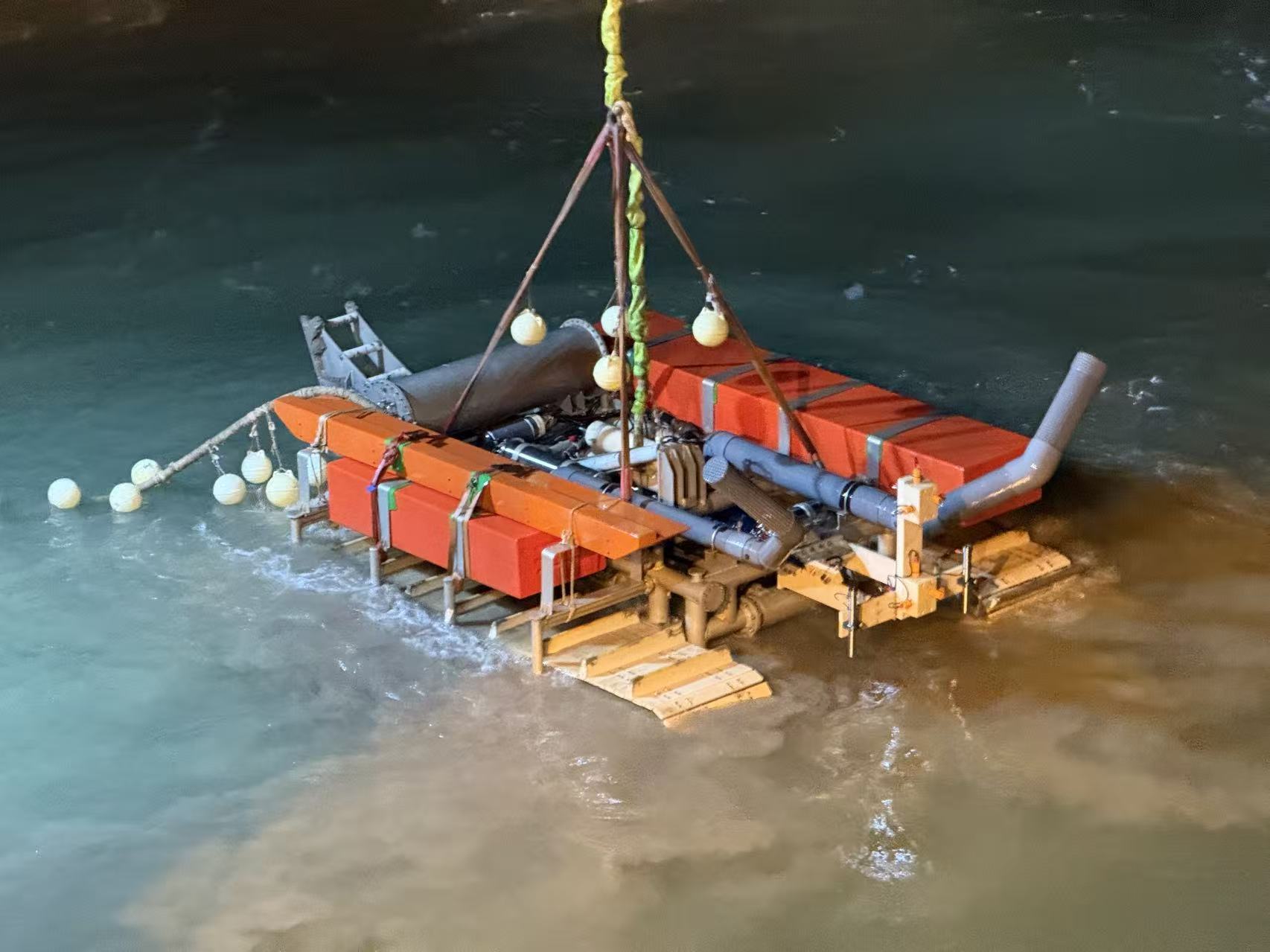
In the Bohai Sea, a robot slowly crawls on the seabed to find exposed submarine cables and bury them again.
This is the new smart way to lay submarine cables and maintain them, developed by a research team from Dalian Jiaotong University, focusing on intelligent sensing and control technologies of rail transport.
Accurate analysis of complex undersea environment
Called the veins of ocean engineering, submarine cables are used to transmit electricity and information. However, they can become exposed, suspended or ruptured due to erosion caused by ocean currents, changes in the seabed geology, and fishing activities, according to Meng Qingxin, a member of the research team.
The traditional methods for laying submarine cables and their maintenance have low efficiency and high risk. In 2017, the team began to develop an underwater robot that can efficiently and accurately detect and lay submarine cables in low visibility and high disruption, particularly in the transitional waters between the shallow and deep seas of the Bohai Sea.
There is a degree of discrepancy between the actual position and preset routes of submarine cables, resulting from factors such as silt coverage, murky sea water and complicated submarine topography. The work therefore requires an extremely high degree of equipment stability.
To prevent the robots from getting lost or operating unstably, the researchers developed an intelligent system to detect the cables by innovatively integrating electromagnetic and sonar detection technologies.
Electromagnetic sensors detect cable signatures to quickly identify the target cable, while the sonar system simultaneously acquires information on its submarine topography and surrounding environment to continuously track and conduct positioning for the submarine cable route.
By integrating multi-source information and intelligent analysis, the system can accurately tell the position, direction and laying condition of the cables, providing data support for construction.
"It's like equipping the robot with a pair of complementary eyes," said Chen Shaohua, in charge of the research team.
With the two approaches combined, the positioning error can be controlled within five percent, even when the cable is buried in silt, Chen said.
Application in real-world projects
Offshore engineering sites are the most direct platforms to test the maturity of technology. The research team has formulated an integrated solution incorporating submarine cable detection and positioning, route tracking, installation guidance and post-lay burial operations. This has been adopted in multiple national ocean engineering projects.
In 2021, the team undertook post-lay burial for the landfall section of the Hainan Wenchang international optical cable, overcoming the challenges of cable burial in complex reef areas.
In the same year, the team completed the post-lay burial task for the landfall section of the submarine cable on Nanji Island, Zhejiang in east China. The robotic equipment developed by the team successfully carried out submarine cable detection and post-lay burial operations in the strong currents of the East China Sea, demonstrating its operational stability under complex marine conditions.
In 2023, the team participated in the construction of a main cable burial project for an offshore wind farm in Guangdong province, achieving an industry-leading burial speed of 11.6 meters per minute.
The intelligentization of ocean engineering equipment is an irreversible trend, Chen said. The research team is developing an intelligent and visualized operation system to realize dynamic sensing and visualized management of underwater construction.
The system displays the position, route and burial condition of the cable relative to the cable-laying robot via real-time 3D animation. This enables operators to gain a more direct understanding of the overall operation, further improving construction efficiency and operational safety.
To cope with the common problem of inaccuracies in the laying positioning above three meters, the team is also developing a new-generation ultra-deep detection system to enhance the capability of identifying and positioning submarine cables in complex submarine conditions and deep burial.
The marine environment is complicated and volatile. Only after repeated verification in real submarine conditions and engineering scenarios can technological achievements from laboratories form core capabilities to serve industrial development, Chen said.