
Good Contents and Technology Make Chinese Culture Reach Further
In recent years, various forms of Chinese cultural products, including outstanding literary works, TV shows and micro-dramas, have gained popularity overseas. Science and technology has also played an important role in this process.
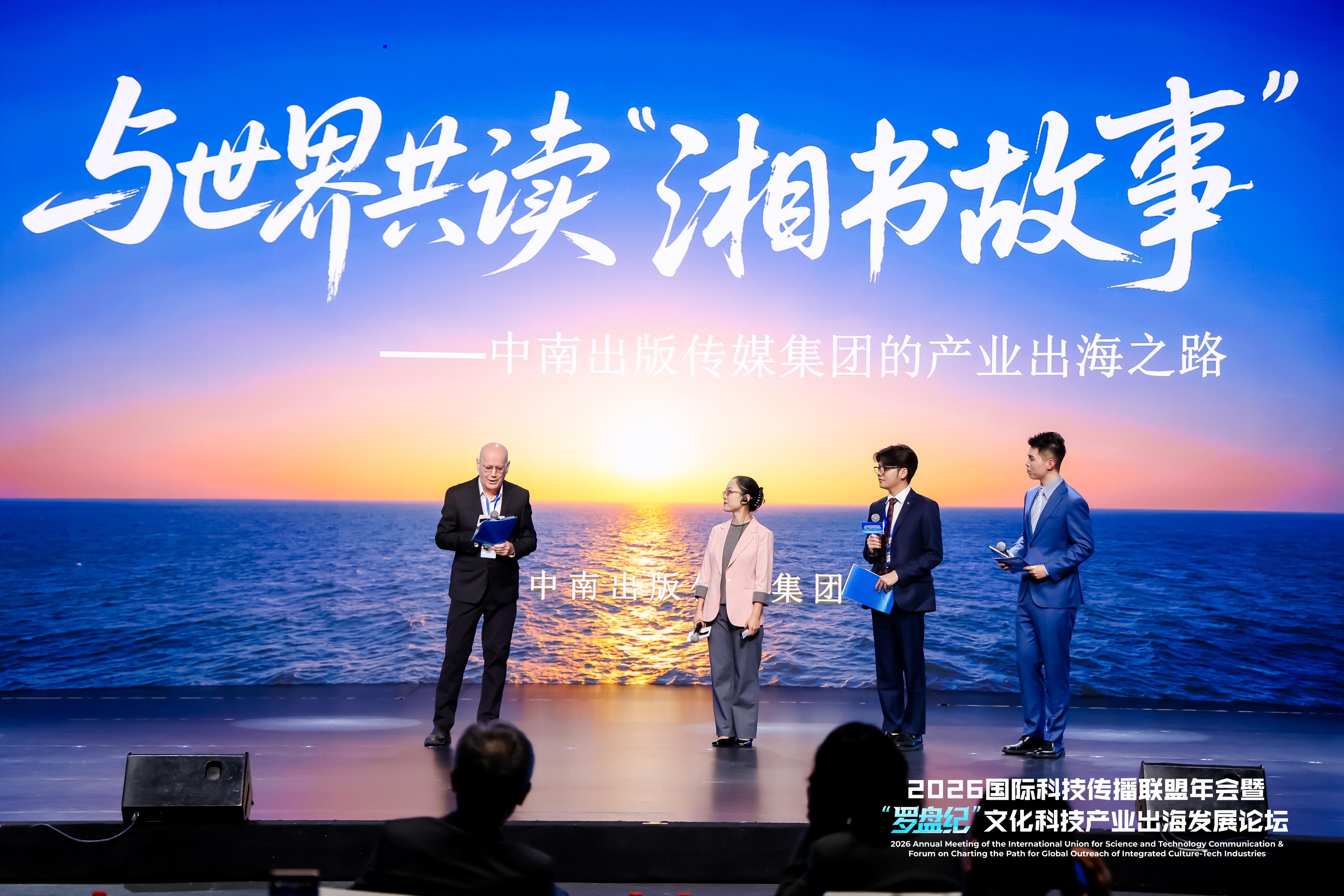
But that is not the whole story as experts shared their thoughts at the 2026 Annual Meeting of the International Union for Science and Technology Communication (IUSTC) & Forum on Charting the Path for Global Outreach of Integrated Culture-Tech Industries in Changsha, Hunan province in central China, on November 9.
The importance of localization
The first step in bringing Chinese culture to the world is to produce high-quality content.
I Deliver Parcels in Beijing, a book by Hu Anyan about his experience as a delivery worker, which became a hit in both domestic and overseas book markets, is a vivid example. Its English version was listed as one of the Best Books of 2025 by both The Economist and Financial Times.
Good content knows no borders. It is essential to plan content carefully from the outset, Yu Yi, executive deputy director of the Brand Promotion & International Cooperation Department of China South Publishing & Media Group Co., Ltd., said. “We should take root in the local context while keeping a global audience in mind.”
The micro-dramas produced by Hunan Liuyi Film and Television Culture Media have topped the overseas micro-drama charts several times. Yue Junyan, deputy general manager and director of business and copyright of the company, said competition will no longer be about financial resources or team size in the future, but about the quality of the content itself.
But good content alone is not enough. Localization is what allows content to take root in overseas markets.
Li Shihai, deputy editor-in-chief of AseanTop News Agency, said international communication should feature localized stories and lightweight storytelling. It should also leverage both local and social media platforms, while balancing factual accuracy with cultural empathy.
Relying solely on copyright export makes it difficult to build a lasting user base, Li Dongxu, head of Overseas Operations, Mango TV App, said. The company has achieved good results by localizing major Chinese intellectual properties for overseas markets.
Li cited the example of Sisters Who Make Waves, a reality TV and music competition series in which the participants are women over 30. A Vietnamese edition of the Chinese TV show was launched in 2023 through a partnership between Mango and a local Vietnamese company. The premiere of the show set three records in Vietnam at the time: the largest production scale, the highest ratings and the largest number of advertisers.
Science & technology, a powerful language
Science and technology knows no borders and has tremendous power to resonate with people. It is a powerful language for international communication, Huang Qiwang, founder and chairman, Chinese Headline New Media, said. The IUSTC has chosen to take a focused approach, using tangible, relatable and human-centered examples of sci-tech innovation, as well as technological achievements that deliver tangible benefits to the public, to tell the story of humanity’s scientific and technological progress.
The documentary "Tech Code," produced by Science and Technology Daily, integrates culture and technology in a coordinated manner. Young people from other countries were invited to explore Jingdezhen ceramics in east China’s Jiangxi province, the Beijing-Hangzhou Grand Canal, the Longmen Grottoes in central Henan province, and the Jinci Temple in Shanxi in north China. They experienced firsthand the important role of technology in protecting and passing on cultural heritage.
When sci-tech elements are integrated into cultural symbols, they help culture reach further, Fang Linlin, deputy director of the International Department of Science and Technology Daily, said.
Özge Atalay, a Turkish student at Jingdezhen Ceramic University, and Camilla Quaranta, an Italian student at Henan University, took part in the documentary.
Atalay said she saw many new innovations in modern ceramics in the course of making the documentary, such as the use of facial scanning and modeling technologies in design.
China uses science and technology to protect its grottoes, which can be a valuable reference for Italy, Quaranta said.
Technological development has also made bringing culture to overseas audiences more efficient. Sovannvita Torng, project assistant and researcher in science and technology communication at the Asian Vision Institute (AVI) of Cambodia, said technology has made the exchange of news articles faster and easier than ever. “Digital platforms, short videos and AI-assisted translation now allow a story published in Beijing or Changsha to reach readers in Phnom Penh within hours.”
Putting people first
However, culture outreach cannot rely on science and technology alone.
Ananya Praditasanee, project manager at the Sino-Thai Communications Group Co., Ltd., said, technology can help us tell stories more efficiently, but the emotion and warmth in those stories still depend on the dedication of their creators. As content production becomes increasingly fast-paced, it is the story and the figures themselves that keep the audience engaged.
Technology is only a tool, Ren Chuangong, head of United Front Aus-China TV Media, said. Algorithms cannot replace cultural empathy or mutual understanding between people. Ultimately, these depend on communication and collaboration between people and local communities, he added.
Young people play a crucial part in bringing Chinese culture to the world. Peter Brian Ditmanson, professor at Yuelu Academy, Hunan University, said we must tell China's story to young people in other countries around the world. “They are the ones who understand new media and new ways of learning about China.”
“We believe in investing in young people as the next generation of storytellers, and in keeping cultural exchange two-way, where each side both shares and listens,” Torng said.