

Chinese Embassy in U.S. Hosts Open House with Sci-tech Exhibition
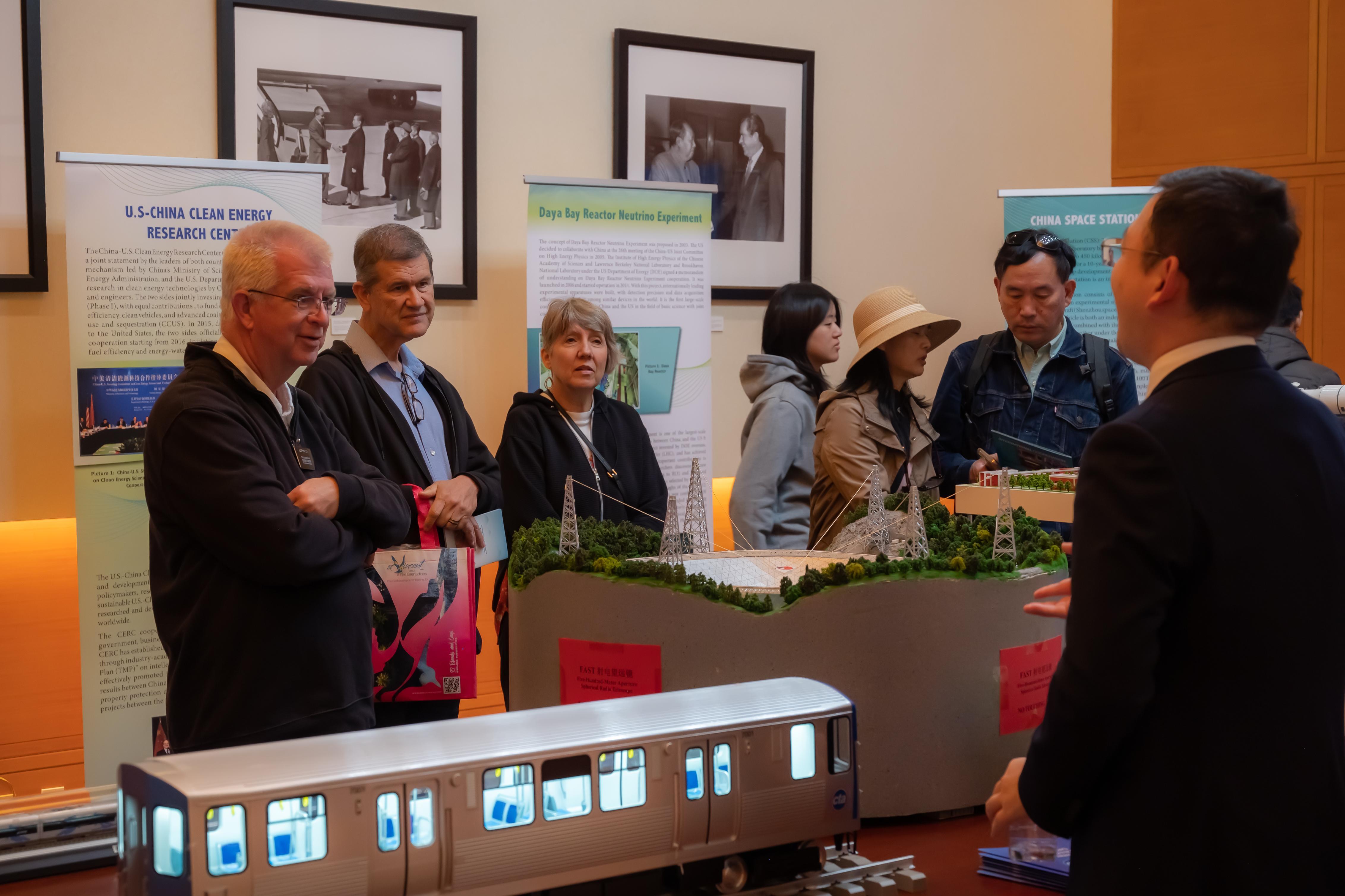
The Chinese Embassy in the U.S. hosted an open house on May 2, featuring a science and technology exhibition titled "Innovate Together: Science & Technology for a Shared Tomorrow."
The exhibition was built on a popular format from previous years, using panels, models, videos, and hands-on experiences to present the outcomes of U.S.-China sci-tech cooperation and China's own innovation drive. It underscored China's commitment to open, win-win collaboration in science and technology and its contribution to the global innovation system.
The "China-U.S. Sci-Tech Cooperation and China's Sci-Tech Innovation" section detailed their practical collaboration in agriculture, public health, clean energy, and high-energy physics. Highlights included hybrid rice cooperation to bolster food security, a folic acid intervention program that reduced birth defect rates, and the work of the China-U.S. Clean Energy Research Center in advancing green and low-carbon development.
Additionally, panels introducing the International Science and Technology Cooperation Initiative and the Initiative on International Cooperation in Open Science illustrated China's advocacy for an open, fair, equitable, and non-discriminatory approach to global scientific cooperation. They also demonstrated China's readiness to join other nations in tackling shared development challenges.
The model display area featured replicas of major Chinese scientific achievements: the Five-hundred-meter Aperture Spherical radio Telescope (FAST), the Jiangmen Underground Neutrino Observatory (JUNO), the High-Intensity Heavy-Ion Accelerator Facility, the Fendouzhe deep-sea manned submersible, and the Tiangong space station.
Many visitors lingered in the area, having in-depth conversations with the embassy's science and technology staff. English-language videos on China's open sci-tech cooperation, its women scientists, and major facilities such as FAST and JUNO were also played on a loop, giving American audiences an insight into the latest progress in China's science and technology development and its open cooperation practices.
For the first time, the exhibition introduced a regional innovation section, with northwestern Shaanxi Province as the guest of honor. The Shaanxi exhibition highlighted the province's achievements and international cooperation in aerospace, advanced manufacturing, and AI through panels, models, and interactive experiences.
A BYD model car demonstrated the growth of the new-energy vehicle industry, and an AI-powered chess robot drew many participants. The arrangement enriched the exhibition and offered the American public a window into the scientific and technological development at China's local level.
The embassy's science and technology staff talked with visitors on topics such as sci-tech cooperation, innovation policies, and future developments. Many attendees said they walked away with a fuller, more nuanced understanding of China's innovation system and its vision for open collaboration.
Dai Gang, the embassy's minister counselor for science and technology, said the exhibition vividly demonstrated the openness and inclusiveness of China's sci-tech innovation. It helped Americans better understand China's technological progress and played a positive role in promoting bilateral sci-tech exchanges and cooperation.