

Robots Move into Home
In China, robots are being integrated into daily service scenarios. In Shenzhen, the country's first robotic cleaning assistant has been deployed, forming a "golden duo" with human domestic workers to serve ordinary households.
In the city's Bao'an district, resident Chen Guo recently experienced this new service model firsthand. During a nearly three-hour cleaning session, the robot and the human cleaner worked in coordination, each performing distinct roles. The robot was responsible for basic cleaning and organization in the living room, while the human cleaner focused on deep cleaning, client communication, and on-site decision-making.
This clearly defined division of labor leverages the strengths of both sides: Humans excel at communication and handling complex, non-standard tasks, while robots deliver tireless, standardized performance — together achieving an efficiency gain greater than the sum of their parts.
"This represents an upgrade from traditional labor-intensive services to a digitally enabled model of human-machine collaboration," said Si Weixin, an associate professor from Shenzhen University of Advanced Technology. He added in the early stages, humans will continue to lead complex decision-making while robots handle execution. Over time, with continuous autonomous learning, robots are expected to independently perform increasingly sophisticated domestic tasks.
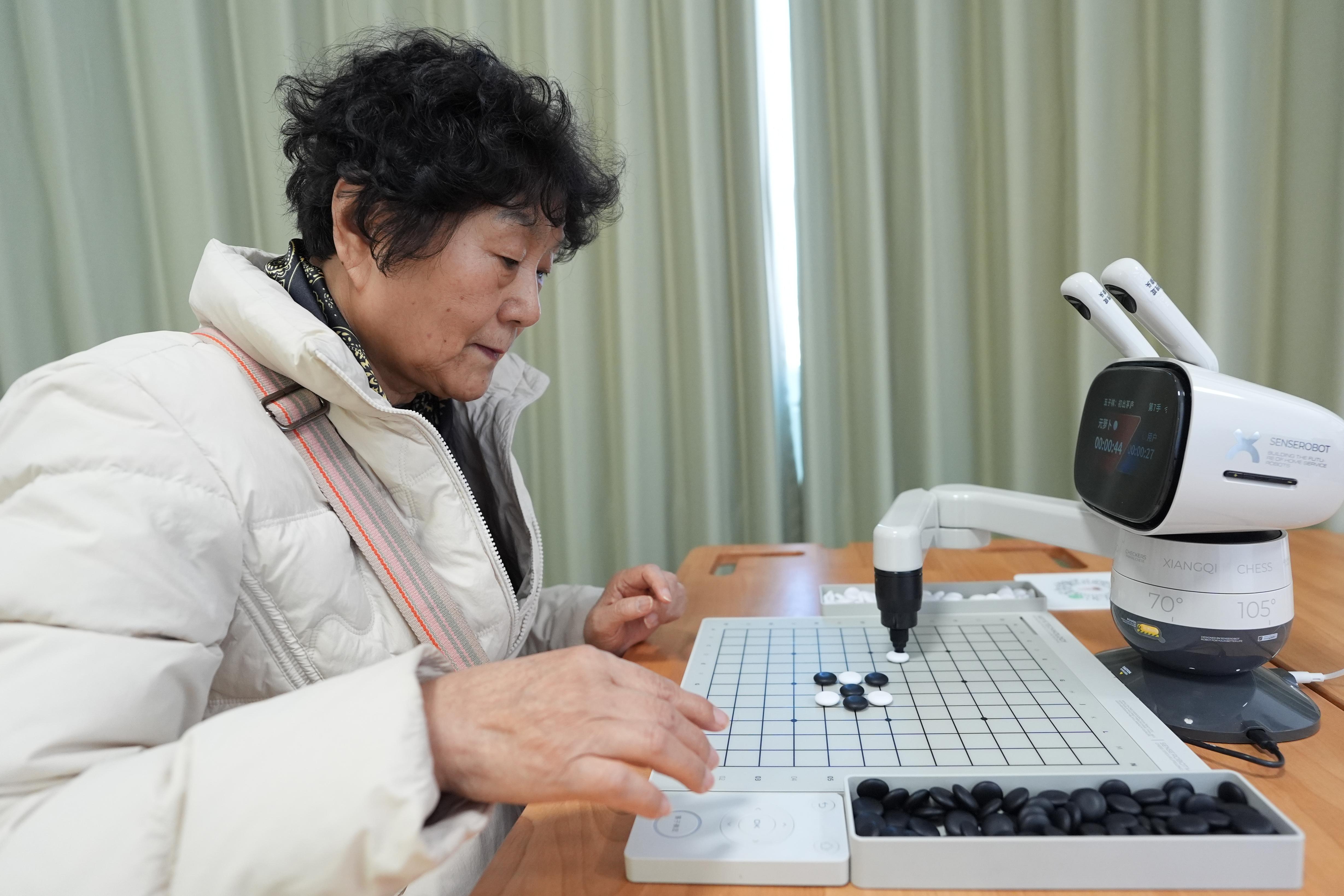
A similar transformation is underway in eldercare. At a smart elderly care robot station in Ronghua, a subdistrict in the Beijing Economic-Technological Development Area, over 40 robotic products have been deployed, covering multiple scenarios. A pancake-making robot can dish out a hot pancake in just three minutes, while rehabilitation robots provide personalized therapy services tailored to individual needs.
"We are using smart elderly care robot stations as a starting point to deploy a range of advanced technologies," said an official from the Beijing Economic-Technological Development Area. These technologies include AI-driven nutrition analysis and smart meal planning, age-friendly interaction systems, non-invasive autonomous health monitoring, and personalized intelligent rehabilitation training.