
Zhongcun Site Unlocks Xia Dynasty Secrets
Lying dormant beneath the ground in Xiyang county for over 3,800 years, the Zhongcun site has now been selected as one of China's "Top 10 New Archaeological Discoveries of 2025." Located in Jinzhong city, Shanxi province, it features the largest known single-chambered aristocratic tomb from the Xia Dynasty. Excavations have yielded rare artifacts from distant regions, including scallops from the Yellow and Bohai Seas, cinnabar from the Hunan-Guizhou area, and turquoise from the eastern Qinling Mountains. These discoveries fill a gap in Xia and Shang Dynasty archaeology on the western foothills of the Taihang Mountains and have revolutionized academic understanding of the hierarchical structure of Xia Dynasty tombs and the broader civilizational landscape.
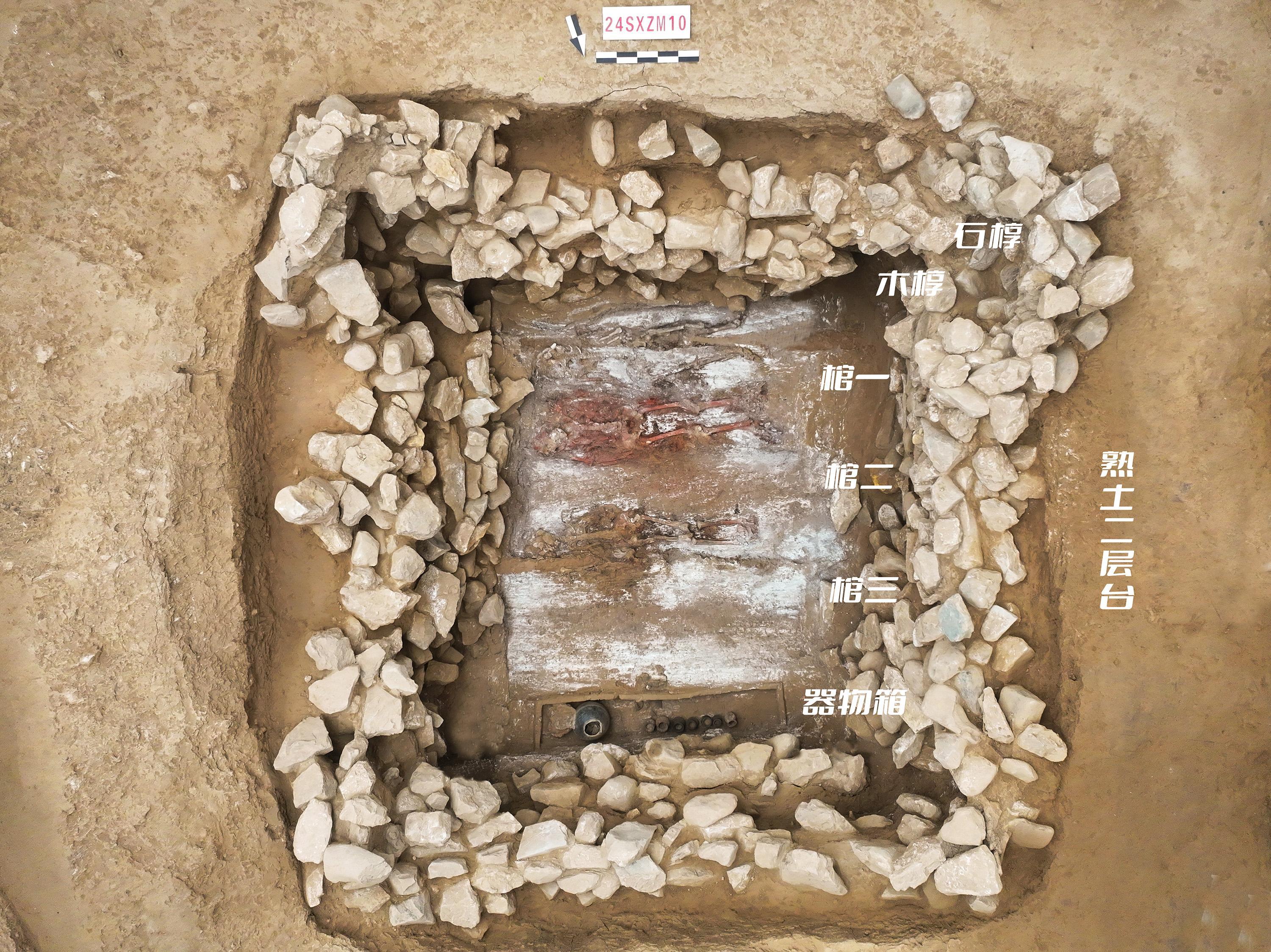
According to Fan Wenqian, director of the Shanxi Provincial Institute of Archaeology, a total of 18 tombs were excavated at the Zhongcun site, including six high-status noble tombs from the late Xia Dynasty and 12 small tombs from the Warring States period. The most striking discovery is the large Tomb M10, covered an area of 46.2 square meters.
The primary occupant was a man over 56 years of age, whose body was entirely coated in cinnabar, with a scallop shell placed atop his head and a turquoise plaque buried on his left side — a level of ritual grandeur unprecedented in the region. In contrast, female burials featured only partial cinnabar application and no other valuable artifacts, reflecting the mature ritual system of a patrilineal aristocratic society.
A systematic survey of the Songxi River basin and neighboring areas by the archaeological team confirmed that the Zhongcun site served as a regional political center independent of the Xia Dynasty's core ruling area, situated within the core zone of the Dongtaibao culture. The noble tombs discovered here represent the highest-ranking remains within this culture.
Multidisciplinary scientific archaeology played a crucial role in decoding the mysteries behind the Zhongcun site excavation. DNA research reveals that the Zhongcun population primarily belonged to the ancient Central Plains people, with a small proportion exhibiting characteristics of the ancient Mongolian Plateau people. The site has been confirmed as a patrilineal family cemetery, and the occupants of the high-status tombs M9 and M10 share a father-son kinship.
Isotopic dietary analysis indicates that the primary subsistence pattern was millet-based agriculture. Sulfur isotope analysis traces the origin of cinnabar to the Wanshan region of Hunan and Guizhou, while turquoise comes from Luonan in the eastern Qinling Mountains of Shaanxi, and scallop shells originate from the Yellow and Bohai Seas. Cinnabar from the south, turquoise from the west, and shell ornaments from the east converged here across thousands of kilometers, clearly outlining the Xia Dynasty's resource circulation network that spanned north to south and connected east to west. Research suggests that these luxury goods were first concentrated in the core area of the Erlitou Xia Dynasty, then distributed to local regions through allocation and exchange, reflecting the Xia Dynasty's firm control over key resources.