

Exploring Living Heritage of 'Smart Canal'
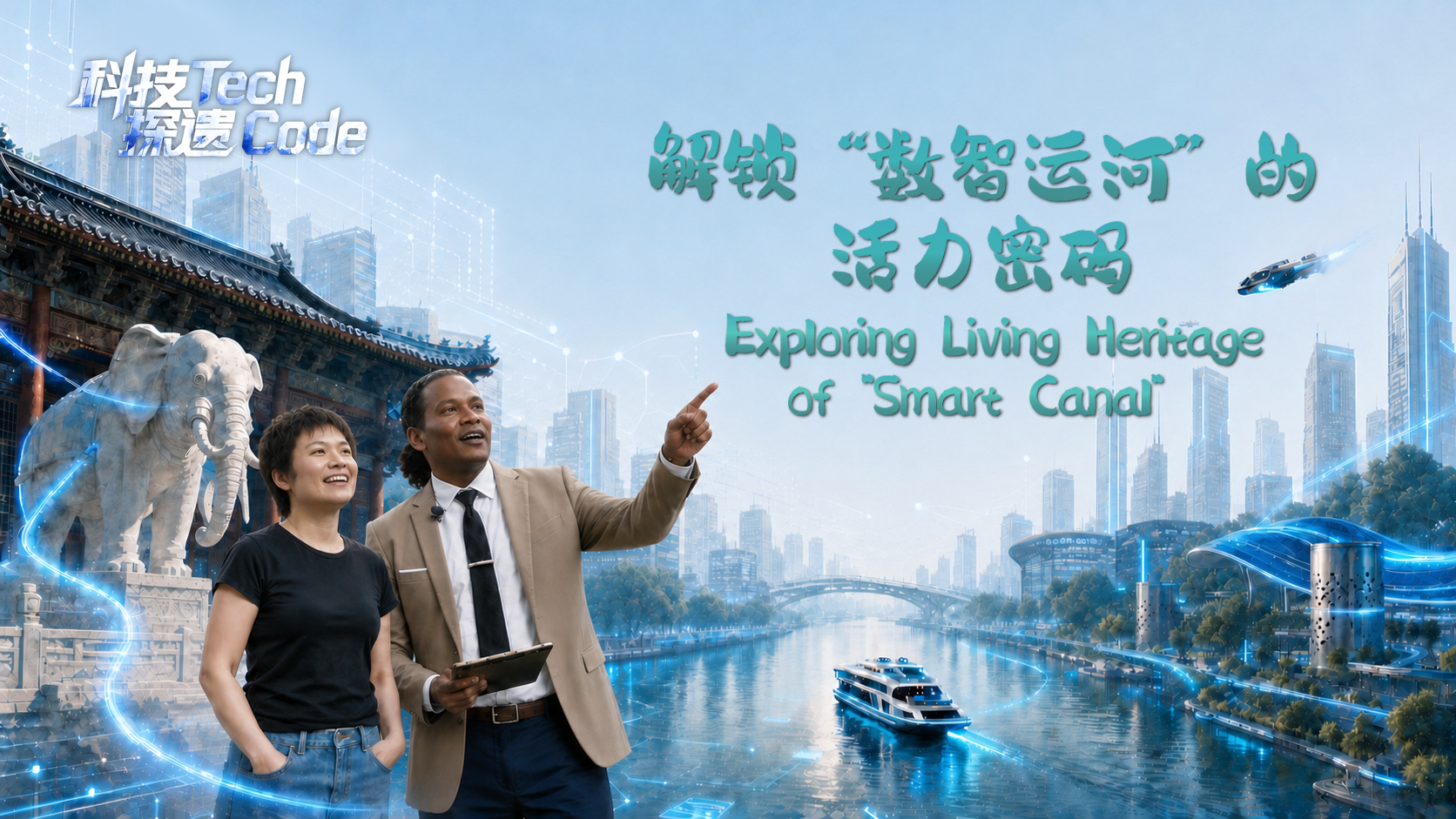
The Grand Canal has been flowing for 2,500 years. It still carries boats and water, and it still runs through cities. But keeping it in working order requires more than traditional maintenance today. It requires laser scanning to assess the state of every stone, sensors to detect the slightest movement, and data to make sense of it all.
Abubaker Hayaty, a doctoral student at Zhejiang University, has spent years studying how cultures communicate. His friend Ke Ning works at the Hangzhou Arts and Crafts Museum Cluster and knows the canal's history intimately. Both have spent years around this waterway. But the technology now being used to protect it is new to both of them.
At the Beijing-Hangzhou Grand Canal Museum, a massive screen shows ancient workers digging the canal with primitive tools. "Seeing this introduction," Hayaty says, "I have come to appreciate the wisdom and perseverance of the ancient builders."
What he is about to see is how that ancient wisdom is being preserved with modern tools.
A bridge made of data
From the museum, they go to Zhejiang University. In a laboratory at the Cultural Heritage Institute, engineer Huang Shuo pulls up raw data from the Gongchen Bridge digital protection project on a screen. A complete 3D model of the bridge floats beside thousands of white points.
Huang explains that the technology is photogrammetry that uses algorithms to reconstruct photographed objects. The team used drones, ground cameras, and boats to scan the bridge from every angle. The result is a digital replica accurate to the millimeter. Researchers can now monitor the bridge's condition without touching it.
The data is stored in a server room where cluster computing systems handle the massive volume. "Regular computers can no longer meet our demands," Huang says.
Diao Changyu, deputy director of the Cultural Heritage Institute at Zhejiang University, explains: "We aim to transform physical artifacts, which are difficult to preserve forever, into digital assets that can be copied and passed down permanently."
When Hayaty asks about AI, Diao says he is a technology optimist. In archaeology, many time-consuming tasks are being sped up, thanks to AI's power.
Monitoring a 110-km waterway
The digitization of one bridge is only the beginning. The Hangzhou section of the Grand Canal stretches 110 kilometers and contains 11 heritage elements. According to Shen Ying, deputy director of the Hangzhou Grand Canal Protection Center, these figures account for one-tenth and one-eighth of the entire Grand Canal system respectively. The canal passes through 27 cities.
Managing this vast heritage is complex. The canal runs through Hangzhou's urban core, tied to the lives of millions. This requires multi-departmental collaboration.
So Shen's team built the "Smart Canal" system, a digital platform that integrates data from multiple sources. It operates on a monitoring network called "Water, Land, Satellite, and Sky." But technology alone is not enough. Shen says some problems can be spotted only by going to the venue, doing a foot patrol. Sometimes plants grow in the bridge cracks, she explains. Tourists might see life and vitality in that but if the roots grow too large, they damage the stones. That will eventually weaken the bridge itself.
Inspectors use what Shen calls "fingertip inspection." They compare pairs of images side by side, looking for changes. "When we spot a problem, we compare the left and right images to find differences," she says. "Those differences are the areas we need to monitor."
On the 428 boundary markers that define the protected area, small round devices have been installed. "That small device is like a digital armor," Shen says. "It is an online monitoring module."
Gongchen Bridge has a structural monitoring module. Blue markers on the 3D model indicate cracks or subsidence identified over years of monitoring. It is like taking the bridge's pulse and diagnosing its condition, Ke exclaims.
At Fengshan Water City Gate, the only surviving water gate among the 15 built in the Yuan Dynasty, monitoring is more precise. Researchers collect data on subsidence, bulging, arch deformation, and cracks. Hu Chaoqiao, deputy head of the Heritage Monitoring Department of the Hangzhou Grand Canal Protection Center, says they use a four-color early warning system to denote the level of danger: red, orange, yellow, and green.
A small inclination sensor functions like a nerve ending. "In the near future, it will transmit changes to our Smart Canal platform 24 hours a day," Hu says. "This is not merely an upgrade. It is a key advancement for the entire monitoring system."
From the lab to the public
Technology serves not just experts but millions of visitors.
At the Beijing-Hangzhou Grand Canal Museum, Deputy Director Xia Handan shows Hayaty a 26-meter-long scroll depicting the canal's route during the Qing Dynasty. "The painting uses text to label each location," she explains. "We can trace which cities and water facilities the canal passed through."
A data platform lets visitors explore the canal's story. "We have gathered scattered information on this screen," Xia says. "Visitors can explore food, scenery, and customs, and learn how the canal changed daily life."
At the Hangzhou Arts and Crafts Museum, 351 artifacts have been digitally preserved through 360-degree scanning. "Visitors can select an artifact and view its complete digital record," Ke says, "including name, age, and a rotating 3D image."
"Is it possible I won't need to come to the museum at all in the future?" Hayaty asks. The answer is yes. The museum already offers 360-degree virtual tours on its website and WeChat account.
Legends on the water
The most dramatic fusion of technology and experience happens on the water.
At Wulin Gate, Hayaty and Ke board a boat for an augmented reality (AR) water tour, launched in October 2025. Passengers wear Rokid's AR glasses that blend real scenery with animated stories about the canal's legends.
Shen Jiahuan, a Rokid representative, explains: "We dug deep into the cultural stories behind each scenic spot and produced animations. With our Optical See-Through (OST) solution, you see both the real scenery and the animated stories."
A central control system manages the experience. "At important scenic spots like the Xiangji Temple and Gongchen Bridge, all passengers see the same story at the same time," she says. "This creates shared cultural resonance."
Li Linwei, spokesperson of the Hangzhou Water and Land Transportation Tourism Development Group, says the tour started last October. "Visitors used to only hear stories from the tour guide. We wanted them to experience it visually. So we added AR glasses to blend virtual stories with real scenery."
As the boat returns, Hayaty reflects that the Grand Canal is a living cultural heritage. "We use technology to record it, understand it, and protect it. Technology helps us observe it from perspectives we've never had before," he says.
A living heritage, digitally alive
As the boat returns, Hayaty reflects that the Grand Canal is a living cultural heritage. "We use technology to record it, understand it, and protect it. Technology helps us observe it from perspectives we've never had before," he says.
Diao speaks of a broader vision. China's commitment to cultural heritage protection has never wavered, he says. The country values mutual exchange between civilizations. "We once worked hard to learn advanced technologies from around the world," Diao says. "Today, we have developed many cutting-edge technologies and reached world-leading levels. We are willing to share these technologies and China's experience with other countries."
Shen adds, "We are moving from single-point breakthroughs toward holistic smart governance."
Behind them, the canal flows on. It does not announce itself as a world heritage site. It just keeps flowing, as it has for 2,500 years. But now, in data centers, in AR glasses and monitoring platforms, something new moves alongside the water: the digital life of a living heritage.