

China's Vision Shines in Global AI Governance
By WANG Xiaoxia & CUI Shuang
As AI technology rapidly evolves and expands into new application scenarios, it is becoming a key driver of technological innovation, industrial transformation, and social progress. At the same time, safety risks and governance challenges have become pressing global issues.
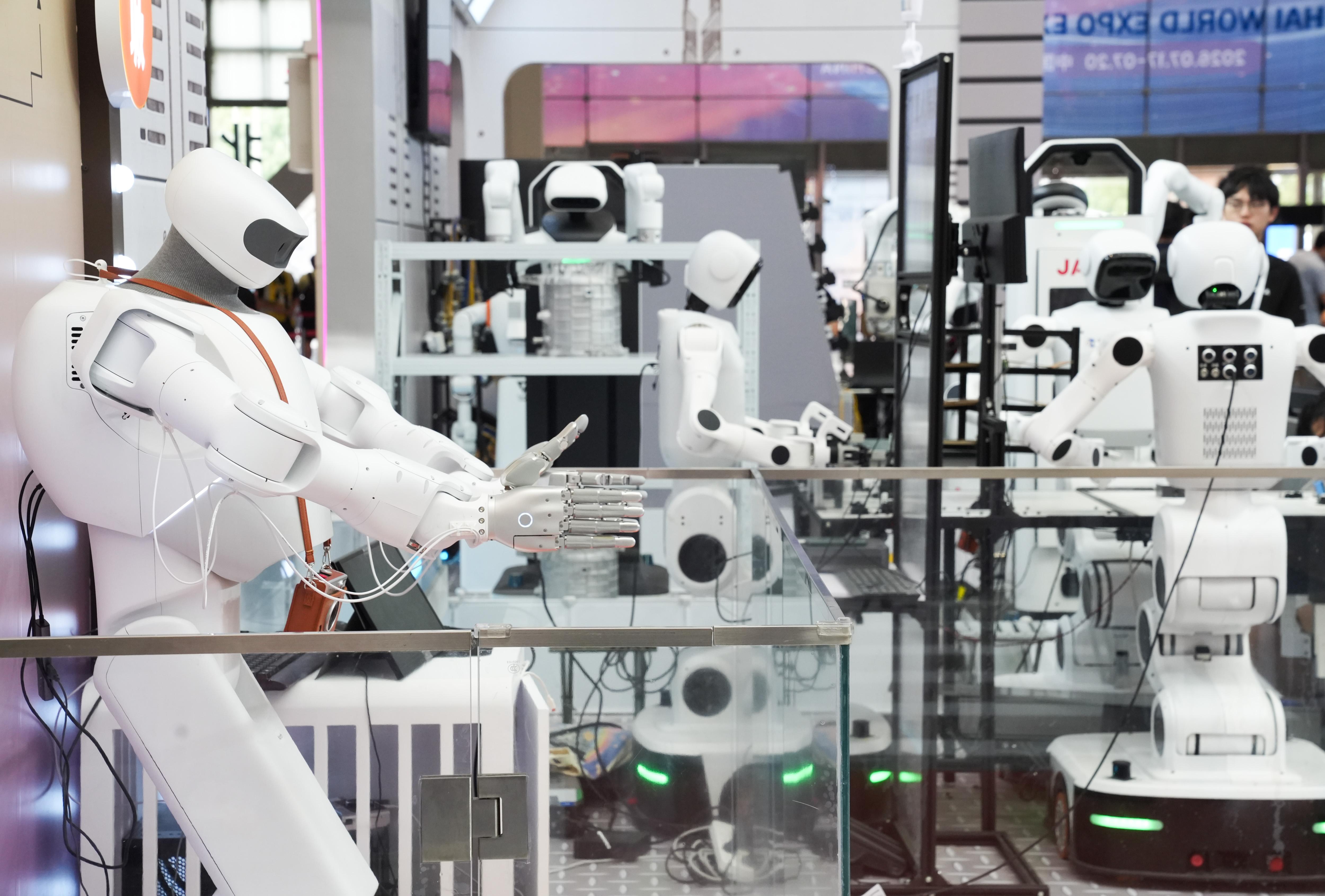
To promote international exchange and cooperation, the 2026 World Artificial Intelligence (AI) Conference and High-Level Meeting on Global AI Governance is being held in Shanghai from July 17 to 20, themed "AI Partnership for a Brighter Future."
China continues to promote the establishment of a global AI governance framework with broad consensus, championing innovation while emphasizing responsibility, and contributing Chinese solutions and insights to global AI governance.
Open for digital inclusion
As the world's largest holder of AI patents, China is providing solutions to the world. For instance, a translation system based on the DeepSeek foundational model was used in earthquake relief efforts in Myanmar; a parallel mining operating system enables efficient and green operations in Thai mining areas; and Huawei's intelligent systems help South Africa's railways improve inspection and maintenance efficiency.
Over the past year, Chinese open-source models accounted for 17.1 percent of global downloads, ranking first in the world. China is opening its low-cost, replicable technological pathways to the world to narrow the AI divide. China is also participating in capacity building for developing countries under the framework of the United Nations, helping them bridge gaps in technology, talent, and governance.
China's AI industry follows the principles of people-centered and AI-for-good development, accumulating valuable and replicable experience, said Wei Kai, director of the AI Institute at the China Academy of Information and Communications Technology (CAICT).
Joe Tsai, chairman of the Alibaba Group, said China's AI breakthrough hinges on the belief in open source for win-win outcomes. In 2025, the global download volume of China's open-source models was the highest in the world, making intelligent technology truly a public good for all mankind.
Systematic governance for safety and development
As AI integrates into daily life, risks such as privacy breaches and algorithmic bias are emerging. Laws and regulations play a critical role in defining boundaries and ensuring transparency, fairness, and accountability.
China is advancing AI governance with a systematic approach, building a comprehensive framework that spans laws, policies, standards, and supervision. It has established three foundational laws—the Cybersecurity Law, the Data Security Law, and the Personal Information Protection Law—providing basic guidelines for AI data processing. Special regulations addressing deep synthesis, generative AI, and facial recognition have also been introduced, moving governance from general principles to targeted measures.
"The institutional framework of AI governance in China emphasizes both development and security," said Wu Shenkuo, a law professor at Beijing Normal University. A multi-tiered legal system covering algorithm registration, security assessments, and tiered classification is taking shape, providing robust institutional support for technology that benefits livelihoods and fosters healthy industrial growth. It also offers an example for global AI governance.
Upholding multilateralism
AI is not only reshaping industries but also redefining global governance. China advocates a multilateral approach, releasing the Global AI Governance Initiative, implementing the AI Capacity-Building Action Plan for Good and for All, proposing the Global AI Governance Action Plan. It has called for the establishment of a World Artificial Intelligence Cooperation Organization to build a fairer and more equitable global governance system.
Amandeep Singh Gill, the UN secretary-general's envoy on technology, stressed that progress in AI governance relies on global cooperation, and China is making sustained contributions. China's perspectives are invaluable for international discussions, particularly in bridging digital and AI divides, strengthening capacity building, and ensuring broader sharing of AI dividends.
At the recent UN Global Dialogue on AI Governance, Li Lecheng, China's delegation head and minister of industry and information technology, emphasized China's willingness to work with all parties to promote fair and inclusive development, assist countries—especially those in the Global South—in developing AI technologies and services, and build a governance framework with broad consensus.
From conceptual initiatives to institutional exploration, from technological inclusion to multilateral collaboration, China is committed to steering AI governance toward a positive and beneficial direction, ensuring that this technological revolution better serves humanity.