
Chinese Machinery Empowers Family Farming in Brazil
By GONG Qian
In northeastern Brazil, the China-Brazil Science and Technology Backyards (referred to as Residences in local Brazilian usage) on Family Agricultural Mechanization are transforming the landscape of local family farming.
The China-Brazil Science and Technology Backyards (STBs) established in capital city Brasília and Apodi municipality are not only emerging as a vital platform for agricultural cooperation, but also a testament to the deepening bond between the two peoples.
The birth of Brazil's STBs
The Apodi STB was launched on November 13, 2024, as China's first STB in Brazil and even across Latin America, Professor Yang Minli from China Agricultural University (CAU), one of the initiators of the China-Brazil STB program, told Science and Technology Daily (S&T Daily). Less than a month later, another STB was launched in Brasília.
This cooperation began in September 2021. The International Association for Popular Cooperation, a non-profit association that functions as an exchange platform for the community of the Global South, approached Yang with Brazilian representatives, seeking Chinese assistance to solve mechanization issues in Brazil's family farming. The request surprised Yang as she had always regarded Brazil's large-scale agriculture as highly advanced and even a model for China.
However, she was told that many Brazilian smallholder family farms still rely on very traditional methods. Smallholder farmers cannot afford the imported large farm equipment, which is expensive, and Brazil lacks domestic manufacturers producing suitable small and medium-sized agricultural machinery. Yet, they produce about 70 percent of the food on Brazilian dining tables.
Having achieved comprehensive poverty alleviation in 2020 and boasting mature experience and tailored machinery for small-scale farming, China became a natural partner for Brazil.
In 2024, CAU, together with some Chinese agricultural machinery enterprises, joined the Brazilian government, universities, research institutions and farmer organizations to set up the two STBs in Brazil.
Before departing for Brazil, the CAU team members underwent rigorous training in agricultural and machinery operation techniques, China's agricultural policies, and national development experience and models.
Their primary mission is to meet the needs of Brazilian smallholder family farming through actions like field surveys, machinery testing, technology promotion, joint R&D, and talent cultivation.
Moreover, leveraging big data management systems jointly developed by CAU and Sinomach Digital Technology Co., Ltd., the STBs provide services like operation monitoring and production statistics, significantly enhancing precision management in local crop production.
Chinese machinery delivers big livelihood gains
"Local farmers are eager to use Chinese agricultural machinery and speak highly of it: it is high-efficiency, labor-saving and highly practical," Yang said.
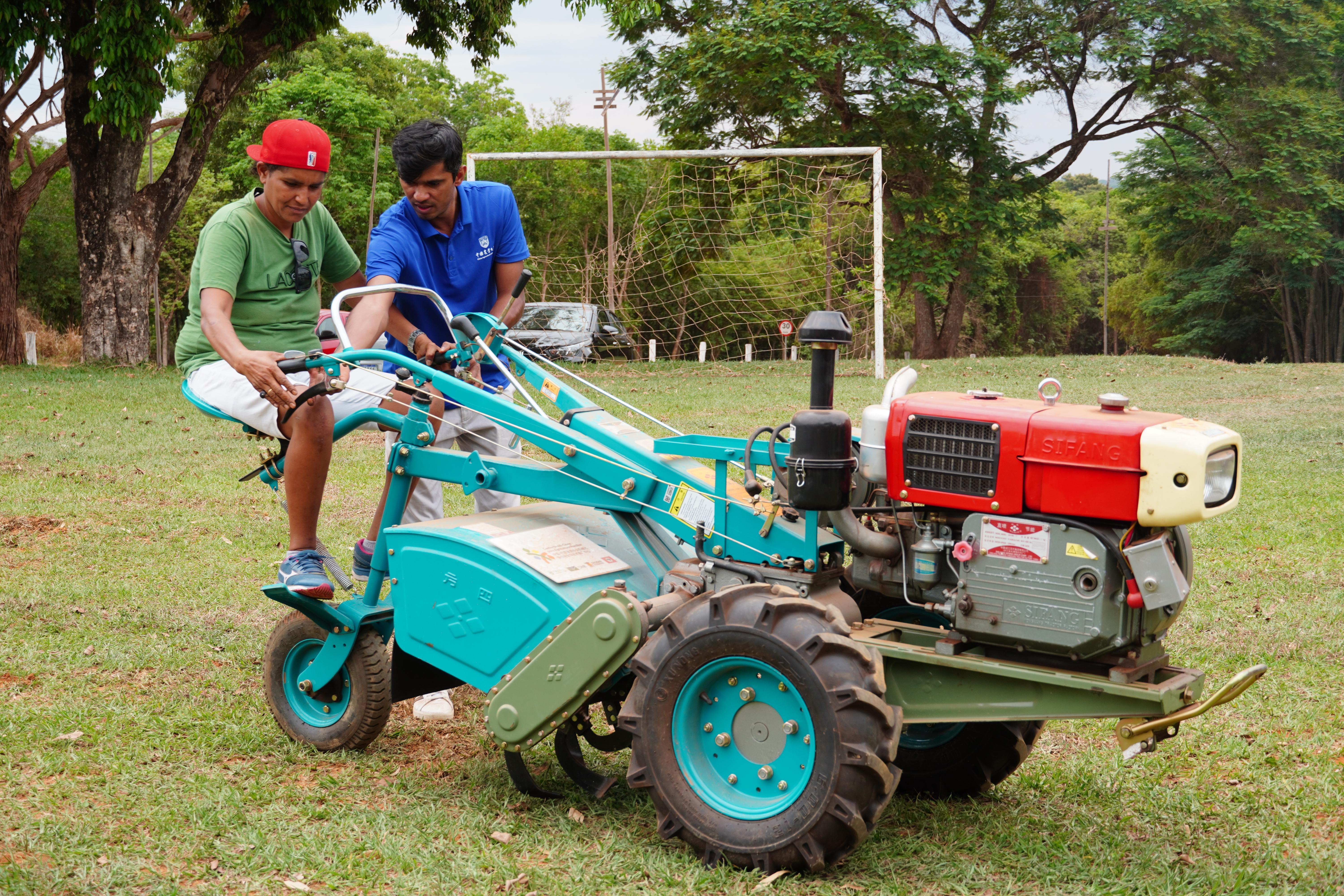
The benefits were particularly evident during harvesting and land preparation, according to Muhammad Mateen from Pakistan, a PhD student at CAU and a member of the program. Mateen recalled visiting Alcione, a farmer who grows vegetables and beans with her husband. Getting their plot ready, especially during planting, used to be a very time-consuming job for the couple.
After being shown a walking tractor, a versatile machine especially suitable for small farms, Alcione was eager to learn how to use it. The Chinese machine changed her routine and made work easier, not just reducing the labor cost but also saving time, and directly increasing crop yields.
"What touched me most was her sense of empowerment. She even planned to take out a loan to purchase her own Chinese agricultural machinery," Mateen said. "This is the impact we want to achieve through the China-Brazil STB program, enabling small farmers, especially women, to access affordable technology and control their own farms and future."
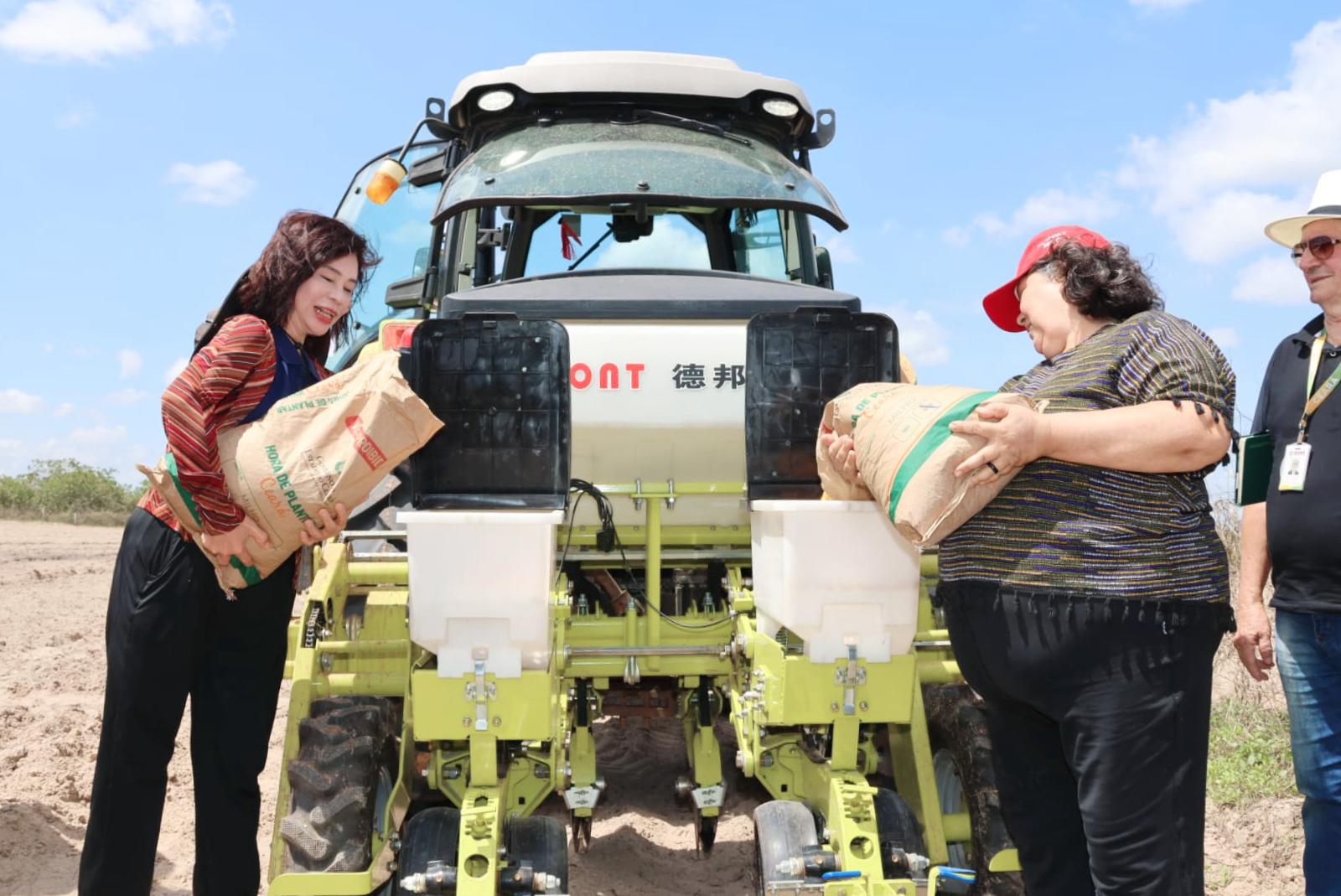
Chinese machinery has brought tangible benefits. Farmers growing cilantro and lettuce have seen their household incomes rise by 80 percent to 90 percent. The seed usage for corn dropped by roughly 50 percent, while expected yields increased by 40 percent.
So far, 15 Chinese enterprises have provided 62 small and medium-sized agricultural machines and more than 60 sets of big data equipment across Brazil, serving over 1,000 family farming households.
In addition, a preliminary big data system and BeiDou satellite base stations have been set up, applying digital technology to boost productivity.
Yang said these tangible achievements have also driven the introduction of supportive policies. For example, the Brazilian government introduces credit policies specifically for small machinery and plans to procure Chinese rice combine harvesters.
Friendship across the ocean
Cultural differences, particularly language barriers, posed a challenge initially. As a Portuguese-speaking nation, Brazil has very low English penetration.
Tang Xu, a master student at CAU involved in the project, told S&T Daily that he was impressed by a field exchange with local farmers. They communicated using simple words and gestures due to the language barrier but could understand each another very quickly.
"This made me realize that true cooperation doesn't rely entirely on language but is built on shared goals and trust," he said.
Beyond technological cooperation, the STBs serve as a cultural bridge. During Chinese New Year, the Chinese team invites locals to make dumplings and paste Spring Festival couplets written on red paper. They also participate in Brazil's celebratory events and hold academic and cultural salons. "Such two-way interactions deepen mutual understanding in a relaxed atmosphere," Tang said.
Yang said people-to-people bonds transcend borders in international exchanges. Dedication to helping others with Chinese technologies and experience always earns genuine friendship and mutual respect.
Once she gave a local partner a red envelope containing a new one-yuan banknote during the 2026 Spring Festival. The young man pulled out the bill and exclaimed, "Mao Zedong!" on seeing the image on the note.
Tang was moved by the changing way the farmers addressed the Chinese team members. Initially, the members were seen as visiting technical experts. But over time, the farmers called them "amigo" (friend), and even "familia" (family), brought them fresh fruits and vegetables, and offered rides when getting transport was difficult.
"Via the STB, we didn't just promote technology, we spread culture and made true friends," Tang said.
"Cooperating with Brazilian farmers feels like being with family," Yang added. "Their passion and eagerness make us determined to keep moving forward."
To celebrate the China-Brazil Cultural Year 2026, a series of cultural events in the fields of the performing arts, visual arts, music, and intangible cultural heritage are being held in both countries.
Such exchanges will enhance mutual understanding, build a closer bond between the two peoples, and unleash the dynamism of the China-Brazil community with a shared future.
The Rural Special Technology Service Center of China Association for Science and Technology(CAST) contributed to this article.