

Exploring an Innovative Path for Desert Green Power —— China-Egypt Belt and Road Joint Laboratory on Renewable Energy
On Karaman Island in Sohag, southern Egypt, rows of photovoltaic (PV) panels cover the roofs of the PV R&D base of Egypt's Academy of Scientific Research and Technology (ASRT). The PV modules absorb sunlight, converting it into green electricity.
This is the work of the China-Egypt Belt and Road Joint Laboratory on Renewable Energy. Speaking of the major achievements made by the joint lab so far, Mohamed Zahran, a professor at the ASRT, listed several "firsts."
In October 2023, Egypt produced its first locally made half-cut solar cell. One month later, Egypt fabricated its first locally made high-efficiency half-cell solar module.
"The joint lab is the core driver behind these achievements, providing comprehensive support for our technological breakthroughs and independent production," Zahran said.
Building an R&D and production system
"Before the joint lab was launched for establishment, Egypt's PV sector faced numerous constraints," Zahran noted. There was a lack of standardized R&D facilities, complete sets of production equipment, and mature fabrication processes or technical systems. Since all solar cells relied on imports, local research teams had no means to conduct hands-on R&D or test trial-mass production.
The joint lab changed all of that.
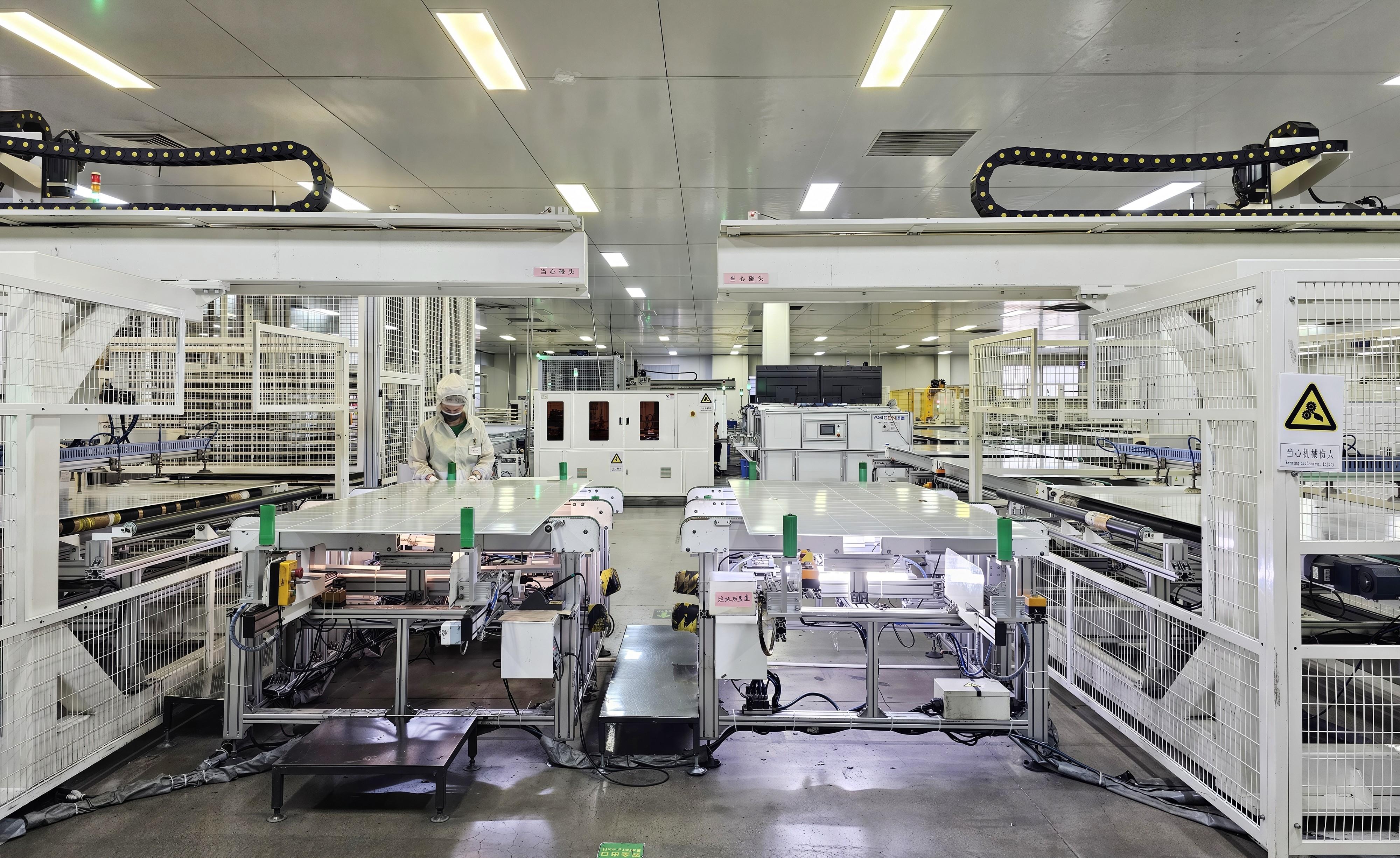
"It established a complete PV cell R&D and production system for Egypt," Zahran said. The system covers core processes of PV cell manufacturing, a complete set of professional production and testing equipment, and a standardized, clean R&D and production facility tailored for desert climates.
"Over the years, the joint lab has truly become a standout 'Chinese business card' locally," said Zhou Meng, deputy director of the research department at the 48th Research Institute of China Electronics Technology Group Corporation (CETC). Moving forward, the two sides will further promote joint R&D and transformation of advanced PV technologies, enabling local residents to enjoy more technological dividends from renewable energy.
Broadening the scope of collaboration
"Egypt is rich in solar resources, with an average of 3,000 hours of full sunshine per year, giving it uniquely gifted natural conditions for developing renewable energy like solar power. China possesses the world's most mature PV technologies, equipment, and supply chains," Zhou said. The cooperation between China and Egypt in the renewable energy sector represents a textbook case of complementary advantages, making the partnership "a perfect match right from the start."
During the initial construction phase of the joint lab on Karaman Island, the site faced constraints in local power supply and water access.
"In response to these challenges, the joint lab has established a series of PV demonstration systems, including an on/off-grid PV system, a PV water pumping system, and a PV water purification system," said Lu Yunzhang, a research fellow at the 48th Research Institute of CETC. These "small and beautiful" livelihood projects have effectively mitigated local power and water scarcity, serving as a practical model for regional energy security.
In the eyes of Aref Eliwa, a professor at the ASRT, there is immense potential for China-Egypt cooperation in the renewable energy sector, and the joint lab has a promising future in driving Egypt's energy transition.
"Through the invaluable platform of the joint lab, scientists from China and Egypt can carry out deep cooperation and drive joint innovation," Eliwa noted, citing an example. With collaborative research efforts, the joint lab overcame technical bottlenecks in high-resistance dense-grid solar cell technology. The milestone significantly enhanced PV cell efficiency and laid a solid technological foundation for developing PV products tailored to Egypt's local solar environment.
Forging a deep friendship
In building and running the joint lab side by side, the two sides have shared thick and thin, leading to a steady deepening of their friendship and collaboration.
"In our day-to-day work, despite differences in language, culture, and habits, we have always been completely aligned, moving forward with a single mind and a shared purpose," Lu said. One memory remains particularly vivid for him. On one occasion, the joint lab urgently needed an industrial component that could not be found locally. Upon hearing this, an Egyptian contractor immediately dispatched a courier to drive more than 600 kilometers through the night from Cairo to deliver it. "This kind of 'we're in this together' solidarity is truly moving."
What remains especially unforgettable for Zahran is that at the initial construction phase of the joint lab, the temperature inside the joint lab soared past 40 degrees Celsius during the testing and commissioning of the diffusion furnace. Yet, the Chinese staff still worked tirelessly for long hours to ensure the project stayed on schedule.
"It is moments like these that make me say with certainty: we have never been two separate teams, but rather one family tightly bound by a shared mission," Zahran said. This shared mission is to jointly tackle breakthroughs in renewable energy technologies, steering Egypt and the entire African continent toward success in the green energy sector.
"In the future, we plan to upgrade the joint lab into a regional renewable energy innovation center," stated Zhou. Through collaborative R&D, technology demonstration and promotion, as well as technical training, the joint lab will amplify its spillover and driving effects across the region.