

Building Resilience Across Borders
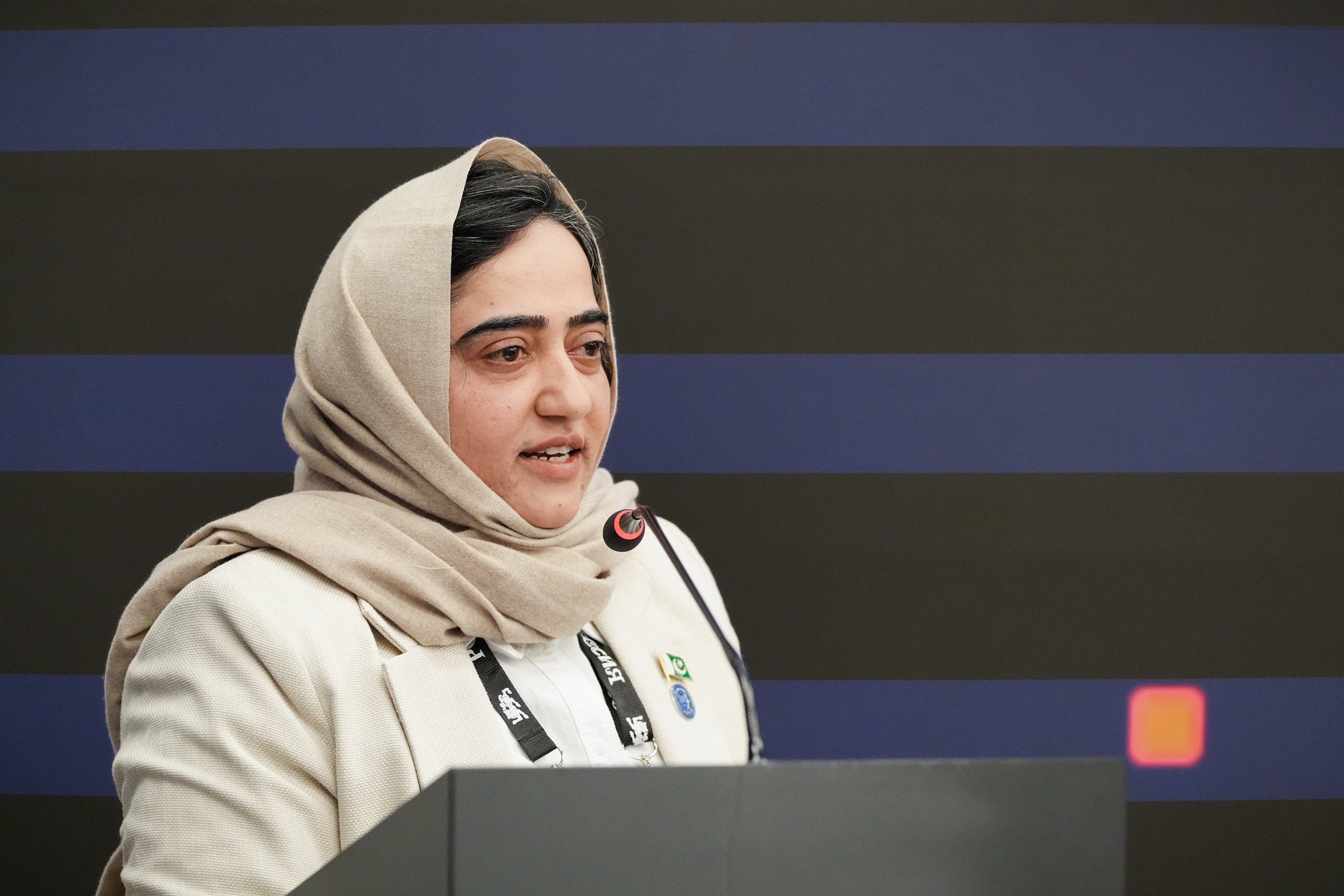
In the laboratory at Tianjin University (TJU)'s School of Architecture, Pakistani PhD student Asma Bibi is refining her "Climate-Mental Health-Community" tri-resilience model. She hopes to help communities in Pakistan rebuild after climate disasters through a science-based framework.
Asma has spent over a decade on grassroots climate action, community development, and mental health advocacy in Pakistan. Her mission was shaped by a pivotal experience: the devastating floods of 2010. "I witnessed entire communities lose their homes and struggle to recover from the trauma. That disaster made me realize that climate change is not only an environmental issue; it also causes long-term psychological and social suffering."
Determined to make a difference, Asma began working in flood-affected communities, promoting climate awareness, mental health support, and ecological restoration.
Over the past 13 years, her efforts have reached communities across Pakistan. To date, Asma has organized over 1,200 public outreach activities, planted more than 16,000 trees, and carried out projects in 28 cities and 300 villages.
Seeking stronger academic foundations for her fieldwork, she came to China in 2024 to pursue a PhD in landscape architecture at TJU.
"I chose TJU because of its interdisciplinary research environment," she explained. "My academic interests connect climate resilience, psychology, and nature-based solutions. The expertise of my supervisor in child mental health and plant therapy aligns perfectly with my background and research goals."
Her background in psychology and mental health has given her a deep understanding of human suffering, but at TJU's Department of Landscape Architecture, she is learning something transformative: how to scientifically design environments that support both ecological and psychological recovery. What has reshaped her thinking most, she says, is China's "sponge city" concept and its long-term commitment to integrating blue-green spaces with community planning. She is now learning to design not just for flood control, but for people’s well-being. Her tri-resilience model, connecting climate resilience, mental health, and community strength, is being built on evidence-based research.
Her research focuses on the relationship between climate change, psychological well-being, and sustainable community development. She hopes to transform years of grassroots experience into scalable, evidence-based solutions that can help climate-vulnerable communities improve both ecological resilience and mental well-being.
While pursuing her studies at TJU, Asma has continued to gain international recognition for her work. In 2025, she received the R.K. Pachauri Award for Youth-Led Climate Action, which honors young climate advocates dedicated to practical community engagement.
When asked about the key differences between China and Pakistan in addressing climate challenges, Asma offered a frank comparison. She observed that the difference lies in systematic planning versus reactive response. China treats ecological governance as a long-term national strategy, while Pakistan responds to floods only when they come. What she finds most applicable from her studies in China, she said, is the country's integrated early warning systems, community-level disaster networks, and the sustained "short-intervention to long-term development" approach.
With her 10 years of grassroots work in 300 villages and her training at TJU, she wants to bring back two things. She wants to bring back the science of climate-responsive design which she is learning in landscape architecture. Also, she wants to bring back frameworks for sustained community mental health support drawn from her psychology background. She believes Pakistan has no shortage of will or community spirit, but what it lacks are structured, evidence-based frameworks. That is what she aims to build.
Reflecting on her journey from grassroots activism in Pakistan to academic research in China, Asma said two guiding principles have shaped her path. The motto of TJU, "Seeking Truth from Facts," has taught her the importance of practical action and perseverance. She also quoted a Pakistani proverb, "Slowly, slowly, the container fills." "Meaningful achievements are built step by step over time," she added.
Asma is deeply grateful for the support she has received in China. "None of these accomplishments belongs to me alone," she said. "I am thankful for the guidance of my professors, the encouragement of my classmates, and the strong academic platform provided by TJU. More importantly, they reflect the spirit of friendship and mutual support between young people in China and Pakistan."
Looking ahead, Asma hopes to continue advancing her "climate-mental health-community resilience" framework while strengthening academic cooperation between China and Pakistan. "There is tremendous potential for joint research in climate adaptation, post-disaster psychological recovery, and ecological governance," she said.